

The Box Man
Tags
Summary
The story is structured around the notebook written by the "Box Man," an experimental collage of texts by other characters, abruptly inserted fables, news reports, and poems that cut across time and space, exploring invisibility in urban life, the relationship between "seeing" and "being seen," the human need to belong, and a questioning of "writing" itself.
Editor's review
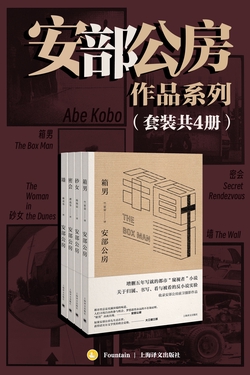
One of the "three giants of postwar Japanese literature," Abe was deeply influenced by Kafka and existentialist philosophy, and his works often use absurd premises to mount social critique. The Box Man is a particularly ingenious narrative construction: the Box Man observes the world through a peephole in his box, while he himself becomes an object of observation; notebooks, photographs, and rumors interweave to build a multiply nested "reality." This self-referential, metafictional quality not only challenges the reader's habits but also sharply interrogates the power relations between record and truth, and between watching and being watched. This Shanghai Translation Publishing House edition offers a precise, coolly restrained translation that fully preserves the detached, philosophically rich texture of the original.
In our present age, wrapped in screens and algorithms, The Box Man feels ever more prophetic. It reminds us that everyone dwells, to some degree, in a "box" of their own—whether a social mask, a digital identity, or a cognitive bubble. Reading this work is not only an intellectual challenge but a piercing examination of how we exist.
Who it's for
A good fit for
- Readers interested in existentialist literature and modern philosophical themes
- Literary enthusiasts who appreciate experimental narrative structures and are not satisfied with conventional linear stories
- Readers researching literature of Japan's postwar social and cultural transformation
- Deep thinkers who enjoy constantly reflecting on the relationship between self and the outside world while reading
Not a good fit for
- Readers seeking light entertainment or plot-driven stories
- Readers with low tolerance for abstract philosophy and absurd premises
Reading tips
- Try setting aside the urge for "the truth of the plot" and focus instead on the sense of detachment and voyeurism the narrative itself creates
- While reading, consider: if the identity and dwelling that society confers were stripped away, what would human nature be?
- Read alongside Abe's The Woman in the Dunes and The Face of Another to understand the arc of his work
About the publisher
Shanghai Translation Publishing House is a Chinese publisher oriented mainly toward translation and publishing. Its publications cover foreign literature, world classics and classic works, as well as social culture, folk literature and classical poetry. The database contains 2,618 titles, including Never Let Me Go, Les Misérables (2 volumes), Don Quixote (illustrated collector's edition), The Complete Comedies of Molière (4 volumes), The Complete Novels of Kafka (3 volumes), The Collected Works of Dostoevsky (9-volume set), Reason and Persons, and Oedipus Rex (Translation Classics). Its author resources include foreign writers such as Kazuo Ishiguro, Victor Hugo, Cervantes and Molière, as well as translators such as Zheng Kelu, Sun Jiameng, Li Jianwu and Zhang Kun. The publisher has brands such as "Translation Classics Selections" and "Translation Documentary," and emphasizes translated works in foreign literature and the humanities and social sciences, while also publishing bilingual dictionaries and foreign-language educational books. Public information is limited; the above is based on the book information in the database.
Contents
- 版权信息
- 整治上野流浪汉 今晨拘捕一百八十人
- 我的经历
- 纸箱制作法
- 箱男A君的故事
- 有备无患
- 有关封皮背面所贴照片的几点补充说明
- 流浪汉曝尸街头 十万人熟视无睹
- 后来,我打了几次瞌睡
- 协议得到履行。从桥上飞下来一封信及购买纸箱的五万日元。就在五分钟之前收到的。现附信于此
- ……
- 镜中所见
- 写在其他纸上的三页半补充
- 关于写的我和被写的我之间令人不快的关系
- 供词
- C的故事
- 供词·续篇
- 行刑者无罪
- 此处再次,也是最后一次插入一段记录
- D的故事
- ……
- 在梦中,箱男也走出了纸箱。他梦见的到底是进入纸箱之前的生活,还是走出纸箱之后的呢……
- 开幕前五分钟
- 开幕铃声还没响起,剧已闭幕
- ……
FAQ
Is this book similar to Kafka's works?
Why is The Box Man described as prophetic?
How difficult is this book to read?
Related on WeRead



Comments
Find this book
This site is an index: you start “Search all sources” in your browser, and the entries it lists all point to third-party sites; please judge their availability yourself.
About the author
Kobo Abe is a highly representative writer in modern Japanese literature, and his works have a steady readership in the Chinese-speaking world as well. The library holds nine of his works, including The Woman in the Dunes, The Box Man, The Secret Rendezvous, The Wall, and the four-volume Kobo Abe Works Series, which together sketch the core profile of his writing. Because personal details such as his dates of birth and death and nationality are not specified in the library records, public information is limited, so no biographical narrative is given here. Judging from the common categories "social novel, foreign literature, and social science," his writing often takes ordinary people's situations as its entry point and, through parable-like scenarios, examines individual identity anxiety, alienation, and existential predicaments in modern society. Works such as The Woman in the Dunes and The Box Man especially embody this narrative style poised between reality and abstraction, with concise plots and striking imagery that draw readers in with suspense while leaving thought-provoking space. His works have attracted attention in Japan and abroad and continue to influence later literary and intellectual discussion, making them suitable for readers willing to explore the relationship between society and the self through story.
Zhu Jiarong is a Chinese translator long active in the field of introducing foreign literature. Public information about her is limited, and details of her life, such as nationality, dates of birth and death, and educational background, are not clearly documented. Judging from the 32 works included in the database, her translation work centers on modern and contemporary Japanese literature, covering representative works by major writers such as Natsume Soseki, Akutagawa Ryunosuke, Mishima Yukio, Tanizaki Junichiro, and Abe Kobo, including I Am a Cat, Rashomon, Shunkinsho, and Kokoro. These translations are mostly classified as foreign literature, indicating her sustained engagement with rendering Japanese fiction into Chinese. Her translations are known for staying close to the tone of the original and preserving narrative rhythm, offering Chinese readers relatively reliable versions through which to understand Japanese literature and exerting a certain influence in translation and publishing circles.
