

The Scholars (Part Two)
Tags
Summary
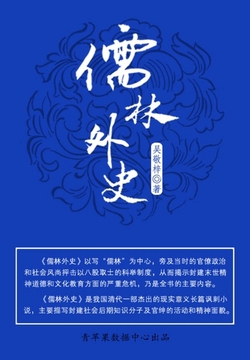
In fifty-six chapters, it depicts with realism how people of every station respond to 'rank and riches': on the one hand, it truthfully reveals the process and causes of human corruption and thereby sharply criticizes and satirizes the corruption of officialdom, the abuses of the civil service examinations, and the hypocrisy of the rites and moral teaching of the time; on the other, it warmly celebrates the few who hold fast to themselves and so guard their humanity, embodying the author's ideals. Its vernacular prose is already highly accomplished and its characterization deep and subtle; above all, its consummate irony makes it a masterpiece of classical Chinese satirical literature. This is the middle volume.
Editor's review
Who it's for
A good fit for
- Researchers interested in classical Chinese literature and the art of satire
- Readers seeking to understand Ming-Qing society and culture and the condition of intellectuals
- Literature lovers who enjoy analyzing social phenomena through groups of characters
- Upper-level students in need of training in critical thinking and humanistic cultivation
Not a good fit for
- Readers seeking light entertainment or quick, easy reading
- Beginners wholly unfamiliar with classical Chinese expression and the social background of the Ming and Qing dynasties
Reading tips
- Readers may first read a brief introduction to Ming-Qing history to understand how the examination system basically worked
- Reading in chapter order is recommended, with attention to the network of relationships among characters
- The classical commentaries, such as those by Jin He and Xianzhai laoren, may be consulted alongside for comparison
About the publisher
China Publishing Group Digital Media Co., Ltd. takes digital publishing as its main business, with titles spanning traditional medical classics and classical literature. Its catalogue includes medical works such as Treatise on Cold Damage, Essential Prescriptions from the Golden Cabinet, and The Pulse Classic, involving writings by Zhang Ji, Wang Shuhe, Lin Yi, and Zhang Jiebin. In literature, it offers Wu Jingzi's The Scholars and Xiao Hong's Tales of Hulan River, as well as foreign literary translations such as Fu Lei's rendering of Voltaire's Candide. Its publishing focus thus falls roughly into medicine, social fiction, foreign literature, and fine fiction, reflecting a balance between collated ancient texts and general reading. As public information is limited, this summary is based only on the books in the catalogue and draws no further inferences.
Contents
- 版权信息
- 第二十回 匡超人高兴长安道 牛布衣客死芜湖关
- 第二十一回 冒姓字小子求名 念亲戚老夫卧病
- 第二十二回 认祖孙玉圃联宗 爱交游雪斋留客
- 第二十三回 发阴私诗人被打 叹老景寡妇寻夫
- 第二十四回 牛浦郎牵连多讼事 鲍文卿整理旧生涯
- 第二十五回 鲍文卿南京遇旧 倪廷玺安庆招亲
- 第二十六回 向观察升官哭友 鲍廷玺丧父娶妻
- 第二十七回 王太太夫妻反目 倪廷珠兄弟相逢
- 第二十八回 季苇萧扬州入赘 萧金铉白下选书
- 第二十九回 诸葛佑僧寮遇友 杜慎卿江郡纳姬
- 第三十回 爱少俊访友神乐观 逞风流高会莫愁湖
- 第三十一回 天长县同访豪杰 赐书楼大醉高朋
- 第三十二回 杜少卿平居豪举 娄焕文临去遗言
- 第三十三回 杜少卿夫妇游山 迟横山朋友议礼
- 第三十四回 议礼乐名流访友 备弓旌天子招贤
- 第三十五回 圣天子求贤问道 庄征君辞爵还家
- 第三十六回 常熟县真儒降生 泰伯祠名贤主祭
- 第三十七回 祭先圣南京修礼 送孝子西蜀寻亲
- 第三十八回 郭孝子深山遇虎 甘露僧狭路逢仇
FAQ
What are the characteristics of the satire in The Scholars?
How does this novel differ from denunciation novels such as The Exposure of Officialdom?
How should modern readers understand the book's critique of the examination system?
Related on WeRead




Comments
Find this book
This site is an index: you start “Search all sources” in your browser, and the entries it lists all point to third-party sites; please judge their availability yourself.
About the author
Wu Jingzi (1701–1754) was a Qing dynasty literatus and novelist, courtesy name Minxuan and style name Limin, a native of Quanjiao, Anhui. Born into an official family, he later experienced a family property dispute and repeated failures in the imperial examinations, moved to Nanjing, and made a living by writing. Over nearly twenty years he wrote the long satirical novel The Scholars (Rulin Waishi), which vividly portrays the world of scholars and officials with a cool, finely observed style and laid the foundation of classical Chinese satire. His works are commonly classified under social fiction and classical literature, and he also wrote the Wenmu Shantang Collection. The library holds 43 of his works, including multiple editions and volumes of The Scholars. Public information on the details of his life is limited, and scholarship tends to focus on the themes, satirical style, and literary influence of The Scholars.
