

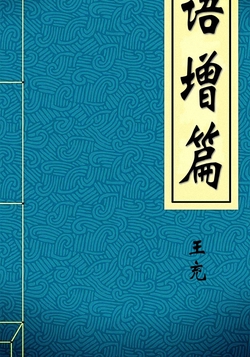
On the Exaggeration of Sayings
Tags
Summary
Editor's review
Who it's for
A good fit for
- Readers interested in Han intellectual history and the text of Lunheng
- General readers who want to learn how to identify exaggeration in circulating claims
- Readers of history and literature interested in the relationship between ancient historical narrative and popular rumor
- Students who need short argumentative texts for reading-analysis training
Not a good fit for
- Readers expecting systematic historical source criticism or mutual corroboration with excavated documents
- Readers who only want quick conclusions about historical figures and do not wish to follow the argumentative process
Reading tips
- First list the seven “exaggerated sayings” in the chapter, then compare them one by one with Wang Chong’s reasons for refutation.
- While reading, distinguish “factual error” from “exaggerated addition” and observe what Wang Chong focuses on.
- Read alongside “Jie Shu” and compare the two chapters’ similarities and differences in targets of criticism and modes of argument.
About the publisher
Jinzhang Book Company (Jinzhang Shuju) was a private publishing and distribution house in Shanghai during the late Qing and early Republican periods, issuing traditional works by lithographic printing. Judging from the 1,194 titles in the collection, its publishing focused on classical poetry, Eastern philosophy, historical reading, traditional Chinese medical texts, and canonical works, along with books on literary appreciation. Representative titles include the poetry and prose collections of Du Fu and Ouyang Xiu; historical works such as the Book of Han and Zizhi Tongjian; classical texts such as the Book of Documents and Mencius; and specialized and literary classics such as Treatise on Cold Damage and Li Sao. Its author resources cover major figures across the ages, including Du Fu, Ban Gu, Sima Guang, Zhang Zhongjing, Qu Yuan, Ouyang Xiu, and Tang Shenwei, reflecting the house's characteristic reliance on traditional scholarship and medical literature while serving general readers. Public information on its early history and operational details is limited, so no conjecture is offered here.
Contents
- 版权信息
- 正文
FAQ
What does the chapter title “Yu Zeng” mean?
What does Wang Chong mainly rely on when refuting “exaggerated sayings”?
What does this chapter have in common with “Jie Shu”?
Related on WeRead



Comments
Find this book
This site is an index: you start “Search all sources” in your browser, and the entries it lists all point to third-party sites; please judge their availability yourself.
About the author
Wang Chong (27–c. 97), courtesy name Zhongren, was a native of Shangyu in Kuaiji (present-day Shaoxing, Zhejiang). A thinker, literary critic, and atheist of the Eastern Han, he entered the Imperial Academy in Luoyang in his youth and studied under Ban Biao; later he left office, stayed at home, and devoted himself to writing. His representative work, the eighty-five-chapter Lunheng (Balanced Inquiries), criticizes Chenwei superstition and the theory of interactions between Heaven and humanity, advocates a naturalist theory of qi, and stands as an important representative of Han-dynasty materialist thought. Wang Chong valued evidence and analysis in his writing, often developing arguments through questions and debates in a plain but sharp style. The collection holds sixty-nine of his works, including such pieces as Shizhi pian, Wenkong pian, Ziran pian, Daoxu pian, Duizuo pian, and Hanwen pian, covering philosophy, social criticism, and literary appreciation. He championed independent thinking and opposed blind submission to authority, exerting a lasting influence on later thought and literary criticism.
