

The Chapter on Replies to Objections
Tags
Summary
Editor's review
Who it's for
A good fit for
- Readers interested in ancient Chinese intellectual history and Han philosophy
- Students of literature and history researching Wang Chong and Lunheng
- Readers who enjoy ancient argumentative prose and critical thinking
Not a good fit for
- Casual readers seeking light entertainment or storylines
- Those who still find classical Chinese difficult and have no annotations to assist them
Reading tips
- First read the relevant background introduction to Lunheng before entering this chapter, to grasp the argumentative context.
- While reading, mark the targets of Wang Chong's questioning and his argumentative steps, and appreciate his method of reasoning.
- Read alongside other Han intellectual texts to observe the characteristics of Wang Chong's critical spirit.
About the publisher
Jinzhang Book Company (Jinzhang Shuju) was a private publishing and distribution house in Shanghai during the late Qing and early Republican periods, issuing traditional works by lithographic printing. Judging from the 1,194 titles in the collection, its publishing focused on classical poetry, Eastern philosophy, historical reading, traditional Chinese medical texts, and canonical works, along with books on literary appreciation. Representative titles include the poetry and prose collections of Du Fu and Ouyang Xiu; historical works such as the Book of Han and Zizhi Tongjian; classical texts such as the Book of Documents and Mencius; and specialized and literary classics such as Treatise on Cold Damage and Li Sao. Its author resources cover major figures across the ages, including Du Fu, Ban Gu, Sima Guang, Zhang Zhongjing, Qu Yuan, Ouyang Xiu, and Tang Shenwei, reflecting the house's characteristic reliance on traditional scholarship and medical literature while serving general readers. Public information on its early history and operational details is limited, so no conjecture is offered here.
Contents
- 版权信息
- 对作篇第八十四
FAQ
What does "Duizuo" mainly discuss?
Can I read this chapter without prior knowledge of Lunheng?
Related on WeRead
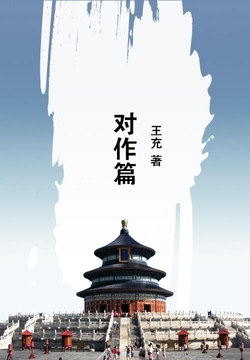 对作篇
 传播研究方法与论文写作——对180篇文章的观察
 突发公共卫生事件应对技术丛书:应急处置操作指南:霍乱、手足口、预防接种、健康教育和现场心理干预篇
 派对与节庆场景制作基础实战:气球篇
 深渊之上:点亮黑夜温暖我
Comments
Find this book
This site is an index: you start “Search all sources” in your browser, and the entries it lists all point to third-party sites; please judge their availability yourself.
About the author
Wang Chong (27–c. 97), courtesy name Zhongren, was a native of Shangyu in Kuaiji (present-day Shaoxing, Zhejiang). A thinker, literary critic, and atheist of the Eastern Han, he entered the Imperial Academy in Luoyang in his youth and studied under Ban Biao; later he left office, stayed at home, and devoted himself to writing. His representative work, the eighty-five-chapter Lunheng (Balanced Inquiries), criticizes Chenwei superstition and the theory of interactions between Heaven and humanity, advocates a naturalist theory of qi, and stands as an important representative of Han-dynasty materialist thought. Wang Chong valued evidence and analysis in his writing, often developing arguments through questions and debates in a plain but sharp style. The collection holds sixty-nine of his works, including such pieces as Shizhi pian, Wenkong pian, Ziran pian, Daoxu pian, Duizuo pian, and Hanwen pian, covering philosophy, social criticism, and literary appreciation. He championed independent thinking and opposed blind submission to authority, exerting a lasting influence on later thought and literary criticism.
