

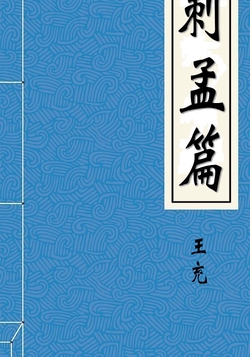
Chapter Criticizing Mencius
Tags
Summary
Editor's review
Who it's for
A good fit for
- Readers interested in Balanced Inquiries and Wang Chong's thought
- Those who have read Mencius and want to learn about ancient criticisms
- Researchers concerned with the Han-era tendency to question classics and critical writing
- Readers who enjoy watching ancient intellectual debates and are willing to think about argumentation
Not a good fit for
- Beginners who have not yet encountered Mencius and lack textual grounding
- Readers seeking a systematic introduction to Mencius's thought rather than criticism
- Readers prone to taking one critic's words directly as a final verdict
Reading tips
- Review the relevant passages of Mencius first, then read this chapter, to see the focus of the exchange clearly.
- While reading, distinguish Wang Chong's paraphrase from Mencius's original text and note any simplification or taking out of context.
- For each paragraph, first summarize the basis of Wang Chong's criticism, then ask yourself whether that basis holds.
- After finishing, read an ancient text defending Mencius alongside it to appreciate the divergence between the two sides.
About the publisher
Nanhai Publication Company is a comprehensive publisher known for its literature and arts titles, covering fields such as classical poetry, martial arts fiction, and folk literature. Judging from the more than 1,600 books in the database, the company has released classical poetic works including the Nineteen Old Poems and the Nine Songs, as well as multiple volumes of Huanzhulouzhu's series The Swordsmen of Mount Shu, along with related writings by authors such as Guan Hanqing, Qu Yuan, Zuo Si, and Wang Zhihuan. Its publishing character lies in balancing the organization of classic texts with the dissemination of popular literature, placing poetry anthologies alongside long martial arts novels and presenting a relatively diverse literary profile. Public information is limited, and further details about its editorial practices and series planning remain to be supplemented.
Contents
- 版权信息
- 卷十
FAQ
Is “Stabbing Mencius” a standalone book?
Does Wang Chong fully negate Mencius in this chapter?
Must one be thoroughly familiar with Mencius before reading this chapter?
What use is this text to today's readers?
Related on WeRead


Comments
Find this book
This site is an index: you start “Search all sources” in your browser, and the entries it lists all point to third-party sites; please judge their availability yourself.
About the author
Wang Chong (27–c. 97), courtesy name Zhongren, was a native of Shangyu in Kuaiji (present-day Shaoxing, Zhejiang). A thinker, literary critic, and atheist of the Eastern Han, he entered the Imperial Academy in Luoyang in his youth and studied under Ban Biao; later he left office, stayed at home, and devoted himself to writing. His representative work, the eighty-five-chapter Lunheng (Balanced Inquiries), criticizes Chenwei superstition and the theory of interactions between Heaven and humanity, advocates a naturalist theory of qi, and stands as an important representative of Han-dynasty materialist thought. Wang Chong valued evidence and analysis in his writing, often developing arguments through questions and debates in a plain but sharp style. The collection holds sixty-nine of his works, including such pieces as Shizhi pian, Wenkong pian, Ziran pian, Daoxu pian, Duizuo pian, and Hanwen pian, covering philosophy, social criticism, and literary appreciation. He championed independent thinking and opposed blind submission to authority, exerting a lasting influence on later thought and literary criticism.
