

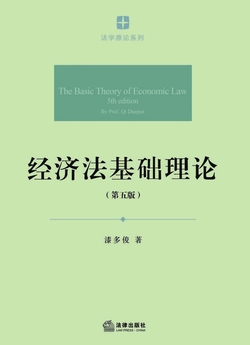
Economic Law (Fifth Edition)
Tags
Summary
Editor's review
From an editor's perspective, the book's core value lies in the balance it strikes between "theoretical depth" and "practical relevance." The editors not only trace the historical development of economic law and the scholarly debates surrounding it, but also draw on a wealth of typical cases and judicial practice to translate abstract statutory provisions into perceptible applications of legal rules. In the "Market Regulation Law" section, for example, recent antitrust cases involving internet platforms are used to illustrate vividly how the law responds to the challenges of new economic forms. This approach lifts the book above the stereotype of the traditional textbook and makes it an excellent window onto the progress of China's economic rule of law.
For readers, the updates in this fifth edition are especially timely. With the introduction of new rules such as the Personal Information Protection Law and the Data Security Law, the field of economic law is undergoing rapid change. The book's absorption and interpretation of these developments ensure that its knowledge is current and forward-looking. Whether law students are building a body of knowledge or practitioners are updating their understanding of practice, the book offers solid and clear guidance. Its language is concise and restrained, and its logic advances layer by layer, reflecting the editors' deep scholarly grounding and teaching experience.
Who it's for
A good fit for
- Undergraduate and graduate students in law, economics, management, and related fields, as a core-course textbook or supplementary reading
- Legal practitioners such as lawyers, in-house counsel, and regulators who need to systematically update their knowledge of economic law
- General readers interested in business operations, market regulation, financial compliance, and similar areas who wish to build a systematic understanding
- Candidates preparing for the National Unified Legal Profession Qualification Examination or other relevant exams, seeking to consolidate their grounding in economic law theory
Not a good fit for
- Casual readers seeking light, accessible reading who lack the patience for statutory provisions and theoretical analysis
- Practitioners who only need operational details on one very specific, narrow subfield of economic law (such as a single tax type)
Reading tips
- Read the "Chapter Introduction" at the beginning and the "Chapter Summary" at the end of each chapter first to grasp the chapter's core structure and key points
- Read the statutory provisions and cases cited in the book as extended reading to deepen your understanding of how theory is applied in practice
- Pay attention to the editors' commentary on recent legislative developments (such as antitrust in the platform economy); this content is highly relevant to the present day
About the publisher
Jinan University Press is a comprehensive university press known for publishing in language and writing, history and culture, and medicine. Judging from the 2,481 titles in the database, its publishing focuses on language and writing research, the compilation of unearthed documents, Chinese culture and Eastern philosophy, traditional Chinese medicine, and grassroots medical standards. Representative books include the Chinese Dictionary (Second Edition), the series on the collected interpretation and modern translation of Warring States documents from the Language Services Series and the series on the language of unearthed documents, Chinese Cultural Psychology (6th Edition), Illustrated Compendium of Traditional Chinese Medicine Processing Techniques, and Construction and Technical Standards for Standardized Bronchoscopy Rooms in Primary-Level Pediatrics. In terms of authors, scholars such as Zhu Cheng, Zhang Yujin, Wang Fengyan, Zheng Hong, Cao Hui and Ma Zhiguo form its author base in language and documents, cultural psychology, and traditional Chinese medicine. In terms of publishing characteristics, the press emphasizes the collected interpretation and modern translation of unearthed documents and language service research, while also systematically organizing cultural psychology and medical techniques. Public information on specific matters such as overseas Chinese-language education is limited and is therefore not elaborated here.
Contents
- 版权信息
- 1
- 2
- 3
- 4
- 5
- 6
FAQ
What are the main differences between this fifth edition and previous editions?
Can the book be read without a legal background?
Is the book suitable for preparing for the legal profession qualification examination?
Related on WeRead



Comments
Find this book
This site is an index: you start “Search all sources” in your browser, and the entries it lists all point to third-party sites; please judge their availability yourself.
About the author
Fang Saiying is an author engaged in writing and textbook compilation in the field of economic law. Publicly available information is limited, and details of the author's life, educational background, and professional positions cannot be confirmed. Judging from the four works held in the collection, the author's writing centers on economic law, with successive editions of Economic Law—the second, third, and fifth editions—as well as a version issued as a premium textbook in the university economics and management series. This suggests that the author has continually revised and updated the book, forming a relatively stable sequence of editions. The works are commonly classified under finance and economics, examinations, and law, indicating that their content serves classroom teaching for economics and management majors and may also meet the needs of readers preparing for relevant examinations. Overall, Fang Saiying's writing is mainly in the textbook genre, emphasizing the systematic and practical organization of knowledge, and is suitable for university teachers and students as well as introductory readers in law and finance.
Deng Baoguo is an author about whom limited public information is available. His confirmed representative work is the textbook Economic Law, of which the library holds three editions: the second, third, and fifth. The successive editions suggest that the textbook has been revised and reprinted multiple times, with its content adjusted in line with updates to economic law regulations, giving it a strong sense of continuity and practical relevance. The work is commonly classified under finance and economics, law, and examinations, indicating that its intended readers are mainly students and exam candidates in finance, economics, and law. Overall, Deng Baoguo's writing focuses on textbook compilation, emphasizing the systematic organization and normative explanation of economic law knowledge, with a style that is clear and suited to teaching and review. Because details such as birth and death years, nationality, education, and professional experience are not specified, his personal background and academic lineage cannot be further introduced.
