

The Fourth Wave
Tags
Summary
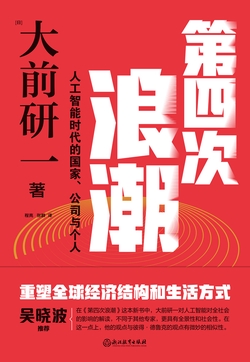
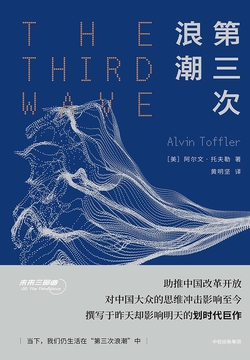
Today, management guru Kenichi Ohmae draws inspiration from Toffler's ideas and points out that human society is ushering in a "Fourth Wave."
What is the "Fourth Wave"?
It is the industrial revolution triggered by artificial intelligence and smartphones, now impacting every sphere of human society: recurring waves of layoffs, the anxiety of the "era of hundred-year lives," the slide from a "low-desire society" to a "no-desire society," an endless stream of new business models...
This is the "Fourth Wave," a sweeping social transformation reshaping the global economic structure and ways of life. It encourages individuality, pursues the ultimate, and embraces imagination; challenges and opportunities coexist. Only countries, companies, and individuals that understand and adapt to it early and play an active role within it can ride the wave and stand at the crest.
For people of that time, Toffler's The Third Wave was a "book of hope"; it is the author's wish that this book may likewise bring hope to today's readers.
Editor's review
Ohmae's core argument is that this wave is not a simple technological iteration but a profound social reorganization. He systematically analyzes how technology is reshaping our work, life, education, health, and even models of national governance. Unlike many futurology works that traffic in empty concepts, this book is full of Ohmae-style concrete analysis and pragmatic judgment. Combining the real dilemmas of Japanese society (such as declining birthrates and aging, and industrial hollowing-out) with global trends, he raises highly relevant issues such as "ways of working in the era of hundred-year lives," "technological paths for regional revitalization," and "the transformation of education from knowledge transmission to creativity cultivation."
The value of reading this book lies in the fact that it is not merely a prophecy of the future but a framework for action. Ohmae seeks to provide strategies for individuals, companies, and nations to survive and thrive amid upheaval. For readers in an era of uncertainty, this book can help us step beyond daily trivialities and examine our career planning, asset allocation, and life choices from a longer-term perspective. Its views may be controversial, but that way of thinking—piercing through appearances and striking at the core—and its ability to sort complex trends into clear threads are precisely the distinctive appeal of Ohmae's work.
Who it's for
A good fit for
- Readers concerned with the trends of technology and social development over the next decade
- Managers and professionals who feel uncertain about corporate strategy or personal career planning and hope to find long-term direction
- Researchers and observers interested in Japan's model of social and economic development and its dilemmas
- Enthusiasts who enjoy macro analysis and have some grounding in economics or sociology
Not a good fit for
- Readers seeking concrete, immediately actionable technical guides or investment manuals
- Readers who prefer light narrative or fiction and have low tolerance for theoretical frameworks and analytical content
Reading tips
- It is recommended to read the introduction and Chapter One first to grasp the author's overall definition and logic for dividing the "four waves."
- While reading, relate the trends mentioned in the book to your own industry or area of life and consider what specific impacts and opportunities they may bring.
- The book contains many Japanese cases; when understanding them, try comparing them with your own country's situation to gain a more three-dimensional perspective.
About the publisher
Zhejiang Education Publishing House is a professional publisher focusing on educational publishing while also serving general readers and academic accumulation, with publications covering textbooks, educational readers, popular science, and academic works. Judging from the more than 1,000 titles in the database, the press places considerable emphasis on classics and traditional culture for general readers: modern literature includes Lao She's Camel Xiangzi, Lu Xun's Call to Arms and Wandering and Wild Grass, Xiao Hong's The Story of Hulan River, and Zhu Ziqing's Back View; classical poetry includes Three Hundred Tang Poems and selections from the "Good Chinese Poetry" series, such as the Chu Ci and Qing ci anthologies. Related authors include modern writers such as Lao She, Lu Xun, Xiao Hong, and Zhu Ziqing, as well as classical literature selectors and annotators such as Hengtang Tuishi, Jin Xingyao, Jin Kaicheng, and Qian Zhonglian. Common categories in the database also include social novels, classic works, prose and miscellaneous writings, popular science, and inspirational growth, reflecting a publishing orientation that balances educational service with the popularization of public culture.
Contents
- 版权信息
- 推荐序 时代浪潮下的变与不变
- 前言 预测未来,成就希望
- 序章 现状分析 法跨越第三次浪潮的日本
- 摇摇欲坠的“世界第三大经济体”
- 多方经济下行
- 为何拜登先访问韩国而非日本
- 落后于时代的索尼与本田
- 担当大臣象征着政府“功能不全”
- 日本政府是“失败组织”的代表
- 止步于第二次浪潮的日本
- 第1章 何谓“第四次浪潮” 日本应尽早了解的世界最新潮流
- 从盛赞到衰退
- 主题研讨 应对第四次浪潮的国家战略——21世纪型经济理论①
- 验证1 “最低时薪3900日元!”全球招聘正在剧变
- 验证2 第四次浪潮与第三次浪潮的区别
- 第2章 对未来的不安可以消除 “课题先进国”日本应展示的未来
- 日本率先进入少子老龄化与低欲望社会
- 主题研讨 人生百年时代的国家战略——21世纪型经济理论②
- 提议1 经济新常识——“利率上调则经济复苏”
- 提议2 给沉默的大多数的提案
- 第3章 生存的关键在于“极致型” 将自身优势发挥到极致
- 超越“选择与集中”的经营方式
- 主题研讨 将企业优势发挥到极致的经营战略——21世纪型经济理论③
- 补充研讨1 如何评价优衣库董事长柳井正的表态?
- 补充研讨2 日本电报电话公司(NTT)的新型“远程办公”将改变日本
- 后记 培养孩子的“手机想象力”
- 译后记
- 内容说明
FAQ
How is this book different from futurology works such as Sapiens and Homo Deus?
Are the views in the book applicable to Chinese readers?
How difficult is this book to read?
Related on WeRead



Comments
Find this book
This site is an index: you start “Search all sources” in your browser, and the entries it lists all point to third-party sites; please judge their availability yourself.
About the author
Kenichi Ohmae, born in 1943 in Kitakyushu, Fukuoka Prefecture, Japan, is a renowned Japanese management scholar and economic commentator. He holds a doctorate in nuclear engineering from MIT, worked at Hitachi early in his career, and later spent more than twenty years at McKinsey, where he served as head of its Japan office. He is known for the 3C model (strategic triangle) and has been called the "father of Japanese strategy" and "Mr. Strategy." His books include The Borderless World, The M-Shaped Society, and The Professionalism. His works span finance, politics, management, and social science, often starting from broad trends and consistently addressing issues such as aging and a low-desire society. Chinese translations of his work have had a notable influence on Chinese readers.
Cheng Liang is an author about whom limited public information is available. His works span inspirational growth, language and writing, mystery and detective fiction, fashion, essays, and finance. Judging from the existing titles, he attends both to the workplace and personal improvement, as in What McKinsey Taught Me About Work Methods, What McKinsey Taught Me About Negotiation, The 12 Basic Skills of Work, and The Fourth Wave, and to writing techniques and the aesthetics of daily life, as in The Complete Guide to Writing Bestsellers, Every Day's Heart-Throbbing Tidying Magic, and Even If I Die Tomorrow, It Won't Stop Me from Watering Flowers Today. He has also written mystery fiction such as The Blood-Crying Copper Crane. His writing tends toward practical methods and reflections on life, with diverse themes, aimed at readers who wish to improve their work skills, writing ability, and quality of life.
Zhang Qun is an author whose publicly available personal information is limited, and whose signed works show a notably cross-domain range of subjects. Four of his works are held in the collection, including foreign literary works such as Qiangli Duoqu and Lavelstein, as well as financial and data-related titles such as The Fourth Wave and A Guide to Data Asset Valuation. This combination suggests that his writing and editorial work may span both literary translation and financial practice, and the common categories are accordingly listed as "foreign literature" and "finance." Because his birth and death years, nationality, education, and professional experience cannot be confirmed, it is currently difficult to outline his full biography; judgments can only be based on the works themselves: he pays attention to foreign novels with strong narrative qualities while also addressing practical economic issues such as data assets. Readers who wish to learn more about him will need further public information.
