

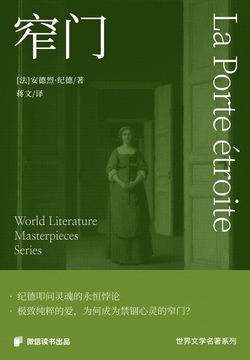
Strait Is the Gate
Tags
Summary
Gradually, the seed of love begins to sprout within them.
Their souls intertwine, and they dream of the coming of a perfect love.
But when Alissa sees married life as it truly is, she begins to doubt it all.
She longs to pursue an eternal love in this world, yet the door to that love proves to be a narrow gate that only a few can ever find...
Editor's review
Who it's for
A good fit for
- Readers interested in French literature and philosophical thought
- Readers who enjoy exploring the complexity of human nature and psychological depth
- Thinkers who wish to understand the conflict between religious ethics and individual freedom
- Literature lovers who appreciate classical, elegant, and restrained narrative styles
Not a good fit for
- Readers seeking light entertainment or fast-paced plots
- Readers impatient with religious themes and psychological description
Reading tips
- Read slowly in a quiet setting and savor the subtleties of the characters' dialogue and inner monologues
- Read alongside Gide's life and other works (such as The Immoralist and La Symphonie pastorale) to gain a fuller understanding of his intellectual trajectory
- After reading, reflect on the symbolic meaning of the "narrow gate" and its personal interpretation in a modern context
About the publisher
Based in Suzhou, Guwuxuan Publishing House publishes in fields including Eastern philosophy, literary appreciation and foreign literature, as well as essays and philosophical readers. Judging from its catalog, the press carries Chinese classics such as A New Account of the Tales of the World, Reminiscences of Tao'an, Instructions for Practical Living and Discourses on Salt and Iron, while also offering Chinese translations of foreign literature including The Myth of Sisyphus, Rashomon, The Temple of the Golden Pavilion and Tagore's poetry collections. Its authors and translators include Liu Yiqing, Zhang Dai, Wang Shouren, Albert Camus, Ryunosuke Akutagawa, Yukio Mishima, Li Yumin and Chen Dewen. The press is characterized by giving equal weight to Chinese and foreign classics, combining the organization of traditional texts with the introduction of foreign literature. As public information is limited, this profile is based only on the books in our catalog.
Contents
- 版权信息
- 第一章
- 第二章
- 第三章
- 第四章
- 第五章
- 第六章
- 第七章
- 第八章
FAQ
What is the theme of Strait Is the Gate?
Why is Strait Is the Gate considered a representative work of Gide?
What is the specific meaning of the "narrow gate" in the book?
Related on WeRead




Comments
Find this book
This site is an index: you start “Search all sources” in your browser, and the entries it lists all point to third-party sites; please judge their availability yourself.
About the author
André Gide was a French writer, born in Paris in 1869 and died in Paris in 1951. His work spans novels, essays, and literary criticism, with representative titles including The Immoralist, Strait Is the Gate, La Symphonie pastorale, The Counterfeiters, and The Fruits of the Earth. These works often trace the moral struggles of their characters, written in restrained yet reflective prose. In 1947 he was awarded the Nobel Prize in Literature, which brought his literary standing wider international recognition. Gide is regarded as an important figure in twentieth-century French literature and has had a lasting influence on the psychological depiction and narrative forms of the modern novel. The library holds 70 of his works, spanning categories such as foreign literature, classic works, and social fiction, showing that his writing has long circulated among Chinese readers.
Li Yumin (born 1938) is a renowned Chinese translator of French literature. A graduate of Peking University's French program, he later became a professor at Capital Normal University. In 1964, he went to France as one of the first publicly sponsored students of New China. He has devoted himself to translating French literature for decades, producing more than 200 translated works totaling over 30 million characters, about half of them first translations in China. His representative works include Notre-Dame de Paris, Les Misérables, The Three Musketeers, The Plague, The Stranger, and The Little Prince, spanning foreign literature, world classics, and Western philosophy. He has received the Fu Lei Translation and Publishing Award. His translations are known for accuracy, fluency, and readability, offering Chinese readers an important window into classic French literature and thought.
