

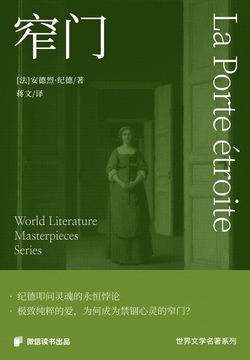
The Narrow Gate
Tags
Summary
Editor's review
As an editor, I believe the reading value of Strait Is the Gate far exceeds a simple love story. It is a mirror reflecting the eternal conflicts deep in the human soul between faith and desire, reason and emotion, individual freedom and moral law. With calm and restrained strokes, Gide peels back layer by layer the complexity and contradiction within the characters; the density of his prose and the sharpness of his thought are striking. This edition from Huacheng Publishing House has a fluent translation that conveys the literary texture and intellectual depth of the original well. Reading this book is not only an experience of literary aesthetics but also a profound philosophical dialogue about "how to live" and "what true love is." It is not suited to readers seeking light entertainment, but it will provide abundant spiritual nourishment for those willing to examine their inner selves and contemplate the ultimate meaning of life.
Who it's for
A good fit for
- Deep readers with a strong interest in literary classics and philosophical speculation
- Thinkers who wish to explore eternal questions such as love, faith, and freedom
- Literature lovers who appreciate delicate psychological portrayal and a beautiful, restrained style
- Readers who study or are curious about French literature or the works of André Gide
Not a good fit for
- Casual readers seeking exciting plots and light entertainment
- Readers with no interest in religious or philosophical issues, or who reject introspective narrative
Reading tips
- It is recommended to read in a relatively quiet environment where you can focus and think, so as to deeply appreciate the subtleties of the text.
- It may help to learn a little about Gide's life and the intellectual background of his time, which aids understanding of the work's core.
- During reading, you may wish to pause briefly and reflect on the questions the book raises about sacrifice, happiness, and moral choice.
About the publisher
Jiangsu Phoenix Literature and Art Publishing House focuses on literary publishing while also covering the humanities, social sciences, and books on art and daily life. Its approximately 1,535 titles in the database span social novels, world history, design, science fiction, classic works, and film and television: they include modern Chinese literary classics by Lu Xun such as A Madman's Diary: The Complete Short Stories of Lu Xun, Call to Arms, Four Generations Under One Roof, and Teahouse, as well as foreign literary memoirs like Stefan Zweig's The World of Yesterday. In science fiction it offers Asimov's Galactic Empire series, while in architecture and art it publishes Liu Dunzhen's Classical Gardens of Suzhou and design titles from Phoenix Space. Its authors are concentrated among classic writers such as Lu Xun, Zweig, and Asimov, with translators including Liang Xijiang, Zhong Haonan, and Ye Lihua. Its overall character is built on classic works while embracing genre fiction and visual culture. Public information is limited, and this introduction is based on the titles in the database.
Contents
- 版权信息
- 第一章
- 第二章
- 第三章
- 第四章
- 第五章
- 第六章
- 第七章
- 第八章
- 《窄门》独家文学手册
- 导读 《窄门》,从亲身经历到虚构现实
- 译后记 请进纪德迷宫
FAQ
Is Strait Is the Gate a love novel?
Why is the book titled Strait Is the Gate?
Is any prerequisite needed to read this book?
Related on WeRead




Comments
Find this book
This site is an index: you start “Search all sources” in your browser, and the entries it lists all point to third-party sites; please judge their availability yourself.
About the author
André Gide was a French writer, born in Paris in 1869 and died in Paris in 1951. His work spans novels, essays, and literary criticism, with representative titles including The Immoralist, Strait Is the Gate, La Symphonie pastorale, The Counterfeiters, and The Fruits of the Earth. These works often trace the moral struggles of their characters, written in restrained yet reflective prose. In 1947 he was awarded the Nobel Prize in Literature, which brought his literary standing wider international recognition. Gide is regarded as an important figure in twentieth-century French literature and has had a lasting influence on the psychological depiction and narrative forms of the modern novel. The library holds 70 of his works, spanning categories such as foreign literature, classic works, and social fiction, showing that his writing has long circulated among Chinese readers.
Li Yumin (born 1938) is a renowned Chinese translator of French literature. A graduate of Peking University's French program, he later became a professor at Capital Normal University. In 1964, he went to France as one of the first publicly sponsored students of New China. He has devoted himself to translating French literature for decades, producing more than 200 translated works totaling over 30 million characters, about half of them first translations in China. His representative works include Notre-Dame de Paris, Les Misérables, The Three Musketeers, The Plague, The Stranger, and The Little Prince, spanning foreign literature, world classics, and Western philosophy. He has received the Fu Lei Translation and Publishing Award. His translations are known for accuracy, fluency, and readability, offering Chinese readers an important window into classic French literature and thought.
