

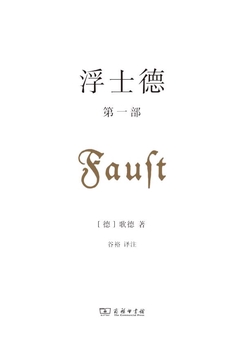
Faust (Part One)
Tags
Summary
Editor's review
Who it's for
A good fit for
- Deep readers with a strong interest in European classical literature and philosophical thought
- Readers who wish to understand the core of German spiritual culture and the origins of Western modernity
- Students and researchers of literature who need to read classic texts closely
- Enthusiasts who appreciate the verse-drama form and can immerse themselves in the beauty of language, rhythm, and imagery
Not a good fit for
- Readers seeking light entertainment or quick, fast-food reading
- Readers completely unfamiliar with European historical and cultural background and unwilling to explore it
Reading tips
- It is advisable to read the translator's preface or introduction first to understand Goethe's life, the creative background, and the main lines of thought.
- Keep notes while reading to sort out character relationships, core plot points, and philosophically rich monologues and dialogues.
- Do not feel compelled to understand everything at once; read in sections and repeatedly, and consult relevant research materials to deepen understanding.
About the publisher
The Commercial Press is a publisher known for classic works and academic publishing, with titles spanning Eastern philosophy, foreign literature, world history, social culture, and applied psychology. Its list includes classical commentaries such as Zhu Xi's Collected Commentaries on the Analects and Wang Bi's Commentary on the Zhouyi, as well as modern annotated translations like Zhuangzi with Modern Notes and Translation. In foreign literature it offers War and Peace and Crime and Punishment, while in world history it carries Braudel's The Mediterranean and the Mediterranean World in the Age of Philip II. Applied psychology is represented by Irvin D. Yalom's Existential Psychotherapy, and ethical texts include a Greek-Chinese-English edition of the Nicomachean Ethics. Its authors and translators include Zhu Xi, Wang Bi, Yalom, Braudel, and translators such as Huang Zheng, Zhang Yiling, Shen Dongyu, and Tang Jialong, balancing the editing of original texts with academic translation.
Contents
- 版权信息
- 译者序
- 第一部简要说明
- 献词
- 舞台序幕
- 天堂序剧
- 悲剧·第一部
- 第一部分 学者剧
- 夜
- 钟声与合唱
- 城门外
- 书斋 一
- 书斋 二
- 莱比锡的奥尔巴赫地下酒窖
- 女巫的丹房
- 第二部分 格雷琴剧
- 大街上 一
- 傍晚
- 小路上
- 邻妇家中
- 大街上 二
- 花园
- 花园小屋
- 森林与洞窟
- 格雷琴的小屋
- 玛尔特的花园
- 水井边
- 壁龛
- 夜晚
- 大教堂
- 瓦尔普吉斯之夜
- 瓦尔普吉斯之夜的梦
- 阴天·野地
- 夜·旷野
- 牢房
- 附录一 歌德手绘草图
- 附录二 手稿影印及说明
- 附录三 致谢
FAQ
What are the main differences between Part One and Part Two of Faust?
What are the features of this translation?
What prior knowledge should one prepare before reading Faust?
Related on WeRead



Comments
Find this book
This site is an index: you start “Search all sources” in your browser, and the entries it lists all point to third-party sites; please judge their availability yourself.
About the author
Johann Wolfgang von Goethe (1749–1832) was a German thinker, writer and scientist, and the most celebrated representative of Weimar Classicism. Born in Frankfurt am Main, he rose to fame in 1774 with The Sorrows of Young Werther, an epistolary novel whose heartfelt emotional portrayal moved many readers of the time. Over the following decades he continued to write; his masterpiece, the verse drama Faust, took many years to complete and explores striving, temptation and redemption, exerting a profound influence. The library holds 40 of his works, including several versions of Faust, Wilhelm Meister's Apprenticeship and the four-volume Collected Translations of Feng Zhi, spanning literature, foreign literature, classics, world masterpieces, essays and modern poetry. His writing combines philosophical reflection with lyricism across many genres, and holds an important place in German and world literature.
Gu Yu is an author about whom little public information is available. The library holds two works under this name, both Chinese translations of Goethe's Faust, covering respectively the first and second parts of the verse drama. The existing categories place these works under literature and foreign literature, indicating that the translator's focus lies in rendering German literary classics into Chinese. Together the two volumes trace the full arc of Faust, from his scholarly striving and his pact with the devil to his pursuit of classical beauty and of a life of deeds, a text whose verse form, philosophical dialogue and shifting monologue demand both linguistic skill and literary sensitivity from the translator. Gu Yu's versions offer Chinese readers accessible texts through which to approach Goethe's original, and hold some reference value in the field of translated foreign literature. Owing to limited sources, details of the translator's life, education and research interests cannot be confirmed.
