

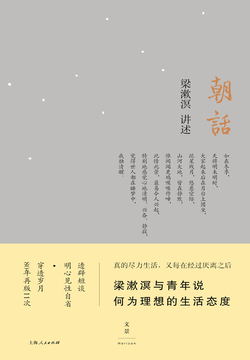
Morning Talks
Tags
Summary
Editor's review
As an early representative of modern New Confucianism, Liang's thought centers on 'life' and 'reason'. In Morning Talks this thought sheds the forbidding garb of academic treatise and appears intimate, plain and full of practical wisdom. When he discusses the meaning of the morning assembly, he is really discussing how daily ritual can lift the spirit and cultivate the mind. When he speaks of 'repentance and self-renewal', it is not religious guilt but the Confucian discipline of daily self-examination, emphasizing inner awareness and an upward force. When he discusses 'desire and aspiration', he distinguishes desire pulled by private inclination from aspiration issuing from within and striving upward—an excellent entry into his concept of 'reason', a clear, self-aware, upward activity of the mind.
The book's value lies first in its 'living' form. Readers feel transported to a rural courtyard of the 1930s, listening to a wise man's morning musings that fuse lofty Confucian ideals with lived experience. Second, it is practical and speaks directly to the heart. Liang avoids empty talk; all he discusses are matters of personal cultivation and social concern—a sobering tonic for readers today adrift in information overload and enslaved by things. Finally, it offers an accessible yet profound window into Liang Shuming, 'the last Confucian': his sincerity, his anxiety, his cultural responsibility shine through these plain talks. Reading Morning Talks is not merely acquiring knowledge but a practice of dialogue with a wise man and of self-examination.
Who it's for
A good fit for
- Readers interested in Confucian thought, especially its modern transformation and practical discipline
- Modern readers seeking inner calm and spiritual uplift amid a restless life
- Newcomers to modern Chinese intellectual history who want to understand Liang Shuming and his thought
- Readers who enjoy short philosophical, aphoristic texts and return to them again and again
Not a good fit for
- Readers seeking systematic academic monographs with detailed argumentation
- Readers expecting systematic solutions to specific social problems
Reading tips
- Dip into one or two pieces at dawn or in a calm mood; don't rush—the point is to savor and reflect
- Try applying methods such as 'self-examination' and 'making resolutions' to daily life as an experiment
- Read alongside Liang's life and other works (e.g., Eastern and Western Cultures and Their Philosophies, The Essentials of Chinese Culture) for deeper understanding
About the publisher
Shanghai People's Publishing House is a comprehensive publisher whose list focuses on academic monographs and general-interest titles in philosophy, social sciences, politics and law, economics and management, and history. Among its books are Wei, Jin, Southern and Northern Dynasties History in the Chinese Dynastic History series; The Hobbit and The Lord of the Rings trilogy in foreign literature; the Wenjing Classical Translation Illustrated Edition of The Complete Greek Tragedies of Euripides; and works of social theory such as Max Weber's Economy and Society and Dialectic of Enlightenment: Philosophical Fragments. Its authors include Wang Zhongluo, J.R.R. Tolkien, Luo Niansheng, and Zhou Zuoren.
Contents
- 版权信息
- 增订版叙言
- 辑校说明
- 01 朝会的来历及其意义
- 02 忏悔——自新
- 03 吾人的自觉力
- 04 言志
- 05 发心与立志
- 06 欲望与志气
- 07 心理的调整
- 08 调整自己必亲师取友
- 09 如何才能得到痛快的合理的生活
- 10 日常生活的态度
- 11 谈习气
- 12 求学与不老
- 13 秋意
- 14 朋友与信
- 15 朋友与社会信用
- 16 谈学问
- 17 研究问题所需的态度
- 18 择业
- 19 对异己者的态度
- 20 猴子的故事
- 21 没有勇气不行
- 22 我们应有的心胸态度
- 23 开诚布公以立信
- 24 我的信念
- 25 谈合作
- 26 启发社会的力量
- 27 真理与错误
- 28 成功与失败
- 29 先父所给予我的帮助
- 30 我的生活实情
- 31 我自己的长短
- 32 三种人生态度——逐求、厌离、郑重
- 33 生命的歧途
- 34 一般人对道德的三种误解
- 35 道德为人生艺术
- 36 新年的感触
- 37 谈生命与向上创造
- 38 人生在创造
- 39 真力量要从乡村酝酿出来
- 40 中国民族的力量
- 41 心理的关系
- 42 帮助理性开发的是经济
- 43 制度与经济
- 44 农民运动与合作
- 45 谈罪恶
- 46 谈规矩
- 47 为人类开辟一新历史而奋斗
- 48 中国士人的心理
- 49 谈用人
- 50 志愿真诚
- 51 谈组织团体原则
- 52 谈应付难关
- 53 婚姻问题
- 54 谈戏剧
- 55 谈音乐
- 56 中国本位文化宣言
- 57 中西学术之不同
- 58 东方学术之根本
- 59 以出家的精神做乡村工作
- 60 谈儿童心理
- 附录
- 61 青年修养问题
- 62 谈修养
- 63 人生的意义
- 64 谈戏
- 65 这便是我的人生观
- 66 如何成为今天的我
- 第九版编后附记
- 第十版编后附记
- 《朝话》版次一览
FAQ
How does Morning Talks differ from ordinary aphoristic works such as The Analects?
What exactly does 'reason' mean, so often mentioned in the book?
Will readers unfamiliar with the rural reconstruction movement find the book hard to understand?
Related on WeRead


Comments
Find this book
This site is an index: you start “Search all sources” in your browser, and the entries it lists all point to third-party sites; please judge their availability yourself.
About the author
Liang Shuming (1893–1988) was a modern Chinese thinker, philosopher, and educator, and an early representative of modern New Confucianism. Born in Beijing to a family from Guilin, Guangxi, he once taught Indian philosophy at Peking University and later devoted himself to the rural reconstruction movement. His writings span comparative cultural studies, Eastern philosophy, Confucian interpretation, and personal essays. His major works include Eastern and Western Cultures and Their Philosophies, The Essence of Chinese Culture, Mind and Life, Morning Talks, A Brief History of My Self-Education, An Interpretation of Confucianism, and the two-volume Diaries of Liang Shuming; twenty-three of his works are held in this collection. Writing from pressing personal and social questions in a plain and earnest style, he explored the differences between Eastern and Western cultures, the character of Chinese culture, and the meaning of life, combining reflection with practical concern. His work has influenced the fields of culture, Eastern philosophy, history, and the personal essay.
