

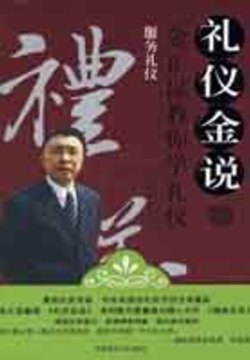
Service Etiquette
Tags
Summary
Editor's review
From a professional perspective, the book's value lies in its rigorous systematic structure and practicality. As a well-known scholar in the field of etiquette research in China, Professor Jin draws on internationally accepted etiquette standards while fully taking the local cultural context into account, avoiding mechanical copying. The explanation of the three core ideas—"respect as the foundation," "skill in expression" and "standardized form"—forms a solid theoretical basis for service etiquette.
For today's service industry practitioners, reading this book can not only improve personal professional competence but also deepen their understanding of the spiritual essence of quality service: etiquette is by no means rigid formality but a process of building trust and creating value through professional, appropriate and sincere behavior. In an era when customer experience is increasingly important, mastering these principles and skills is of clear practical significance.
Who it's for
A good fit for
- Frontline service employees and managers
- Practitioners in high-end service industries such as hotels, aviation and finance
- People in marketing and customer relations roles
- Those who wish to improve their professional competence and personal image
Not a good fit for
- Readers looking for light, entertaining reading
- Researchers interested only in historical or folk etiquette
Reading tips
- Focus on chapters relevant to your own job and make a practical plan for applying them
- As you read, consider the psychological and cultural logic behind etiquette norms
- Reading and discussing the book with team members is recommended to help raise the overall service level
About the publisher
Peking University Press is a comprehensive university press whose publishing areas cover classical literature, popular science, social culture, world history, Western philosophy, and culture. Its catalogue contains 6,031 titles, with representative books including A Dream of Red Mansions, Relativity: The Special and General Theory (15th Edition) (with Einstein's classic papers on unified field theory and other topics), Elements, Conics, The Aristocratic Families of the Eastern Jin, The Philosophy of Mythology (Volume I), The Philosophy of Mythology (Volume II), and The Origin of Continents and Oceans. Representative authors include Cao Xueqin, Zhou Ruchang, Albert Einstein, Euclid, Apollonius, Tian Yuqing, Schelling, and Xian Gang. The press has developed distinctive strengths in classical Chinese literature and in the translation of Western philosophical classics, while also covering scientific classics and social and cultural studies. As public information is limited, this description is based only on the books in the catalogue and offers no further extrapolation.
Contents
- 绪 论 礼仪就在你身边
- 第1篇 服务礼仪概述
- 第2 篇职业道德
- 第3篇 服务意识
- 第4篇 心态调整
- 第5篇 善始善终
- 第6篇 仪表装饰
- 第7篇 着装规范
- 第8篇 环境优化
- 第9篇 零度干扰
- 第10篇 距离有度
- 第11篇 三A规则
- 第12篇 礼貌用语
- 第13篇 文明用语
- 第14篇 行业用语
- 第15篇 书面用语
- 第16篇 电话用语
- 第17篇 岗前准备
- 第18篇 接待顾客
- 第19篇 导购推销
- 第20篇 售后服务
- 第21篇 纠纷处理
FAQ
How is this book different from other etiquette books?
Does the content apply to online or remote service?
What can readers outside the service industry gain from the book?
Related on WeRead
Comments
Find this book
This site is an index: you start “Search all sources” in your browser, and the entries it lists all point to third-party sites; please judge their availability yourself.
About the author
Jin Zhengkun, born on November 6, 1959, is a native of Dongyang, Zhejiang, and of Manchu ethnicity. He is a professor and doctoral supervisor in the Department of Diplomacy at the School of International Studies, Renmin University of China, and a well-known expert in etiquette and public relations. He has served as director of the Department of Diplomacy and director of the Center for Etiquette and Public Relations Research. For many years he lectured on etiquette on CCTV's Lecture Room, bringing etiquette knowledge from the classroom to a broad public audience and exerting wide influence in inspirational and personal-growth reading. His writing addresses concrete settings such as the workplace, social life, business, official functions, service, public relations and international exchange, with an emphasis on propriety and practicality, in plain and clearly organized language. Seven of his works are included in the collection, namely Workplace Etiquette, International Etiquette, Service Etiquette, Business Etiquette, Official Etiquette, Public Relations Etiquette and Social Etiquette; he is also the author of Diplomacy, A Course in Social Etiquette and Business Etiquette.
