

Cut, Discard, and Detach
Tags
Summary
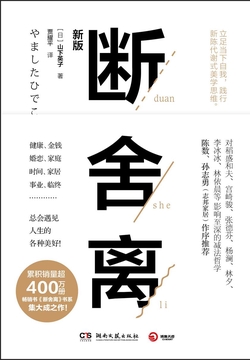
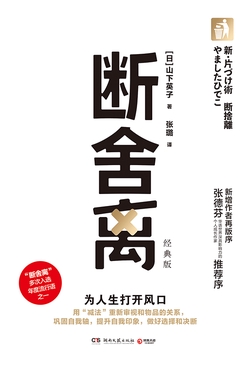
Dan means cutting off what is unnecessary, sha means discarding excess waste, and ri means detaching from attachment to objects. Only by throwing away what you do not need can you obtain what is important. Grounded in the present self, practice a metabolism-style aesthetic way of thinking. Health, money, marriage and romance, family, time, home, career, the end of life… you will always encounter all kinds of beauty in life! Only by detaching from inner obsessions can life move forward lightly! Danshari is about grounding yourself in the present and the principle of metabolism, sorting out your relationship with objects, first recognizing the current situation conceptually, stopping self-denial, envisioning the specific layout of your home, and then, through tidying clutter, understanding your true needs in the present, further building a life state that pleases the self. The author introduces Danshari to readers through "daily new tidying methods" as an entry point, classifying tidying principles into five categories: the "three-part method," the "7·5·1 method," the "1 out 1 in method," the "one touch method," and the "self-reliance, freedom, ease method." Through the tidying order of wardrobe—closet—kitchen—dining rack—refrigerator—bookshelf—toilet—entryway—living room & dining room—reusable items, it helps readers gradually clear their living spaces and regain a sense of pleasure.
The globally popular concept of "Danshari" has been published in dozens of books in 15 countries and has been nominated for buzzword awards many times. But it is always treated as merely a method of tidying objects, which is a pity; the meaning of Danshari goes far beyond that. So-called Danshari is the aesthetics of "output": not only objects at home, but also unnecessary, uncomfortable, unsuitable emotions and values imposed by parents can be separated from and discarded, making body and mind lighter, and gradually some "miracles" will happen, and life will change greatly because of it. This book is suitable for readers who have never heard of Danshari or who have heard of it but do not quite understand it, and also for practitioners of Danshari who remain merely at the level of tidying objects and wish to review and understand the deeper meaning of Danshari; promoting life change in a spiral upward manner is the ultimate purpose of Danshari.
Editor's review
Who it's for
A good fit for
- People troubled by clutter at home who long to improve their living environment
- People who feel busy yet inwardly empty and hope to find a focus in life
- People with decision difficulties or procrastination habits who hope to improve their decisiveness
- Practitioners interested in minimalist lifestyles who hope to explore the balance between material and spiritual life
Not a good fit for
- Readers expecting a detailed, step-by-step manual of room organization techniques
- People who absolutely cannot accept discarding objects and have strong emotional attachment to old things
Reading tips
- It is recommended to read the whole book first to understand the core ideas, then choose a small area (such as a drawer) to begin practicing
- While reading, note down at any time the views in the book that resonate with or repel you, and engage in self-dialogue
- Treat "Danshari" as an ongoing process rather than a one-time task; review regularly and adjust your state
About the publisher
Hunan Literature and Art Publishing House is a publisher known for its literary titles, with a catalogue spanning foreign literature, world classics, classical Chinese literature, essays and miscellaneous writings, and mystery and detective fiction. Judging from the more than 1,100 books in the database, the press publishes foreign classics such as Crime and Punishment, Snow Country, The Complete Sherlock Holmes and Letter from an Unknown Woman, as well as Chinese classical and modern literary works including Lu Xun's Wandering and A Madman's Diary and Wu Jingzi's The Scholars. In terms of translators and authors, translations by Cao Guowei and Tan Jinghua appear in its foreign literature titles, and the authors involved include Dostoevsky, Kawabata Yasunari, Conan Doyle and Zweig. Its publishing character lies in introducing Chinese and foreign literary classics side by side, balancing popular and serious works and attending to both readability and literary value. Public information is limited; the above is a brief overview based solely on the books in the database.
Contents
- 版权信息
- 推荐序一:做物质的减法,精神的加法
- 推荐序二:断舍离帮我们实现对家的美好想象
- 断舍离的奥义不只是“扔东西”
- 第1章 你之所以无法放手的原因
- 被困在水槽淤泥口的鲇鱼
- 我们生活在“事物随意渗入生活空间”的年代
- “不收拾”的深层原因是顽固的“物质轴”思维
- 因过度焦虑而郁闷的我们
- 断舍离注重的不是物品,而是空间
- 家里家外·情绪反差的痛苦
- “无法放手”的人有三类
- “舍”与“弃”的不同
- 人有“获得的自由”,也有“放手的自由”
- 第2章 这就是断舍离的工作机制
- 断舍离,就是扔东西
- 从切实能出成绩的小地方着手
- 有心无力时,先找“出口”
- 居所整体进行断舍离的要点
- 第3章 断舍离改变人生
- 一阵莫名的清爽感抚过心头
- 摆脱过剩执念,减轻心灵负重
- 获得深刻的智慧
- 提高选择·决断的精度和行动速度
- 清除闭塞感,疏通人生路
- 引导现在的自己做出最恰当的选择与决断
- “身体、心灵、生命”机制的回归
- 沟通力显著提升
- 比想象更怡然的人生就在不远处
- 第4章 断舍离,怡然生活
- 没有“出”,则难获自在
- 获得主体性的生活方式
- 抛开家庭关系的烦恼
- 遵守三大原则,收获怡然人生
- 断舍离,让人生处处自在怡然
- “搬”家,遇见新的自己
- 在必要的时刻,能获得必要的东西
- 恢复“呼吸空间”,获得自在人生
- 用心珍惜当下的人·事·物
- 不断地追寻“出”之美学
- 后记
FAQ
Is Danshari just teaching people to throw things away?
Is this book suitable for people who live with family?
After practicing Danshari, will life really change a lot?
Related on WeRead



Comments
Find this book
This site is an index: you start “Search all sources” in your browser, and the entries it lists all point to third-party sites; please judge their availability yourself.
About the author
Hideko Yamashita is the founder of the Japanese concept of "danshari" (decluttering) and a clutter-management consultant. Born in Tokyo in 1954, she graduated from the Faculty of Letters at Waseda University. As a university student she encountered the yoga philosophy of "danting, shating, and riting" and transformed it into a practical method of everyday tidying. Since 2000 she has held lectures across Japan to promote this idea. Her writing centers on home organization and lifestyle, and also extends to life choices and parenting, with common categories including inspirational growth, social science, education, and fashion. Her representative works include Danshari and The Power of Overlook, and 18 of her titles are included in the collection. The Danshari series has had wide influence, making "danshari" a popular term in everyday life.
Jia Yaoping is one of the editors and authors of books in the inspirational personal-growth and applied-psychology categories in China. Public information about the individual is limited, and details such as dates of birth and death, nationality and educational background are unknown. Thirteen of the author's works are held in the collection, spanning inspirational growth, fashion and applied psychology. Representative titles include Danshari, Reliable: The Basic Work Skills Taught by Top Consultants, Hideko Yamashita: Danshari (5 volumes), Stress Resistance: The Rule of Rebirth in Adversity, and Household Danshari. Judging from these works, the content centers on tidying and storage, simplifying life, basic workplace skills and coping with stress. The writing is accessible and clearly structured, focusing on turning ideas into practical everyday methods for general readers who wish to improve their lifestyle and working state, and the books have a certain readership within the practical-life category.
