

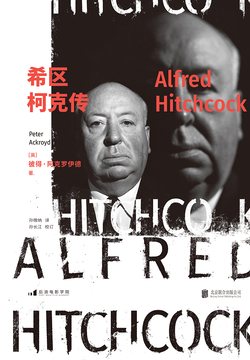
Hitchcock: A Biography
Tags
Summary
In this book, Hitchcock is for the most part an unhappy man. Everyday fear made him cling to order. He arranged his life like a military operation: the clothes in his wardrobe had to be cut identically and matched in pairs; each afternoon at tea he would break a teacup to remind himself how fragile life is; every shot had to be designed with precision in advance, leaving no one room to interfere. Film was not only his career but his only refuge.
Of course, the busy set itself was formidable enough, so he always insisted that the set be quiet, tidy, and highly controlled, as if only then could it be invulnerable. In the end, he brought the fear and trembling from an unruffled life onto the screen, as a way of defying the wounds society had left him.
Editor's review
The value of reading this book goes far beyond obtaining a detailed list of life events. It is more like a key that opens the backstage of Hitchcock's film world: How did those ingenious suspense designs stem from his own fears? What psychological drives lay behind his obsessive fixation on blondes? How are themes such as "the wrong man" and "watching and voyeurism," which recur in his work, related to his own character traits? Ackroyd neither simply mythologizes nor belittles his subject; he calmly presents a life in which genius and flaw coexist, which makes this book more than an ordinary fan read and turns it into a profound report on artistic creativity, human complexity, and the workings of the culture industry. For any reader who wishes to go beyond surface entertainment and deeply understand film art and the creator's mind, this is a rare excellent work.
Who it's for
A good fit for
- Seasoned film fans and film researchers who hope to interpret Hitchcock's authorship and psychological roots in depth
- Readers interested in biographical literature who enjoy exploring the complex inner worlds of geniuses and their relationship to creation
- Creative professionals seeking inspiration from the master's creative methods and career
- Enthusiasts eager to explore twentieth-century popular culture history and the development of the Hollywood film industry
Not a good fit for
- Casual readers who only want a quick look at Hitchcock's life anecdotes or film plot summaries
- Readers expecting a large number of film stills, behind-the-scenes photos, or a purely technical film analysis manual
Reading tips
- It is recommended to first watch several of Hitchcock's signature works (such as Rear Window, Vertigo, and Psycho), then read with concrete impressions of the films in mind to appreciate the book's analyses
- Can be read alongside other Hitchcock biographies or interview materials for comparison, to form a more three-dimensional understanding
- Pay attention to the book's emphasis on Hitchcock's British-period works; this part is often overshadowed by the Hollywood halo but is key to understanding the formation of his style
About the publisher
Beijing United Publishing Co., Ltd. is a publisher known for its literature and history titles, with 2,065 books in the collection. Its publishing covers foreign literature, contemporary Chinese prose and essays, history, folk literature, and cultural books. Its list ranges from Sima Qian's complete edition of the Records of the Grand Historian to foreign classics such as The Book of Disquiet, All Quiet on the Western Front, Snow Country, The Stranger, and Jean-Christophe, as well as modern Chinese works including Teahouse and Dawn Blossoms Plucked at Dusk. Its authors and translators include Yasunari Kawabata, Fernando Pessoa, Erich Maria Remarque, Jin Xinyi, Zhou Miao, and Chen Chao. Public information is limited, but its catalogue reflects a balance between Chinese and foreign literary classics and historical and cultural works.
Contents
- 版权信息
- Ⅰ 从来不哭的孩子
- Ⅱ 我来做
- Ⅲ 来吧,声音
- Ⅳ 我是灰色的
- Ⅴ 在家里
- Ⅵ 去假装吧
- Ⅶ 哦,我的天
- Ⅷ 我被定性了
- Ⅸ 晚上好
- Ⅹ 鸟与兽
- Ⅺ 回归初心
- 参考书目
- 作品年表
- 出版后记
FAQ
What is this book's Douban rating, and what does it focus on?
What are the writing style and background of author Peter Ackroyd?
What is the main difference between this book and other Hitchcock biographies on the market?
Related on WeRead


Comments
Find this book
This site is an index: you start “Search all sources” in your browser, and the entries it lists all point to third-party sites; please judge their availability yourself.
About the author
Peter Ackroyd is an author known for his biographical writing. The Chinese book database currently holds one of his works, a biography of Hitchcock. Because publicly available information is limited, details such as his nationality, dates of birth and death, and educational background cannot be confirmed, and no speculation is offered here. Judging from the work at hand, his writing centers on biography, commonly classified as general biography. The Hitchcock biography takes the film director Alfred Hitchcock as its subject and belongs to the typical genre of artist biography, which usually requires the author to understand the subject's works and creative psychology in addition to narrating his life. Such writing demands both patience in organizing historical material and a sense of narrative pace and readability, so that a public figure's life and artistic achievements can be presented along a single thread. From this one work, one may infer that Ackroyd's biographical approach tends toward comprehensive narrative for general readers rather than dense academic scholarship.
Sun Weina: publicly available information is limited. At present, it is known only that the author has written one work, a biography of Alfred Hitchcock, which is catalogued under general biography. Based on the available information, Sun Weina's writing centers on the film director Alfred Hitchcock and belongs to the genre of biographical writing. Hitchcock is known worldwide for his suspense and thriller films, and his life and creative career have long drawn the attention of biographers. Writing a biography of such a director generally requires tracing his film career, representative works and artistic style, while balancing factual accuracy with readability. Because there are no reliable records of Sun Weina's identity, background or other works, it is not possible to judge the author's academic training or the full scope of their writing; it can only be confirmed that Sun Weina has come to the attention of Chinese readers through a biography of Hitchcock. The book's actual influence and reception await confirmation from further public sources.
Sun Changjiang is the author of a biographical work, with public information about him being limited. The only title by him recorded in the library is a biography of Alfred Hitchcock, the renowned film director, which places the book within the general category of biography. Since details such as his nationality, dates of birth and death, and personal background are not clearly documented, little can be said about his writing style or academic training. Only a limited inference can be drawn from his choice of subject: he takes an interest in film history and individual filmmakers, and tends to trace a single figure's artistic career and life experiences. Writing of this kind generally requires both careful use of historical sources and readable narrative, reconstructing the subject's creative development and personal circumstances. Given the available material, Sun Changjiang's profile as a writer remains unclear, and readers who wish to understand his approach would need to turn to the text of the Hitchcock biography itself.
