

Facing South
Tags
Summary
Editor's review
Who it's for
A good fit for
- Ordinary readers interested in ancient ritual institutions and political culture
- Those who need to clarify names and forms of address when reading pre-Qin and Han texts
- Students of Chinese and history using it as supplementary reading on cultural common knowledge
- Readers who like to understand ancient ideas by starting from a specific concept
Not a good fit for
- Readers expecting a systematic general history or lengthy exposition
- Researchers who need in-depth textual research and academic debate
- Casual readers who only want story-driven content
Reading tips
- Read the main text first, then return to the classical passages quoted in the book and consider what the directional terms mean in their specific contexts.
- Read it alongside common-knowledge entries on ancient titles and ritual institutions to build a network of concepts.
- When encountering expressions such as "facing south" or "facing north" in historical works, turn to the relevant passages in this book.
- After reading, try to restate in your own words how "facing south" shifted in meaning from a seating direction to the imperial throne.
About the publisher
Bashu Publishing House is a publisher centered on collating and publishing classical Chinese cultural texts, with its main publishing areas covering classical literature, Eastern philosophy, ancient poetry, and educational classics. Its library currently holds 1,075 titles, including representative works such as Dream of the Red Chamber, the Preface to the Orchid Pavilion Gathering, Renjian Cihua, and Out to the Frontier, involving authors such as Cao Xueqin, Wang Xizhi, Wang Guowei, Wang Changling, Liu Xie, and Yan Yu. These reflect the publisher's focus on literary classics, poetry criticism, and philosophical readings. Its publishing character lies in working around ancient texts and canonical works, with attention to textual collation and presentation. Public information on its more detailed publishing background and series plans is limited; this introduction is based only on the library's book information.
Contents
- 版权信息
- 南面第十八
FAQ
Why can "facing south" refer to the imperial throne?
Is this book suitable for readers with no background?
Do I need to read this book alongside other materials?
Related on WeRead
 重生:从技校生到工业基石
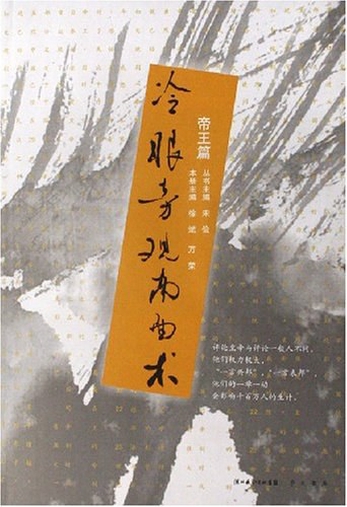 冷眼旁观南面术
 徐霞客游记·全四册(中华经典名著全本全注全译)
 二十六史:完本精校大全集
 二十四史:完本精校大全集(中华古籍国学宝典文库)
 二十五史:完本精校大全集(中华古籍国学宝典文库)
 水经注(精)--中华经典名著全本全注全译(全五册)
Comments
Find this book
This site is an index: you start “Search all sources” in your browser, and the entries it lists all point to third-party sites; please judge their availability yourself.
About the author
Anonymous is not a real personal name but a general Chinese designation for authors whose names are unknown, lost, or unsigned. Neither nationality nor dates of birth and death can be verified, and available public information is limited, so the works attributed to this name are the only basis for description. The collection holds 2,078 works under Anonymous, spanning medicine, classics, historical readings, ancient poetry, classical literature, and philosophy. Representative works include The Yellow Emperor's Inner Canon: Lingshu, Mencius, The Book of Documents, Nineteen Old Poems, Complete Song Ci, and The Peacock Flies Southeast. Most of these works took shape through long transmission and editing, emerging either from collective folk creation or from authors whose names were lost over time. In ancient China, the Book of Songs, the Great Learning, and many popular storybooks and plays were signed Anonymous because their authors could not be traced. Anonymous works cross the classics, histories, philosophical writings, medical texts, and poetry; their subjects are broad, and their styles vary from archaic simplicity to clear naturalness, making them important and influential sources for understanding ancient Chinese thought, medicine, and literature.
