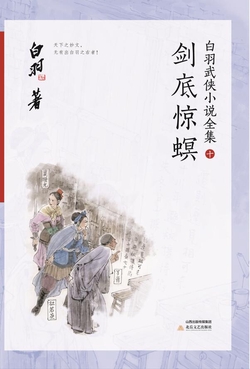
The Startled Moth Beneath the Sword cover

The Startled Moth Beneath the Sword

Rating 3.6
Word count
137K words
Chapters
9

Tags

Summary

Du Ruoying the Eleventh, the far-roaming swordswoman of the Songyang Southern School, vows revenge after her husband is murdered. She raises Zhang Qinghe, the orphaned child of a fellow swordsman, and carefully nurtures him to adulthood. As Zhang Qinghe grows, he weathers many trials yet gradually reveals extraordinary talent and a chivalrous heart. Amid the jianghu they face every manner of challenge and crisis, never shrinking from powerful foes, struggling ever onward through gratitude and grievance, love and hate. The story offers both breathtaking fight scenes and deeply moving emotional entanglements, displaying the distinctive and splendid wuxia world of Bai Yu.

Editor's review

Sword's End Startles the Moth twists revenge and nurture into a single thread: the Gallant Wave Swordswoman Du Ruoying Shiyiniang vows vengeance for her murdered husband while raising Zhang Qinghe, the orphan of a fellow disciple, so that the tale unfolds between gratitude and enmity. Bai Yu's strength in wuxia lies in the layered pull of human relations—Du Ruoying's fierce resolve and forbearance, Zhang Qinghe's talent and chivalrous heart emerging through adversity, are no flat symbols. The fight scenes are breathtaking, and the emotional conflicts are never weightless; revenge, passion, and jianghu crises drive the story forward in a steady, grounded manner characteristic of old-school wuxia. Readers used to fast pacing will need a little patience at the outset, but those willing to follow the characters as they struggle through gratitude and enmity will find a jianghu that honors both rules and feeling. Best read slowly in quiet moments, attentive to the emotion and duty behind each of the characters' choices.

Who it's for

A good fit for

  • Wuxia readers who enjoy interwoven revenge and nurture threads with solid character relationships
  • Adult readers drawn to female swordswoman figures and themes of gratitude and duty
  • Readers curious about Bai Yu's character craft and jianghu atmosphere
  • Those who can embrace traditional storytelling pace and value emotional entanglements

Not a good fit for

  • Wuxia readers seeking fast pacing, strong premises, and dense plot twists
  • Readers with little interest in revenge themes and tangled grudges
  • Casual readers looking for light, humorous fare with minimal heavy emotion

Reading tips

  1. First clarify the sect relationship between Du Ruoying and Zhang Qinghe before entering the revenge mainline.
  2. Slow down at the fight scenes and note the characters' choices amid gratitude and enmity.
  3. Read the experiences of Du Ruoying and Zhang Qinghe, two generations, in parallel to sense the theme of legacy.

Contents

  1. 版权信息
  2. 第一章 诉叛徒侠女惊宴
  3. 第二章 搜逆子群雄下山
  4. 第三章 探巨宅人影闪烁
  5. 第四章 访地道忽遇妖贼
  6. 第五章 鬼画符乡妇求巫
  7. 第六章 雄娘子邪术杀人
  8. 第七章 三太保贪色被阉
  9. 第八章 玉蜻蜓决斗遭擒

FAQ

I haven't read any of Bai Yu's works. Can I start with this one?
Yes. The story stands on its own and does not depend on prior events from other works. It is best to begin patiently at the opening, first getting familiar with the relationship between Du Ruoying and Zhang Qinghe, then following the threads of revenge and growth; that way you will enter the jianghu world of Bai Yu's writing smoothly.
Is the main appeal of the book revenge or character growth?
The two are intertwined. Du Ruoying vows revenge after her husband is murdered, and at the same time raises Zhang Qinghe, the orphan of a fellow disciple. Amid the twists and turns, Zhang Qinghe gradually reveals his talent and chivalrous heart. Revenge drives the plot, while growth and emotion make the characters convincing; together they create the story's tension.
Are there many fight scenes, and how well are they written?
There are quite a few thrilling fight scenes, but they are not mere strings of moves. Bai Yu sets the fights within the characters' grudges and crises, so action and emotion pull on each other; the reading carries more of the jianghu's weight rather than feeling like isolated displays of martial skill.

Related on WeRead

Comments

Find this book

This site is an index: you start “Search all sources” in your browser, and the entries it lists all point to third-party sites; please judge their availability yourself.

About the author

Bai Yu (Gong Zhuxin) Author · China · 1899–1966

Bai Yu (1899–1966), originally named Gong Wanxuan and later Gong Zhuxin, was a prominent Republican-era Chinese writer of martial arts fiction. His ancestral home was Dong'e, Shandong, and he was born in Machang, Tianjin. In his early years he received guidance from Lu Xun and Zhou Zuoren and engaged in new literature writing before turning to martial arts fiction; he rose to fame in 1938 with The Twelve Money Darts. His works combine martial arts fiction with social fiction, and his representative works also include Stealing Boxing, Records of Martial World Strife, The Joint Escort Chronicle, and Blood-Washed Cold Light Sword. He is counted among the "Five Masters of Northern School Martial Arts Fiction." Bai Yu's novels emphasize social observation and character portrayal and hold a place in Republican-era popular literature. In his later years he turned to the study of oracle bones and epigraphy. Public information on the details of his life is limited; the collection contains 77 works, mostly on martial arts, social, and folk themes.

More by the same author

Top rated in the same category