

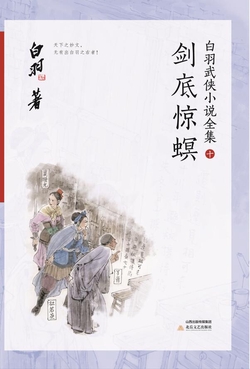
The Startled Moth Beneath the Sword
Tags
Summary
Editor's review
Who it's for
A good fit for
- Readers interested in Republican-era martial arts fiction who want to broaden their reading
- Scholars of popular literature or Republican culture seeking primary texts
- Readers who enjoy traditional chapter-style narrative and can accept old vernacular diction
- Literary enthusiasts curious about the social-irony school of martial arts fiction
Not a good fit for
- Readers who prefer fast modern pacing and lack patience
- Those unaccustomed to Republican-era vernacular and old-fashioned syntax
- Readers seeking only fantasy settings or the thrills of an ultra-long serial
Reading tips
- Read the preface or publication notes first to understand Baifa's creative background and this book's place in the collection
- Slow down in the first few chapters to adapt to the feel and rhythm of Republican-era vernacular; there is no need to scrutinize every word
- Note the satirical technique and descriptions of Jianghu rules, and jot brief annotations as you go
- After finishing, read alongside other Baifa works in the same volume to compare characters and themes
About the publisher
China Culture and History Press has long devoted itself to modern and contemporary literature and culture-and-history reading matter, with publishing directions centered on classic works, social novels, prose and miscellaneous writings, and Eastern philosophy, alongside culture-and-history periodicals such as Zongheng. Among the more than 1,500 titles in the collection, representative books include Zhang Henshui's Ti Xiao Yin Yuan, Lu Xun's Complete Classic Works (10 volumes) and Wild Grass, and Lao She's Four Generations Under One Roof series and the boxed set of Lao She's Classic Works (10 volumes), while its author resources are concentrated on figures such as Zhang Henshui, Lu Xun, Lao She and Sima Qian. Its publishing character lies in solid editorial work on culture-and-history source texts and in issuing famous authors' works in sets, balancing the readability of individual texts with the systematic presentation of complete collections for focused reading and collecting. Beyond these directions, public information on the press's contemporary original publishing is limited, so it is not elaborated here.
Contents
- 版权信息
- 我的生平
- 叙略
- 第一章 诉叛徒侠女惊宴
- 第二章 搜逆子群雄下山
- 第三章 探巨宅人影闪烁
- 第四章 访地道忽遇妖贼
- 第五章 鬼画符乡妇求巫
- 第六章 雄娘子邪术杀人
- 第七章 三太保贪色被阉
- 第八章 玉蜻蜓决斗遭擒
- 附录
- 整理后记
FAQ
Is this book suitable for beginners to wuxia?
What does Baifa's 'socially satirical school' mean?
Is this a complete novel or a selection?
Do I need prior knowledge of Republican-era history to read this book?
Related on WeRead


Comments
Find this book
This site is an index: you start “Search all sources” in your browser, and the entries it lists all point to third-party sites; please judge their availability yourself.
About the author
Bai Yu (1899–1966), originally named Gong Wanxuan and later Gong Zhuxin, was a prominent Republican-era Chinese writer of martial arts fiction. His ancestral home was Dong'e, Shandong, and he was born in Machang, Tianjin. In his early years he received guidance from Lu Xun and Zhou Zuoren and engaged in new literature writing before turning to martial arts fiction; he rose to fame in 1938 with The Twelve Money Darts. His works combine martial arts fiction with social fiction, and his representative works also include Stealing Boxing, Records of Martial World Strife, The Joint Escort Chronicle, and Blood-Washed Cold Light Sword. He is counted among the "Five Masters of Northern School Martial Arts Fiction." Bai Yu's novels emphasize social observation and character portrayal and hold a place in Republican-era popular literature. In his later years he turned to the study of oracle bones and epigraphy. Public information on the details of his life is limited; the collection contains 77 works, mostly on martial arts, social, and folk themes.
