

Criminal Law (6th Edition)
Tags
Summary
Editor's review
Who it's for
A good fit for
- Undergraduate and graduate students at law schools, as a core course textbook or extended reading
- Candidates preparing for the National Unified Legal Professional Qualification Examination, to consolidate their theoretical foundation in criminal law
- Legal professionals engaged in criminal justice practice, such as judges, prosecutors, and lawyers
- Non-law professionals with a strong interest in criminal law theory who wish to systematically improve their legal literacy
Not a good fit for
- Readers seeking quick mastery of criminal law provisions through simple mnemonics or exam-taking techniques
- Practical beginners uninterested in pure theoretical discussion who focus only on operational guidance for specific cases
Reading tips
- It is recommended to first read through the General Part to establish a complete framework of basic criminal law principles and the theory of crime, then proceed to the Specific Part to understand particular offenses.
- When reading, keep the original text of the Criminal Law of the People's Republic of China at hand for reference, and pay attention to footnotes and case notes to connect theory with practice.
- For important theoretical controversies, such as different doctrines on the constitution of crime, readers may combine the book's views with extended reading of other scholars' works to form their own judgment.
About the publisher
Shanghai People's Publishing House is a comprehensive publisher whose list focuses on academic monographs and general-interest titles in philosophy, social sciences, politics and law, economics and management, and history. Among its books are Wei, Jin, Southern and Northern Dynasties History in the Chinese Dynastic History series; The Hobbit and The Lord of the Rings trilogy in foreign literature; the Wenjing Classical Translation Illustrated Edition of The Complete Greek Tragedies of Euripides; and works of social theory such as Max Weber's Economy and Society and Dialectic of Enlightenment: Philosophical Fragments. Its authors include Wang Zhongluo, J.R.R. Tolkien, Luo Niansheng, and Zhou Zuoren.
Contents
- 版权信息
- 本书撰稿
- 上册
- 第一编 绪论
- 第一章 刑法概述
- 第二章 刑法的基本原则
- 第三章 刑法的效力范围
- 第二编 犯罪论
- 第四章 犯罪概述
- 第五章 犯罪构成
- 第六章 犯罪客体要件
- 第七章 犯罪客观要件
- 第八章 犯罪主体要件
- 第九章 犯罪主观要件
- 第十章 犯罪阻却事由
- 第十一章 故意犯罪的停止形态
- 第十二章 共同犯罪
- 第十三章 罪数形态
- 第三编 刑罚概论
- 第十四章 刑事责任
- 第十五章 刑罚概述
- 第十六章 刑罚的体系和种类
- 第十七章 刑罚裁量及其制度
- 第十八章 刑罚执行制度
- 第十九章 刑罚消灭制度
- 下册
- 第四编 罪刑各论
- 第二十章 罪刑各论概述
- 第二十一章 危害国家安全罪
- 第二十二章 危害公共安全罪
- 第二十三章 破坏社会主义市场经济秩序罪
- 第二十四章 侵犯公民人身权利、民主权利罪
- 第二十五章 侵犯财产罪
- 第二十六章 妨害社会管理秩序罪
- 第二十七章 危害国防利益罪
- 第二十八章 贪污贿赂罪
- 第二十九章 渎职罪
- 第三十章 军人违反职责罪
- 主要参考书目
- 后记
FAQ
What are the main differences between the 6th edition and previous editions?
Is this book suitable for complete beginners in law?
Are the views in this book consistent with the mainstream views of the legal qualification examination?
Related on WeRead
 高铭暄《刑法学》(第6版)配套题库【名校考研真题(视频讲解)+章节题库+模拟试题】
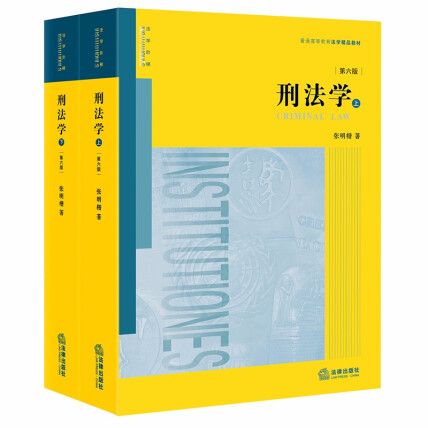 刑法学(第6版 上下册)张明楷 /普通高等教育法学精品教材
 边境管理法律制度通义
 论刑法中的“明知”
 罪数理论简约化论要:兼论“纯粹简约化思想”之提出
 刑法解释(第2卷)
Comments
Find this book
This site is an index: you start “Search all sources” in your browser, and the entries it lists all point to third-party sites; please judge their availability yourself.
About the author
Liu Xianquan, born in Shanghai in December 1955, is a Chinese criminal law scholar. He is dean of the Criminal Law Research Institute at East China University of Political Science and Law, a professor of criminal law and a doctoral supervisor, and holds a doctorate in law from Erasmus University in the Netherlands. He has long engaged in criminal law research, focusing on the criminal law regulation of artificial intelligence, financial crime and economic crime. He has authored or co-authored more than 80 academic works and has received honors including National Advanced Worker and National Teaching Master. His eight works in the library consist mainly of criminal law textbooks and studies of financial crime, such as Criminal Law (6th Edition), Principles of Criminal Law on Financial Crime (2nd Edition), Master Lectures on Criminal Law (3rd Edition, 2 volumes) and Evidence Standards for Financial Crime, as well as titles on the rule of law in China and anti-corruption. These works serve legal study and practice, combining systematic exposition with case-based explanation, and have had a lasting influence on criminal law teaching and financial criminal law research.
