

The Book of Etiquette and Ceremonial: Translation and Notes
Tags
Summary
Editor's review
The Yili records the capping, wedding, funeral, sacrificial, court audience, diplomatic mission, district, and archery ceremonies and other rites of the scholar-official class from the Zhou dynasty through the Spring and Autumn and Warring States periods. It is a core document for studying ancient Chinese social structure, ethical concepts, cultural institutions, and even the details of daily life. Yang Tianyu's translation and annotation not only clarify words, phrases, and passages but also, through detailed textual research and appropriate editorial notes, reveal the historical context and cultural connotations behind each ceremony. For example, his interpretation of the elaborate procedures of the "Capping Ceremony of a Scholar" is in fact connected to the ancients' conception of coming of age and the establishment of social roles, while his careful analysis of the "Mourning Garments" chapter profoundly reflects the hierarchical relations of kinship under the patriarchal clan system.
For modern readers, reading the Yili is by no means a simple exercise in nostalgia. This book offers us a key to understanding the deep logic of traditional Chinese culture—that unique wisdom which rendered social order, moral norms, and daily behavior artistic and ritualized. It helps us move beyond a simplistic, superficial understanding of "ritual" and recognize its historical role as a complex symbolic system in shaping communal identity and sustaining the operation of society. With its solid foundation and clear exposition, Yang Tianyu's annotated translation is undoubtedly one of the best guides for contemporary scholars and enthusiasts of traditional culture seeking to enter this profound hall.
Who it's for
A good fit for
- Professional scholars and students engaged in the study of ancient Chinese history, intellectual history, sociology, and textual scholarship
- Enthusiasts of traditional Chinese ritual culture who wish to gain a systematic understanding
- Writers who frequently need to cite classical ritual institutions and seek reliable texts and explanations
- Advanced readers with some grounding in classical Chinese who wish to take on the challenge of reading the Yili, a core Confucian classic
Not a good fit for
- Those who only wish to learn about history through light storytelling and lack the patience for serious academic texts
- Complete beginners with very weak grounding in classical Chinese and no prior familiarity with ancient institutions and regulations
Reading tips
- Readers may begin with the long Preface at the front of the book, which provides a concise overview of the Yili's authorship, composition, content, value, and scholarly history, establishing a framework for reading the full text.
- There is no need to read straight through in order; readers may start with relatively life-related chapters such as the "Capping Ceremony of a Scholar" and the "Wedding Ceremony of a Scholar," using the translation and notes to appreciate the details.
- While reading, compare the translation with the original text and focus on the annotations' textual explanations of names, objects, and ritual procedures, which are the key to understanding the ritual scene and the ancient mindset.
About the publisher
Shanghai Classics Publishing House is a professional publisher centered on the collation of ancient texts and academic research works. Its publishing areas cover historical readings, classical poetry, folk literature, literary appreciation, canonical works, and Eastern philosophy. Its books include Chen Yinke's A Brief Discussion of the Origins of the Sui and Tang Institutions, Xin Qiji's Chronological Annotated Edition of Jiaxuan's Ci (Simplified Edition), Tang Xianzu's The Peony Pavilion, Liu Xie's The Literary Mind and the Carving of Dragons, as well as New Annotations to Three Hundred Tang Poems (Collector's Edition), Annotated Edition of Han Changli's Collected Works (Simplified Edition, 3 volumes), and Youyang Zazu. Its authors include Chen Yinke, Xin Qiji, Tang Xianzu, Liu Xie, Deng Guangming, Hengtang Tuishi, Han Yu, and Ma Qichang. In terms of publishing characteristics, the house emphasizes collation, annotation, and compilation of ancient texts alongside academic research works, and continues to issue simplified and collector's editions that balance scholarship and accessibility. Public information about the publisher's fuller publishing profile is limited.
Contents
- 版权信息
- 前 言
- 士冠礼第一
- 士昏礼第二
- 士相见礼第三
- 乡饮酒礼第四
- 乡射礼第五
- 燕礼第六
- 大射第七
- 聘礼第八
- 公食大夫礼第九
- 觐礼第十
- 丧服第十一
- 士丧礼第十二
- 既夕礼第十三
- 士虞礼第十四
- 特牲馈食礼第十五
- 少牢馈食礼第十六
- 有司第十七
- 附录
FAQ
What are the main features of Yang Tianyu's translation compared with other annotated editions of the Yili?
For non-specialist readers, what is the practical significance of reading the Yili?
How difficult is this book to read, and what preparation is needed?
Related on WeRead
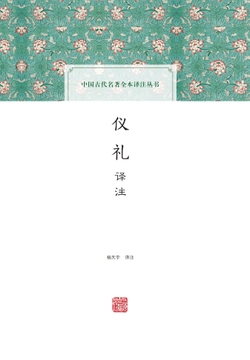 仪礼译注
 仪礼--中华经典名著全本全注全译丛书
 中华传统文化经典全注新译精讲丛书 仪礼 春雨书院
 中国经学(第十八辑)
 半部学术史,一位李先生:李学勤先生学术成就与学术思想国际研讨会论文集
 德性、政治与礼乐教化:《礼记》礼乐释义研究
 十三经译注(全十六册)
 阅微草堂笔记全译
Comments
Find this book
This site is an index: you start “Search all sources” in your browser, and the entries it lists all point to third-party sites; please judge their availability yourself.
About the author
Yang Tianyu is an author in the field of collating and annotating classical Chinese texts. Public information about him is limited, and details such as his native place, dates of birth and death, and educational background are not clearly recorded. Judging from the five works held in the collection, his work centers on modern annotation and translation of the Confucian classics known as the "Three Rites," including Annotated Translations of the Book of Rites, Annotated Translations of the Rites of Zhou, and Annotated Translations of the Etiquette and Ceremonies; the Book of Rites volume exists in both separate and two-volume editions. These works fall under the common categories of Eastern philosophy and history readings and are intended for general readers and beginners who wish to read the original ritual classics directly. His annotation style is mainly to explain meanings alongside the text and clarify sentences, striving to lower the barrier to reading pre-Qin ritual documents so that ancient ceremonial institutions and ideas become more accessible to modern readers, and thus offers some reference value in popularizing traditional ritual studies.
