

The Age of Discontinuity
Tags
Summary
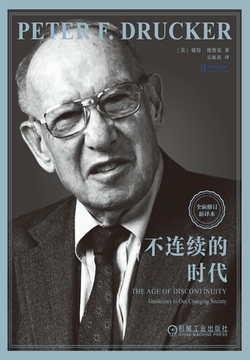
In this book Drucker envisions humanity's passage from an industrial society to a knowledge society; the predictions about the knowledge society made here were later almost all borne out one by one, ample proof of Drucker's extraordinary foresight.
The book gives full expression to Drucker's distinctive way of observing, recording, and analyzing, helping us view the world more rationally, confront the present, and think ahead to the future—of particular value for each person's career choices and for the transformation and development of every organization.
Editor's review
Who it's for
A good fit for
- Readers interested in management, sociology, and future studies who wish to understand the underlying logic of social change
- Business managers, entrepreneurs, and policymakers seeking inspiration for strategy in an age of uncertainty
- Knowledge enthusiasts who enjoy deep thinking, are not satisfied with surface phenomena, and aspire to build systematic cognitive frameworks
- Followers of Peter Drucker's thought who want a systematic understanding of his early visions of a future society
Not a good fit for
- Pragmatic readers expecting concrete, immediately actionable management techniques or checklists
- Readers impatient with theoretical, speculative social science and who prefer light narrative
Reading tips
- Read this book alongside Drucker's later works (such as Management Challenges for the 21st Century) to observe the evolution and deepening of his intellectual trajectory.
- Do not rush; focus on digesting the discussions in Part II, "The Knowledge Society," and Part III, "The Society of Organizations," and relate them to today's platform economy and gig economy.
- As you read, note down the predictions Drucker made that have now become reality, and consider which "discontinuities" are unfolding around us, thereby training your own powers of insight.
About the publisher
In addition to science and technology and professional publishing, the books in our catalog from China Machine Press also reflect a sustained focus on psychology, computing, management, finance and economics, and social sciences. In psychology, the catalog includes works by C. G. Jung and introductions to analytical psychology, as well as applied topics such as stress and health, and addiction and healing. In computing, it features Structure and Interpretation of Computer Programs (JavaScript Edition). Management and finance titles include Administrative Behavior (4th Edition), The Price of Inequality (Collector's Edition), and This Time Is Different: Eight Centuries of Financial Folly (Commemorative Edition). In the philosophy and history of science, there is The Worldview: The Third Edition. Relevant authors include C. G. Jung, William McGuire, Sonu Shamdasani, and Gabor Maté. Public information is limited; the above summarizes the publisher's profile based solely on the books in our catalog.
Contents
- 版权信息
- 1992年版序
- 1983年版序
- 原版序
- 第一部分 知识技术
- 第1章 连续性的终结
- 第2章 新兴产业及其动力
- 第3章 新创业者
- 第4章 新的经济政策
- 第二部分 从国际经济到世界经济
- 第5章 全球购物中心
- 第6章 提高穷人的生产率
- 第7章 超越“新经济学”
- 第三部分 组织型社会
- 第8章 新多元主义
- 第9章 迈向组织理论
- 第10章 政府的弊病
- 第11章 个人如何才能生存
- 第四部分 知识型社会
- 第12章 知识经济
- 第13章 知识型社会的工作与工作者
- 第14章 成功把学校毁掉了吗
- 第15章 新学习和新教学
- 第16章 知识政治
- 第17章 知识有未来吗
- 结语
- 译者后记
FAQ
This book was written over half a century ago—does it still offer guidance today?
How does this book differ from Drucker classics such as The Effective Executive?
Are the book's views overly optimistic or idealized?
Related on WeRead




Comments
Find this book
This site is an index: you start “Search all sources” in your browser, and the entries it lists all point to third-party sites; please judge their availability yourself.
About the author
Peter Drucker (1909–2005) was born in Vienna, Austria, and moved to the United States in 1937. A management consultant, educator, and writer, he is widely regarded as the father of modern management. Through his writing and consulting, he helped establish management as a teachable practice and introduced influential ideas such as management by objectives and the knowledge worker. His major works include The Practice of Management, The Effective Executive, Management: Tasks, Responsibilities, Practices, Adventures of a Bystander, and The Age of Discontinuity. His books combine depth of thought with practical concern and span management, social science, and finance. In 2002 he received the Presidential Medal of Freedom.
Wu Jiaxi is a Chinese author of finance and management books about whom limited public information is available; his nationality, education, and professional background are not recorded in the available sources. Two of his works are currently listed: The Era of Discontinuity and The Rule of Turning Defeat into Victory: How Individuals Can Turn Things Around Against the Odds, both commonly classified under finance and management. Judging from the titles and categories, his writing focuses on uncertainty amid changing times and on how individuals can adjust their strategies and stage a comeback in adversity, offering analysis and practical advice to general readers. His style tends toward the practical and readable, combining management ideas with personal-growth topics. Because verifiable information is scarce, a full assessment of his writing and influence awaits further material.
