

SAT Math
Tags
Summary
Editor's review
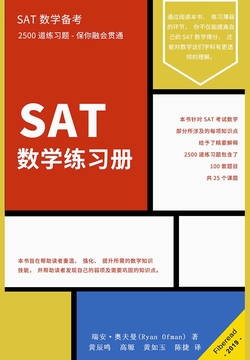
The book's most notable value lies in its systematic and targeted approach. Its content strictly follows the SAT math syllabus, covering all core areas—arithmetic, algebra, geometry, data analysis and probability—while incorporating a large number of real and high-quality mock questions. Zhang Yibing's explanations are clear and accessible: he not only clarifies "how to solve a problem" but focuses on "why it should be solved this way," helping readers fundamentally understand how mathematical concepts apply in the SAT context and develop the ability to draw inferences from one instance.
Compared with similar books, a major highlight is its interpretation of the differences between Chinese and American mathematics teaching. The author deeply understands the characteristics of Chinese test-takers' thinking habits and knowledge structure, specifically pointing out test points Chinese students tend to overlook (such as statistical concepts and data-chart interpretation) and common thinking pitfalls, and providing effective corrective strategies and preparation paths. This localized perspective makes the book's guidance far more valuable than an ordinary exercise collection.
Its content design balances foundational consolidation with advanced skill-building, making it suitable both for test-takers who need systematic review to strengthen their foundations from the start and for those seeking high-score breakthroughs on difficult points. The clear classification of test points and difficulty levels helps readers formulate personalized study plans according to their own situation. Overall, this is a high-quality preparation guide that closely integrates knowledge explanation, strategy analysis, and practical training, offering high reference and practical value for test-takers with clear goals who wish to improve their SAT math scores through systematic study.
Who it's for
A good fit for
- High school students or self-learners aiming to systematically prepare for the SAT math section
- Test-takers with a reasonable math foundation who need to become familiar with SAT question design and test-taking techniques
- Advanced learners hoping to break through high-score bottlenecks in SAT math and fill knowledge gaps
- Users who need an authoritative reference book integrating knowledge explanations with high-quality practice
Not a good fit for
- Learners seeking large numbers of beyond-syllabus, competition-level math problems
- Readers who only need scattered knowledge-point lookups and do not plan systematic preparation
Reading tips
- Read through each chapter's knowledge-point summary first, self-assess against it, identify weak areas, and then do targeted practice
- During practice, focus on understanding the reasoning breakdown in the answer explanations rather than merely checking whether answers are correct
- Combine the book with the official guide by applying its problem-solving strategies to real practice tests to check learning outcomes
About the publisher
Shanghai Translation Publishing House is a Chinese publisher oriented mainly toward translation and publishing. Its publications cover foreign literature, world classics and classic works, as well as social culture, folk literature and classical poetry. The database contains 2,618 titles, including Never Let Me Go, Les Misérables (2 volumes), Don Quixote (illustrated collector's edition), The Complete Comedies of Molière (4 volumes), The Complete Novels of Kafka (3 volumes), The Collected Works of Dostoevsky (9-volume set), Reason and Persons, and Oedipus Rex (Translation Classics). Its author resources include foreign writers such as Kazuo Ishiguro, Victor Hugo, Cervantes and Molière, as well as translators such as Zheng Kelu, Sun Jiameng, Li Jianwu and Zhang Kun. The publisher has brands such as "Translation Classics Selections" and "Translation Documentary," and emphasizes translated works in foreign literature and the humanities and social sciences, while also publishing bilingual dictionaries and foreign-language educational books. Public information is limited; the above is based on the book information in the database.
Contents
- 版权信息
- 序言
- 前言
- 第一章 算数
- 第一节 基本四则运算
- 第二节 偶数和奇数
- 第三节 整除和因子
- 第四节 分数和小数
- 第五节 百分数
- 第六节 比和比例
- 第七节 平均数、中位数和众数
- 第八节 指数和根
- 第九节 集合
- 第十节 序列
- 第二章 代数
- 第一节 方程
- 第二节 方程组
- 第三节 不等式
- 第四节 函数及其图像
- 第三章 几何
- 第一节 线和角
- 第二节 三角形及三角函数
- 第三节 多边形和四边形
- 第四节 圆
- 第五节 立体
- 第六节 解析几何
- 第四章 统计、概率和逻辑推理
- 第五章 图表题
- 附录1
- PRACTICE TEST 1
- PRACTICE TEST 2
- 模拟题答案
- 附录2
- 代数部分
- 几何部分
FAQ
How does the difficulty of this book's practice questions compare with that of real exams?
Is it suitable for students with a relatively weak math foundation?
Does this book cover the new question types after the SAT reform?
Related on WeRead

Comments
Find this book
This site is an index: you start “Search all sources” in your browser, and the entries it lists all point to third-party sites; please judge their availability yourself.
About the author
Zhang Yibing is an author known for writing SAT preparation books. Public information about him is limited, and his nationality, dates of birth and death, and educational background are not clearly recorded. The six works held in the library show that his writing focuses on the reading, vocabulary, essay, grammar, mathematics, and analysis sections of the SAT. His representative works include SAT Reading (2nd Edition), SAT Vocabulary (2nd Edition), SAT Essay (2nd Edition), SAT Analysis (2nd Edition), SAT Grammar (2nd Edition), and SAT Math. Most of these titles carry a "2nd Edition" label, indicating that the content has been revised and updated, which reflects his continued attention to exam question types and preparation needs. His books are often categorized under motivational growth, and their explanations emphasize practicality and operability, making them suitable for students preparing for overseas exams to practice systematically by module. Overall, Zhang Yibing's writing style is characterized by section-by-section training and analysis, giving his SAT preparation materials a practical character.
