

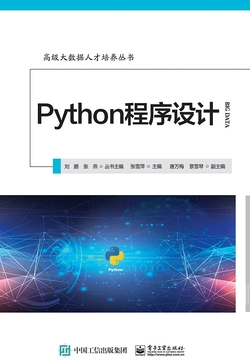
Python Programming
Tags
Summary
Editor's review
Who it's for
A good fit for
- Lower-year students in computer-related majors at colleges and universities
- Complete beginners who want to learn Python programming systematically
- Self-learners who need a clearly structured, carefully explained textbook
- Hobbyists interested in programming who want to learn basic Python syntax
Not a good fit for
- Developers with extensive programming experience seeking advanced Python techniques or in-depth application in specific domains
- Readers who want to quickly master a specialized Python library (such as NumPy or Django) for project development
Reading tips
- Read in chapter order and practice every code example in the book
- Use an online programming environment or a locally installed Python interpreter to practice alongside the text and deepen understanding
- After the basic chapters, try using the knowledge to solve simple real-world problems to consolidate learning
About the publisher
Chongqing University Press is a comprehensive university press whose publishing areas span social and cultural studies, industrial technology, finance and economics, medicine, social psychology, and theory. Judging from its catalog, the press publishes both academic works and popular science titles. Representative books include E. H. Gombrich's Shadows: The Depiction of Cast Shadows in Western Art, Magnesium-Based Hydrogen Storage Materials by Pan Fusheng et al., Research on China's Regional Spatial Development Models by Sun Jiuwen, and titles from the Gynecologic Oncology Committee of the Chinese Anti-Cancer Association, such as the Guidelines for Diagnosis and Treatment of Common Gynecologic Malignancies in China (2019) and Bipolar Disorder: What You and Your Family Need to Know. Its authors work in art history, materials science, regional economics, clinical medicine, and social research methods. Public information is limited, but its publishing profile combines academic translation, industrial technology, and practical medical guides.
Contents
- 版权信息
- 第1章 程序设计与算法
- 1.1 程序设计的基本概念
- 1.2 程序设计语言
- 1.3 算法的基本概念
- 1.4 程序设计的基本过程
- 第2章 初识Python
- 2.1 Python概述
- 2.2 Python开发环境
- 第3章 Python语言基础
- 3.1 Python的数据类型
- 3.2 Python的常量、变量
- 3.3 Python的运算符和表达式
- 3.4 Python的内置函数与模块
- 第4章 程序流程控制
- 4.1 Python的编程风格
- 4.2 顺序结构
- 4.3 分支结构
- 4.4 循环结构
- 4.5 循环控制语句
- 4.6 典型案例
- 第5章 Python的组合数据结构
- 5.1 序列的概念和基本操作
- 5.2 字符串
- 5.3 列表
- 5.4 元组
- 5.5 字典
- 5.6 集合
- 5.7 可变序列的copy
- 5.8 典型案例
- 第6章 函数
- 6.1 函数的定义和调用
- 6.2 函数参数的类型
- 6.3 变量的作用域
- 6.4 匿名函数
- 第7章 面向对象程序设计
- 7.1 面向对象的几个概念
- 7.2 类和对象
- 7.3 成员属性
- 7.4 成员方法
- 7.5 继承和多态
- 第8章 文件操作
- 8.1 文件的基本概念
- 8.2 文件读写
- 8.3 其他文件操作
- 第9章 正则表达式
- 9.1 正则表达式的概念
- 9.2 正则表达式模块(re)
- 9.3 正则表达式详解
- 9.4 综合案例
- 第10章 Python与网络爬虫
- 10.1 网络爬虫概述
- 10.2 相关基础知识
- 10.3 相关库介绍
- 10.4 综合案例
- 第11章 数据分析与绘图基础
- 11.1 数据分析基础
- 11.2 Numpy数值运算基础
- 11.3 pandas数据分析基础
- 11.4 Matplotlib绘图基础
- 参考文献
FAQ
Does this book use Python 2 or Python 3?
Does the book include project practice or comprehensive cases?
What level can I reach after finishing this book?
Related on WeRead



Comments
Find this book
This site is an index: you start “Search all sources” in your browser, and the entries it lists all point to third-party sites; please judge their availability yourself.
About the author
Kong Lingxin is an author of computer books about whom limited public information is available. Four works can currently be confirmed, mainly aimed at university-level basic computer education and introductory Python programming. Representative works include Python Programming and Python Programming Practice; the former focuses on syntax and programming thinking, while the latter provides practice to help readers apply what they have learned. The other two, University Computer Basics Tutorial and University Computer Basics Practice Tutorial, cover fundamental computer knowledge and hands-on exercises, reflecting an approach that combines theory with practice. His writing centers on programming instruction and university computer basics, often pairing a tutorial with companion practice material and emphasizing learning paths for beginners. As details such as education, positions, and awards are unconfirmed, they are not included here; readers may turn to the works above to understand his writing style.
Liu Zhendong is an author about whom little public information is available; his nationality, dates of birth and death, and educational background cannot be confirmed. Judging from the four works held in the collection, his writing spans programming design and medicine, reflecting a fairly broad technical range. Python Programming and Python Programming Practice form a pair, one focusing on language fundamentals and the other on hands-on exercises, suitable for university courses or self-study. University Computer Basics targets general computer education and stays close to classroom needs. The remaining work, on wavelength-switching technology in high-performance liquid chromatography for quality evaluation of traditional Chinese medicine, reflects his professional grounding in analytical chemistry and quality control. Overall, his works are mainly textbooks and research-based titles, emphasizing practicality and applicability for teaching and professional practice.
Ma Yajun is a Chinese author of programming books, though publicly available information about him remains limited. His confirmed works are concentrated on teaching the Python language. Two of his books are included in the collection: Python Programming and Python Programming Practice. Both are commonly classified under programming design. The first focuses on explaining language fundamentals and program design concepts, while the second is practice-oriented and complements the first by reinforcing hands-on skills. Judging from the titles and classification, his writing is aimed at beginners and readers who need systematic training in programming, emphasizing the transition from syntax basics to practical coding, with both conceptual explanations and exercises. Overall, Ma Yajun has published only a small number of works, yet within the niche of introductory Python textbooks they form a coordinated pairing that offers readers a relatively coherent learning path.
