

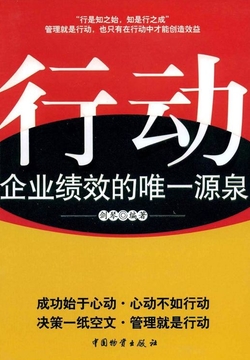
Action: The Only Source of Corporate Performance
Tags
Summary
Indeed, no grassroots practical awareness, only arbitrary decision-making; no concrete action, only personality cult and grandstanding; no market research, only seeking quick success and投机取巧... This is the true portrait of countless Chinese entrepreneurs. Let us look at those successful enterprises and entrepreneurs with outstanding performance and steady development, such as Lenovo Group (Liu Chuanzhi) and Haier Group (Zhang Ruimin). They are all down-to-earth, following the laws of business practice step by step, treating "running a business" as "doing a job," and conducting themselves solidly—that is how they achieved truly long-term, sustained development!
Editor's review
From a professional perspective, the book's value lies in its clear practice orientation. It does not remain at the level of abstract management theory but delves into the micro-mechanisms of organizational behavior, exploring how to stimulate the willingness and ability to act in individuals and teams. Especially noteworthy is that the author's understanding of "performance" goes beyond traditional financial indicators to include long-term capabilities such as organizational learning and adaptive innovation, which gives the book continued relevance in a rapidly changing business environment. However, some views in the book inherit from classic management literature, and its originality lies mainly in integration and contextualized application. Overall, this is a pragmatic read suitable for managers when driving specific change or improving operational efficiency; its thinking frameworks and tools can help readers examine and strengthen their organization's action system.
Who it's for
A good fit for
- Middle and junior managers committed to improving team execution and implementation capability
- Business leaders or entrepreneurs seeking to translate strategic plans into concrete action plans
- HR or management consulting practitioners interested in organizational behavior and performance management who hope for practical insights
- Business school students or workplace newcomers who, while learning management knowledge, want to understand how theory connects to real practice
Not a good fit for
- Pure theoretical researchers expecting cutting-edge academic discussion or deep philosophical speculation
- Those looking for simple, quick solutions that can be applied immediately without complex adjustment to their own context
Reading tips
- Read in connection with a specific project at work or in your management practice, thinking about the application scenarios of the book's views and tools as you go
- Focus on the chapters on "resistance to action" and "feedback loops," which are especially key to diagnosing organizational problems
- After reading, try designing a small "action improvement experiment" for your team or department to deepen understanding through practice
About the publisher
Founded in 1981, China Fortune Press is known for publishing books and textbooks on logistics, supply chains, and economic management; publicly available information indicates it was later renamed China Fortune Press (Chinese: Zhongguo Caifu Chubanshe). This site carries 49 titles from the publisher, covering tourism, inspirational growth, management, social culture, military affairs, fashion, and more. These include social and cultural titles such as Niu Xiaoyan's Chinese Urban Character, inspirational books on dealing with people and life such as Applying the Philosophy of Thick Black Theory, Hu Xueyan's Wisdom in Conduct and Business, and Scheming Is Needed in Doing Things, and management works such as Jack Welch's 11 Guidelines for Young Managers, Action: The Only Source of Corporate Performance, and Chinese Management Philosophy. The Strategies in the I Ching combines traditional culture with strategic thinking. Overall, while maintaining its core focus on economics and management, the publisher also offers accessible general-interest titles, with authors including Li Zongwu, Lü Shuchun, Luo Xianying, Sima Yunfei, Tian Youshen, Liu Yang, and Jian Qin.
Contents
- 版权信息
- 书本介绍
- 前言
- 第一章 行动是实现决策的惟一途径
- 引子
- 决策能力源于市场调查
- 李泽楷的“行动原则”
- 正确决策+立即行动=成功
- 行动缓慢带来的损失
- “知而不行”自寻死路
- 经验主义:企业经营的大忌
- 决策一定,立即行动
- 第二章 管理就是行动
- 引子
- OEC管理的启示:管理在于行动
- 转悠管理:解决问题的快捷方法
- 不可重视纸上谈兵的“人才”
- 重“用”而不重“视”
- 只重真才实干,不重学历经验
- 知人善任要落实在行动上
- 授权:调动员工积极性的秘诀
- 激励要体现在实际行动中
- 以行动来留住人才
- 信任不能只停留在口头上
- 建立行之有效的薪酬制度
- 不怕有问题,就怕不沟通
- 缺乏执行,制度只是一纸空文
- 第三章 把握商机:心动不如行动
- 引子
- 机遇垂青有准备者
- 主动与商机握手
- 认识机遇,利用机遇
- 用行动把握机遇
- 抓住万分之一的机会
- 抢占先机:狭路相逢勇者胜
- 没有风险,就没有利润
- 财富来源于开拓
- 当心“以不变应万变”的陷阱
- 行动是创新的前提
- 用行动证明实力
- 第四章 员工培训:学习能力比知识更重要
- 引子
- 知识也会过期作废
- 用行动打造学习型团队
- 学习是企业发展的强大动力
- “充电”不是搞形式主义
- 将企业办成“人才加工厂”
- 全力打造企业文化
- 建立合理的才智结构
- 员工要按需培训
- 让员工在学习中成长
- 用行动为员工树立榜样
- 学习能力比知识更重要
- 第五章 用行动化解危机
- 引子
- 仅有危机意识是不够的
- 危机管理从一点一滴做起
- 处理危机,刻不容缓
- 在竞争中强化核心能力
- “华为的冬天”:向员工敲响警钟
- 创新消灭危机
- 及时变革:预防危机的保障
- 主动出击,化“危”为“机”
- 向困境发起挑战
- 战胜危机的先决条件:直面危机
- “诚惶诚恐才能生存”
- 时刻走在别人前面
- 从危机中看出变革的信号
- 第六章 求真务实:消费者需要真诚服务
- 引子
- 先打造质量,再谈服务
- 光说不练,必败无疑
- 质量是企业的生命
- 千方百计满足消费者的需求
- 服务不是华丽的广告,而是朴实的行动
- “零缺陷”不能只挂在嘴上
- 以顾客为中心
- 求真务实:切忌隐瞒欺骗消费者
- “顾客是上帝”,不只是口号
- 服务比产品更重要
- 消费者需要真诚的服务
- 服务创造价值
- 服务决定成败
- 以信誉和质量赢得顾客
FAQ
How do the main ideas of this book differ from bestselling management books such as Execution?
Are the methods in the book applicable to nonprofit organizations or government departments?
Is the book difficult for readers with little management experience?
Related on WeRead

Comments
Find this book
This site is an index: you start “Search all sources” in your browser, and the entries it lists all point to third-party sites; please judge their availability yourself.
About the author
Jian Qin is a Chinese author whose writing centers on personal growth and business management. Public information about the author is limited, and details such as real name, nationality, and dates of birth and death are not clearly documented. Ten of the author's works are currently included in the collection, falling roughly into two categories. The first addresses personal development and attitudes toward wealth for general readers, such as Workplace Matters and Becoming Rich: 48 Gaps Between the Poor and the Rich, written in accessible language close to everyday office and daily life. The second focuses on corporate management and business cases, including 42 Golden Rules Managers Must Know, Action: The Only Source of Corporate Performance, Business Lessons, and Business Soul, which draw on distilled principles and the successes and failures of well-known Chinese and foreign companies to summarize management lessons and winning experience. The writing emphasizes practicality and applicability, often presenting ideas in a structured, point-by-point manner, and is suited to professionals and managers seeking reference and insight.
