

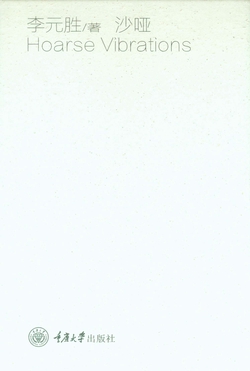
Hoarse
Tags
Summary
Editor's review
Who it's for
A good fit for
- Readers who love modern poetry, especially those seeking texture of language and depth of thought
- Readers in midlife with lived reflections on time, memory, and existence
- Those interested in nature writing and ecological writing who hope for a distinctive angle of observation from poetry
- Fans of Li Yuansheng's poetry who want a systematic view of his 2005–2015 work
Not a good fit for
- Readers seeking light entertainment or strongly narrative stories
- Readers with little interest in more introspective, quiet poetry
Reading tips
- Read slowly in a relatively quiet, undisturbed setting, savoring the rhythm of language and density of imagery
- Pair it with Li Yuansheng's ecological photography for a richer intertextual experience
- Don't aim to finish in one sitting; keep it at hand and dip into a few poems at a time to better feel its contemplative character
About the publisher
Chongqing University Press is a comprehensive university press whose publishing areas span social and cultural studies, industrial technology, finance and economics, medicine, social psychology, and theory. Judging from its catalog, the press publishes both academic works and popular science titles. Representative books include E. H. Gombrich's Shadows: The Depiction of Cast Shadows in Western Art, Magnesium-Based Hydrogen Storage Materials by Pan Fusheng et al., Research on China's Regional Spatial Development Models by Sun Jiuwen, and titles from the Gynecologic Oncology Committee of the Chinese Anti-Cancer Association, such as the Guidelines for Diagnosis and Treatment of Common Gynecologic Malignancies in China (2019) and Bipolar Disorder: What You and Your Family Need to Know. Its authors work in art history, materials science, regional economics, clinical medicine, and social research methods. Public information is limited, but its publishing profile combines academic translation, industrial technology, and practical medical guides.
Contents
- 版权信息
- 序
- 命有繁花
- 你错过的全在这里
- 自述
- 山中
- 对湖
- 环湖记
- 水榭小驻
- 尘土与锦绣
- 我与湖
- 给
- 略有悔
- 磨坊
- 傍晚之拾
- 园丁笔记
- 颂诗
- 削
- 一个人清早读满页注释
- 撤退
- 我与汉语
- 谈话
- 如果
- 微粒之心
- 夜读
- 蜀葵
- 命有繁花
- 若有所得
- 镂空之湖
- 傍晚的剧场
- 终生误
- 忘机之年
- 南山
- 不在场的我
- 有业
- 缺口
- 病房
- 吊罗山记
- 恩宠
- 早起何为
- 秋风里的刻度
- 李花落
- 过张北镇
- 铜铃山半日
- 给
- 良宵引
- 自度曲
- 春风浩荡
- 十年间
- 安居城小坐,兼寄柏铭久兄
- 蒲团
- 古城遇雨
- 过何斯路村
- 题古香樟
- 还山
- 沉默的钟
- 北屏即兴
- 写字
- 半山小驻
- 蝴蝶
- 无尽夏
- 梅岭闻二胡曲
- 有风
- 题新田村古榕树
- 玛曲
- 倒提壶
- 巴山夜曲
- 极北之地
- 稠李
- 谈禅之夜
- 法王寺之晨
- 当我放下笔
- 东风令
- 北屏乡安乐村遇雨
- 九重山
- 沙哑
- 黄河边
- 飞云口偶得
- 南湖感怀
- 范仲淹的岳阳楼
- 君山行
- 濑溪河畔有所得:题夏布小镇
- 嵩山之巅
- 笔架山前想起杜甫
- 给
- 容器
- 暴雨如注
- 天色将晚
- 形同虚设
- 川续断
- 无花果
- 西樵山上小坐
- 庆云寺
- 菡萏
- 木叶
- 黑丽翅蜻
- 赤基色蟌
- 忆西湖
- 蒙顶山下饮茶记
- 龙潭湖的傍晚
- 望乡台瀑布
- 无限事
- 北山夜游
- 一个生病的人解放了自己
- 丽江
- 菩提树
- 偶遇
- 塞罕坝
- 七星湖
- 巫山红叶颂
- 窦圌山顶
- 衣冠冢
- 给
- 李元胜诗歌创作年表(诗集22部)
- 李元胜诗集
FAQ
How does the style of Hoarse differ from Li Yuansheng's earlier work?
Is this book suitable for readers new to poetry?
Are there especially famous or widely circulated pieces in the collection?
Related on WeRead

Comments
Find this book
This site is an index: you start “Search all sources” in your browser, and the entries it lists all point to third-party sites; please judge their availability yourself.
About the author
Li Yuansheng is a Chinese author whose work spans modern poetry and nature-travel writing, with six titles held in the collection. Based on the available information alone, public material on his nationality, dates of birth and death, education, and awards is limited, so a detailed account of his life is difficult to provide. His writing broadly follows two threads: modern poetry, represented by works such as Hoarse, The Uncertain Me, and The Time Difference Between Me and All Things, which uses restrained language to explore the subtle distance between the self, time, and the world; and nature-travel writing, represented by Tropical Rainforest Butterfly-Watching and The Poetics of the Wilderness: Li Yuansheng's Natural History Travel Notes, which blends natural observation with personal reflection. Other works, such as Crossing My Own Seabed, further reflect his continued writing of inner experience, with an overall style that combines poetic sensibility and care for nature.
