

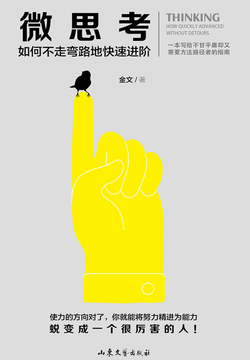
Micro-Thinking
Tags
Summary
Editor's review
Who it's for
A good fit for
- Workplace professionals who feel overwhelmed by daily information and find it difficult to concentrate on thinking for long periods
- Managers and professionals who hope to improve work efficiency and optimize decision quality
- University students or self-learners interested in thinking methods and seeking practical introductory reading
- People working in fields such as creative work and planning that require continuously generating new ideas
Not a good fit for
- Academic researchers seeking rigorous philosophical speculation or advanced cognitive science theory
- Readers expecting immediate, one-move-winning "quick thinking secrets"
Reading tips
- It is recommended to treat this book as a set of thinking exercises; there is no need to finish it in one sitting, and one may try practicing the specific methods during fragmented time such as commuting or lunch breaks.
- Keep a pen and paper or an electronic notebook while reading to record inspirations triggered at any time or reflections on one's own thinking habits.
- Combining the exercises in the book, choose one or two specific problems that have recently troubled you and try to break them down and analyze them using the "micro-thinking" path.
About the publisher
Shandong Publishing House of Literature and Art is a professional publisher focused on literature and art, with publications spanning foreign literature, classical literature, Western philosophy, and social sciences. Judging from the books in the database, it offers foreign classics such as The Brothers Karamazov, The Count of Monte Cristo, and Resurrection, classical Chinese literature including Dream of the Red Chamber: Complete in 2 Volumes, and Japanese literary works by Yasunari Kawabata such as Snow Country, The Old Capital, and Thousand Cranes. Its translator resources include Geng Jizhi and Zhou Kexi, while its author resources cover Chinese and foreign masters such as Cao Xueqin, Dostoevsky, Dumas, and Leo Tolstoy. In terms of publishing features, the house emphasizes the translation and popularization of classic works, balancing academic value and readability. Public information is limited; the above introduction is based mainly on the publishing directions reflected in the books in the database.
Contents
- 版权信息
- Chapter 1 平庸的秘密:为什么有的人始终不能成功
- 都在低头蛮干,你要抬头看看时机
- 别把机遇当垃圾,习惯性扔掉
- 你那么努力,奈何成就不了伟业
- 拿掉盖子之后
- 最大的风险就是不冒任何风险
- 那些你想象中的椅子
- 搞不清这件事,很难立足职场
- 给瑞典国王建一座凯旋门
- 花一分钟试一试,可能会少走一大圈路
- Chapter 2 思维里的墙:被堵住的不是出路,是思路
- 打开思路,才能撬动更大可能
- 善于联想,以“活”取胜
- 苹果里有一颗星星,但大多数人都不知道
- 准备颠覆你的思维吧!
- 如何拆掉趋合心理这堵墙
- 如何从损失之痛中抽身
- 不是方法的方法,有奇效
- 保持清醒,趋利避害
- 后发制人,更以实力制人
- 答案往往不止一个
- Chapter 3 精进:成为杰出人物的路线图
- 不曾为梦想努力,就别说梦想没用
- 第一阶段:思考目标
- 第二阶段:变得认真
- 你所走过的路,每一步都算数
- 第三阶段:全力投入
- 第四阶段:校正方向
- 别用“志气”包装你的“意气”
- Chapter 4 即刻行动——改变一切的核心力量
- 有时候,你得逼自己一把
- 即刻行动
- 光说不练的人都是“山炮”
- 机会给成功者,等待给庸人
- 怕什么,去经历再说
- 关键是要说出来,而不是等时机
- 跨越穷人的围墙
- 比别人快一步,是你必学的技能
- Chapter 5 所谓技巧,就是战术上能拼,战略上够活
- 努力发现优势,比埋头苦干更易成功
- 揣在兜里的剪子
- 缺什么,补什么
- 方向不对,越努力越失败
- 给良好的撤退颁奖
- 聪明人的成功之路一定是弯的
- 树挪死,人挪活
- 省略过程也就省略了精彩
- Chapter 6 选择比努力重要,少走弯路才是最快的捷径
- 今天的生活来自昔日的选择
- 面临重大选择时,学会倾听自己的声音
- 做出选择,任何时候都不晚
- 生活的悲剧是在错的地方找东西
- 学会选择,懂得放弃
- 我们都活在风险之中,你往哪里逃?
- 把控你的机会成本
- 做好人生的第一次选择
- Chapter 7 没成功的人,都少结交了一位朋友
- 不会合作,到了出口也出不去
- 越成功的人越变着花样寻求合作
- 借鸡生蛋,空手套白狼
- 凭自己能力赚钱是“本事”,善借他人力量赚钱是“艺术”
- 不懂诀窍,如何让生意来找你
- 做朋友不做敌人
- 如果不能战胜对手,就加入他们之中
- 以付出换回报,这就是公平的生活
- 如何争,要根据长远利益而定
- Chapter 8 离开舒适区,用高效方法迅速成长
- 成绩是做出来的,而不是“跳”出来的
- 主动深入下去,成功没那么难
- 对不起,你不配让机会等你
- 坚持这件小事最能成就大梦想
- 最短的路走起来最快吗?
- 不会分配注意力,就别想提高效率
- 如何做到高效能,而不是瞎忙
- 最直接的往往最有效
- Chapter 9 别说自己压力大,你只是心太窄了
- 你是如何把生活过成一条夹缝的?
- 困难那么大,多亏了你的畏惧心理
- 瓶子里的囚徒
- 把无奈带着上路,而不是跟它死磕
- 咖啡的启示
- 生活不会妥协,你要去适应它
- 不要总把负担背在身上
- 原则守不住?因为你不会妥协
- 野心是最猛的特效药
FAQ
How is this book different from classics such as Thinking, Fast and Slow?
Are the methods in the book really effective?
Is this book suitable as team reading or training material?
Related on WeRead

Comments
Find this book
This site is an index: you start “Search all sources” in your browser, and the entries it lists all point to third-party sites; please judge their availability yourself.
About the author
Public information about Jin Wen is limited; his nationality, dates of birth and death, and educational background are not clearly documented. Judging from the twenty-three works held in the collection, his writing spans several fields. There are biographies built around the arc of a life, such as Sanmao: Wandering Is the Best Healing, as well as practical books on communication and psychology, including Insight, Say It to the Point, and How Can You Do Sales If You Can't Talk. Harvard Financial Intelligence and Sell Anything to Anyone lean toward business and management, while The Power of Inner Calm: Reading Zen with Nan Huaijin touches on Zen and spiritual cultivation. He also contributed to Yunjin, a volume in the Little Books, Great Heritage general-reader series on China's intangible cultural heritage, showing an interest in traditional culture. Overall, his writing is plain and accessible, emphasizing readability and practicality for general readers, and his works commonly fall into categories such as biography, inspirational growth, management, culture, and social psychology.
