

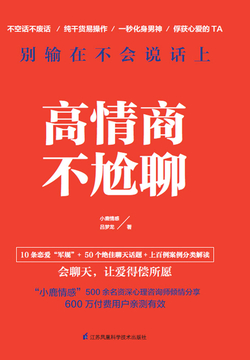
Awkward Chat
Tags
Summary
Editor's review
Who it's for
A good fit for
- People with social anxiety or poor verbal skills who want to improve their communication
- Workplace newcomers or professionals who need to socialize frequently
- Learners interested in the psychology of interpersonal communication
- Parents and partners who want to understand the communication patterns of their children or partners
Not a good fit for
- People looking for quick-fix scripts or expecting to solve all communication problems immediately
- Readers lacking patience for theoretical analysis and case discussions
Reading tips
- Start with Chapter 2, "The Psychological Mechanisms of Awkwardness," to build a basic cognitive framework
- Use the "self-observation notes" at the end of each chapter to record your practice
- Focus on the case chapters most relevant to your own situation, such as those on the workplace or family
About the publisher
Tianjin People's Publishing House publishes across such fields as classic works, foreign literature, architecture, social culture and social sciences, with 749 relevant titles in the collection. In the areas of classics and scholarship, works such as Wang Guowei's Renjian Cihua and Fei Xiaotong's From the Soil and Fertility and Reproduction reflect a sustained attention to social culture and classic texts of thought. Architectural books are represented by Liang Sicheng's Annotated Yingzao Fashi and A History of Chinese Architecture, showing an emphasis on architectural heritage and building traditions. In foreign literature, translations of Sholokhov's And Quiet Flows the Don and Tolstoy's War and Peace and The Death of Ivan Ilyich, through the work of translators such as Li Gang and Yu Dawei, form a substantial series of translated works. Overall, the press combines classic texts, scholarly works and fine translations, with a publishing character oriented toward humanistic depth and the dissemination of knowledge.
Contents
- 版权信息
- 前言
- PART 1 尴尬了!为什么你总把熟人聊成陌生人
- 说话专打脸,再好的朋友也凉凉
- 说话不避讳,等于是在触霉头
- 说话爱揭短,谁都会翻脸
- 随意泄露隐私,必将友情杀死
- 你以为是精明,其实是冥顽不灵
- 措辞不匹配,好心也成驴肝肺
- 别人谈话你插话,别人当你搅屎棍
- 满嘴粗俗口头禅,比蝉还要惹人烦
- 说大话乱许诺,做不到就成了罪过
- 乱嚼舌根,人人躲你如躲瘟神
- PART 2 说话不走心,你就是拿自己的前途当赌注
- 不懂沟通,你就没有前途
- 这些年,你就倒霉在不会说话上
- 没有表达力,就没有竞争力
- 社交时代,不会说话谁给你交际红利
- 你的人生高度,取决于你说话时的风度
- 不注重自我表达,机遇落在别人家
- PART 3 一开口就犯忌,难怪领导没有办法喜欢你
- 默默无声,怎么能晋升?
- 说话没分寸,职场没身份
- 承接任务不干脆,前途荒废
- 不尊重领导,受冷遇没跑
- 和领导唱反调,谁难受谁知道
- 满嘴跑火车,职场必翻车
- 和领导谈道理,你在拿魏徵自比?
- 对领导无保留,小心头破血流
- 事事都应承,领导未必领你情
- 直击领导的错,没有好日子过
- PART 4 世上最遥远的距离,是面对面却无话可说
- 沟通障碍是一种什么体验?
- 怯场是种病,得上真要命
- 曾经的擦肩而过,都是害羞的罪过
- 一见异性就害怕,场面别提多尴尬
- 没人排除你,是你排斥你自己
- 克服恐惧心理,你也能成演讲家
- 想想可能的甜头,还有什么理由不开口
- 别紧张,交谈才能受伤
- PART 5 如何聊天才能暖人心,怎样说话永远不冷场
- 友善的态度,交流的支柱
- 先给一个笑,为聊天定下好基调
- 只要你想说,话题永远不缺
- 把气氛带起来,让聊天可爱起来
- 他喜欢听什么,你就说什么
- “扯闲篇”,也要扯得头头是道
- 会套近乎,感情才热乎
- 让他感到,你对他很感兴趣
- 用关怀的话,将对方的心软化
- PART 6 让人心里受用,所有距离都将变成没有距离
- 不会人情话,人缘必然差
- 用点小聪明,赢得好感并不难
- 多说讨好话,没有谁拿不下
- 说奉承话,没有什么可耻的
- 发自内心、一本正经地恭维
- 赞美别太直白,会点别出心裁
- 赞美走了样,尴尬没商量
- 他说一个错,你认两个错
- PART 7 一本正经使人噤若寒蝉,幽默聊天助你左右逢源
- 超强个人魅力,幽默不能缺席
- 幽默一下,聊天从此不尴尬
- “九幽真经”,助你炼成幽默达人
- 幽默以对,啥场合都不犯怵
- 出糗不可怕,只要大家开心就好
- 尴尬瞬间,幽之一默转危为安
- 话中有话,将交谈引向喜剧化
- PART 8 有些话不好明说,那就换个套路策略性地说
- 说话有弹性,才不会落诟病
- 你懂得装傻,你就并不傻了
- 含含糊糊,进退有度前后有路
- 不便说的话,顾左右而言他
- 把词锋隐遁,从反处说起
- 未必据理力争,有时无声胜有声
- 不懂拒绝,你有收拾不完的烂摊子
- 技术性批评,不尴尬,很融洽
- PART 9 高情商说服,说对话就没有要不到的糖吃
- 摸透人心,才能给人“洗脑”
- 你的说服像命令,他会拒绝被说服
- 多说肯定话,说服效果不会差
- 用饱含情感的话,激发心的共鸣
- 巧从兴趣入手,用细节将人打动
- 让他觉得,这是自己的想法
- 求人办事,看清情况再说话
- “如果我是你”——说服的金句
- 以激代说,让他主动钻进“圈套”
- “死缠烂打”,精诚所至,金石为开
FAQ
How is this book different from ordinary communication-skills books?
Do the methods in the book require long-term practice?
Is it suitable for teenagers?
Related on WeRead




Comments
Find this book
This site is an index: you start “Search all sources” in your browser, and the entries it lists all point to third-party sites; please judge their availability yourself.
About the author
Cai Wangang, a native of Xuzhou, Jiangsu, holds doctorates in management and economics and is a national second-level psychological counselor. He is currently an associate professor at East China Normal University and vice dean of its Xin Hu Shang Development Research Institute, and also serves as a distinguished professor at the City University of Macau and Nanjing Normal University. His long-term research covers entrepreneurial management, enterprise competitiveness, and leadership. His writing spans philosophy, inspirational personal growth, and popular history. His works include philosophical books on Wang Yangming's thought and the unity of knowledge and action, growth psychology courses and public-speaking guides for general readers, and accessible interpretations of Tang dynasty society and daily life in ancient times, combining scholarly substance with readability. Public information is limited, but his seventeen works in the library show a consistent ability to translate professional reflection into approachable prose across multiple subject areas.
