

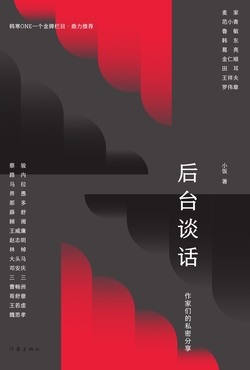
Backstage Talks
Tags
Summary
Editor's review
Who it's for
A good fit for
- Readers curious about the process of literary creation
- Literature lovers who want to understand the real living conditions of contemporary writers
- Writers seeking creative inspiration or facing creative blocks
- Readers who enjoy intellectual dialogue and in-depth interviews
Not a good fit for
- Readers expecting traditional fiction narratives or complete stories
- Pragmatists hoping for a quick guide to writing techniques
Reading tips
- Read this book alongside Xiaofan's fiction to appreciate the resonance between "frontstage" and "backstage"
- No need to read linearly; dip into conversations on different topics according to interest
- Use the literary views in the book to reflect on your own reception and understanding of contemporary literature
About the publisher
Writers Publishing House is a Chinese publisher focused mainly on literary publishing. Its output covers classical literature, foreign literature, folk literature and Eastern philosophy, with some extension into popular reading such as social fiction and parenting books. Its catalogue contains more than 900 titles, including representative works such as Dream of the Red Chamber and its edited editions, Shakespeare's Macbeth and A Midsummer Night's Dream, and foreign literary classics such as The Brothers Karamazov and Lost Illusions. In terms of authors, it includes classical writers such as Cao Xueqin and Gao E, foreign masters such as William Shakespeare, Dostoevsky and Balzac, and translations by translators such as Zhu Shenghao, Geng Jizhi and Fu Lei. Overall, its publishing profile balances Chinese and foreign literary classics, emphasizes quality translations, and serves both academic and general readers; publicly available information on its specific publishing plans is limited.
Contents
- 版权信息
- 作者简介
- 序 产生连接
- 麦家:你可以想象一个严肃的人在家中
- 范小青:仍然被“命运”追得屁滚尿流
- 鲁敏:我一直对时间深信不疑,也深表怀疑
- 韩东:宁愿打人一拳也不要骂人一句
- 葛亮:家国情怀见乎君子之道,也可见乎烟火日常
- 金仁顺:作家就是忍不住要说话的那些人
- 田耳:相对于无意义,我对有意义更为谨慎
- 王祥夫:文学是精神上的大汗淋漓
- 罗伟章:作家行使着对时间的权利
- 蔡骏:作家之间最好不要抱团
- 路内:更庞大的事物会修正人们对文学的认知
- 马拉:这世界上的任何一条狗都有可能登上月球
- 畀愚:深入往往就是迷失的开始
- 那多:怪物终于出现了,你的恐惧也就过去了
- 薛舒:不能让角色思考,而要让读者思考
- 顾湘:令我感到痛苦的是浪费时间
- 王威廉:一切历史都是未来史
- 赵志明:连着几天不做梦,我心里就会有点不踏实
- 林棹:穿过困境写作,或在写作中穿过困境
- 大头马:我有另一个身份——侦探
- 邓安庆:觉得这事儿好玩儿就成了
- 三三:此刻我是一块巨大而柔软的海绵
- 曹畅洲:小说家写作,只是让堕落更缓慢一点
- 哥舒意:只有偏执狂才能获得最后的胜利
- 王若虚:放屁亦有学问
- 魏思孝:文学没有过时,也没有时髦过
FAQ
Is this book fiction or prose?
Can I understand this book without having read Xiaofan's fiction?
What exactly does "backstage" refer to in the book?
Related on WeRead
 后台谈话
 《纵横》30年典藏:全52册
 潮水涌起之前
 近代侠义英雄传
 茵梦湖:施托姆抒情小说选(译文经典)
 《纵横》杂志(全国政协综合性文史期刊,记录建国前后的大事、发表各界人士回忆录):1993~2002共102期
Comments
Find this book
This site is an index: you start “Search all sources” in your browser, and the entries it lists all point to third-party sites; please judge their availability yourself.
About the author
Xiao Fan is an author about whom limited public information is available. The library currently holds only one work by this author, titled Backstage Talk. Judging from the existing category, the book falls under literary appreciation, suggesting that the author's writing focuses on reading, evaluating, and observing literary works from a backstage perspective. The word "backstage" in the title implies that the author may be concerned with the scene of creation, the stories behind texts, or another side of literary activity, rather than merely offering surface-level appreciation of works. Since no clear records exist regarding birth and death dates, nationality, education, or professional experience, this profile makes no speculation on those points. Based on the available clues, Xiao Fan's writing is mainly manifested in discussing and appreciating literary topics, with a style that may lean toward essay-like narration and personal interpretation. For readers interested in behind-the-scenes literary topics, Backstage Talk offers an accessible point of entry, though the author's overall creative trajectory and literary standing await more public material to be presented.
