

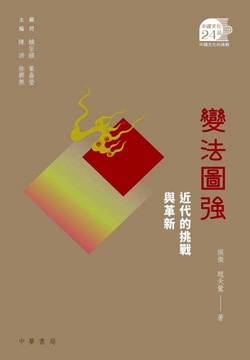
Reform for Strength
Tags
Summary
Editor's review
Who it's for
A good fit for
- Readers with a strong interest in modern Chinese history, especially late Qing reform
- Readers who enjoy tracing intellectual currents and the drivers of social change within historical narratives
- Readers seeking to deepen their understanding of reform, innovation, and institutional change through historical cases
- Readers looking for a well-grounded, balanced history that combines depth with readability
Not a good fit for
- Readers seeking light entertainment or purely narrative historical fiction
- Readers expecting a highly specialized, detail-driven academic monograph
Reading tips
- Read through the book first to grasp the overall arc, then closely read and reflect on chapters of particular interest (such as the 'Petition of the Examination Candidates' and the 'Hundred Days' Reform')
- Use maps or chronological tables as aids while reading to visualize the spatial and temporal connections between events
- After reading, try comparing the historical logic in the book with phenomena in contemporary society; you may find new insights
About the publisher
Founded in 1982, Modern Press is a Chinese publisher that serves general readers across a diverse range of subjects. Judging from its catalog, its publishing focuses on classical poetry, Eastern philosophy, psychological research and application, popular science, and modern poetry, along with history, biography, and children's books. The Book of Songs, the illustrated vernacular edition of the Classic of Mountains and Seas, The Complete Poems of Dai Wangshu, and Buddhism in the Vegetable Roots reflect efforts to make traditional culture and poetry accessible; works by Carl Gustav Jung such as The Development of Personality and Understanding Your Psychological Type, together with titles from the Ivy International Education Alliance, show sustained attention to psychology and educational reading; and Stephen Hawking's works and the illustrated two-volume Brief History of Everything and A Brief History of Time indicate a commitment to popular science. Its authors include figures such as Qu Wanli, Xu Ke, Dai Wangshu, and Jung, and its publishing emphasizes retelling classics and accessible, illustrated presentation. Because public information is limited, this summary is based only on the titles in our catalog.
Contents
- 版权信息
- 序言
- 上古时期——革故鼎新
- 齐国管仲改革
- 郑国子产改革
- 魏国李悝变法
- 楚国吴起变法
- 韩国申不害变法
- 赵武灵王改革
- 秦国商鞅变法
- 中古时期——与民更始
- 北魏孝文帝改革
- 北周武帝改革
- 唐代永贞革新
- 近古时期——推行新政
- 后周世宗改革
- 北宋庆历新政
- 北宋王安石变法
- 金朝金世宗改革
- 元代忽必烈改制
- 近世时期——矫国更俗
- 明代张居正改革
- 清代洋务运动
- 清代戊戌变法
FAQ
Is the book's historical perspective conservative or radical?
Does the book cover so many figures and events that it is hard to read?
Is this book suitable as an introductory read on modern reform?
Related on WeRead




Comments
Find this book
This site is an index: you start “Search all sources” in your browser, and the entries it lists all point to third-party sites; please judge their availability yourself.
About the author
Xiao Dongfa (1949–2016), whose ancestral home was Tianjin and who was born in Shenyang, was a professor and doctoral supervisor at the School of Journalism and Communication, Peking University, and director of its Institute of Modern Publishing. An important scholar in editing and publishing studies, he focused on the history of Chinese books, publishing history, and yearbook studies. He edited the History of Chinese Editing and Publishing and Chinese Libraries of Book Collecting, and led the National Social Science Fund key project A General History of Chinese Publishing, laying a solid foundation for the organization and narration of Chinese publishing history. Beyond academic writing, he attended to Peking University's institutional history and humanistic traditions, writing works such as Character: From the Imperial University to Old Peking University, Exemplars: Former Residences and Anecdotes of Peking University Notables, and Scenes: Yanyuan Landscapes and Cultural Heritage, which recount campus memories and personal stories with warmth. His works also touch on the four treasures of the study, garden architecture, and academic writing standards. Some 491 of his titles are held in the library, spanning language and culture, biography, and architecture, and combining scholarly rigor with accessible readability.
Du Youlong is an author about whom limited public information is available; his biography, nationality, and dates of birth and death remain unclear. Judging from the 18 works included in the library, he is an author concerned with traditional Chinese culture and historical themes. Representative works include Ancient Music's Enduring Fragrance, Classics of Ancient Drama, Folk Entertainment, The Peaceful Prosperous Age, Splendor of Chinese Painting, and Reform for Strength, covering fields such as music, opera, folk customs, painting, and historical change. His works commonly appear in categories such as culture, art, historical reading, and inspirational growth, with writing that emphasizes informative overview and accessible expression for general readers interested in traditional culture. Given the lack of direct information about the author, his creative direction can only be inferred from these subjects, and a full assessment of his personal experience and academic background is not yet possible.
