

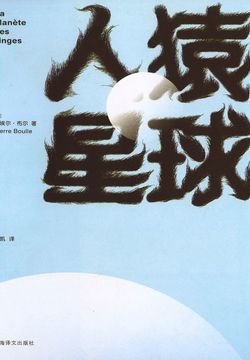
Planet of the Apes
Tags
Summary
Editor's review
This edition from Shanghai Translation Publishing House offers a precise and fluent translation that fully preserves the novel's cold, satirical narrative style. As a winner of the Prix Goncourt, Pierre Boulle demonstrates his full literary power here—he is not writing an adventure story about the future but conducting a philosophical experiment about what it means to be human. The protagonist Ulysses's space voyage is only the surface; at its core is a shocking journey of cognitive upheaval. When readers follow the protagonist in discovering that the relics of human civilization have been distorted by ape scholars, that sense of absurdity and fear is precisely the most biting satire of anthropocentrism.
The value of reading this book lies in its multiple layers of interpretation: it can be enjoyed as a tightly plotted soft science fiction adventure, or mined for its critique of social Darwinism and scientific ethics. The questions it raises—Is civilization defined by intelligence? Who holds the power to narrate history?—are all the more relevant in today's age of algorithmic recommendation and information cocoons. This is not a light or pleasant book, but the intellectual excitement it generates lasts far longer than mere entertainment.
Who it's for
A good fit for
- Readers interested in classic science fiction combined with philosophical speculation
- Deep readers who look for social metaphor and civilizational critique within a story
- Thinkers skeptical of anthropocentrism and open to having their assumptions challenged
- Readers who appreciate a cold, satirical literary style and are not satisfied with surface-level plot
Not a good fit for
- Readers seeking pure entertainment through light, fast-paced adventure stories
- Readers unable to accept the core premise of human civilization being thoroughly overturned and debased
Reading tips
- While reading, try setting aside the assumption of human supremacy and imagine yourself in the perspective of an ape scholar, experiencing the process of having your worldview overturned.
- Pay attention to the book's depictions of scientific authority and historical narrative, and reflect on the relationship between knowledge and power.
- After finishing the novel, compare it with the 1968 film and later series adaptations, and consider how different media interpret and emphasize the same core ideas differently.
About the publisher
Shanghai Translation Publishing House is a Chinese publisher oriented mainly toward translation and publishing. Its publications cover foreign literature, world classics and classic works, as well as social culture, folk literature and classical poetry. The database contains 2,618 titles, including Never Let Me Go, Les Misérables (2 volumes), Don Quixote (illustrated collector's edition), The Complete Comedies of Molière (4 volumes), The Complete Novels of Kafka (3 volumes), The Collected Works of Dostoevsky (9-volume set), Reason and Persons, and Oedipus Rex (Translation Classics). Its author resources include foreign writers such as Kazuo Ishiguro, Victor Hugo, Cervantes and Molière, as well as translators such as Zheng Kelu, Sun Jiameng, Li Jianwu and Zhang Kun. The publisher has brands such as "Translation Classics Selections" and "Translation Documentary," and emphasizes translated works in foreign literature and the humanities and social sciences, while also publishing bilingual dictionaries and foreign-language educational books. Public information is limited; the above is based on the book information in the database.
Contents
- 版权信息
- 第一部
- 第一章
- 第二章
- 第三章
- 第四章
- 第五章
- 第六章
- 第七章
- 第八章
- 第九章
- 第十章
- 第十一章
- 第十二章
- 第十三章
- 第十四章
- 第十五章
- 第十六章
- 第十七章
- 第二部
- 第一章
- 第二章
- 第三章
- 第四章
- 第五章
- 第六章
- 第七章
- 第八章
- 第九章
- 第三部
- 第一章
- 第二章
- 第三章
- 第四章
- 第五章
- 第六章
- 第七章
- 第八章
- 第九章
- 第十章
- 第十一章
- 第十二章
FAQ
What is the relationship between this book and the famous Planet of the Apes film series?
What is the writing style of this book? Is it difficult to read?
Does this novel from the 1960s still hold meaning for today's readers?
Related on WeRead



Comments
Find this book
This site is an index: you start “Search all sources” in your browser, and the entries it lists all point to third-party sites; please judge their availability yourself.
About the author
Pierre Boulle was a French writer best known for two widely read novels that differ greatly in subject: The Bridge on the River Kwai and Planet of the Apes. The former is set against war and focuses on human situations and choices in extreme circumstances; the latter uses a science-fiction premise to explore questions about society and human nature. The two works are classified respectively under foreign literature and science fiction, and both were adapted into films, extending their influence to a broader readership and audience. Public information about his life is limited: his nationality, dates of birth and death, and educational background are not reliably recorded in the available material, so no inferences are made here. Judging only from the two representative works in the collection, Boulle's writing spans war narrative and science-fiction fable, showing a wide range of subjects, and his works often use concrete plots to carry observations about people and society, which is one reason he continues to be read by Chinese readers.
Sun Kai is an author about whom limited public information is available. Four works appear under this name, spanning a fairly wide range of subjects, including science fiction, language learning, popular science, and management. Representative titles include Planet of the Apes, the beginner-oriented 1453 Rapid French, the teaching text College Physics Experiments (English Course), and a study of economic and trade issues titled Research on the Transformation and Upgrading of China's Foreign Trade. This list suggests that Sun Kai does not confine his writing to a single genre: he moves between science-fiction translation or creation, language study, physics laboratory teaching, and foreign-trade research, showing an orientation that is cross-disciplinary and combines knowledge popularization with professional application. Because details such as dates of birth and death, nationality, and educational background are unavailable, a full picture of his personal history and overall body of work remains difficult to outline; readers may instead turn to the works themselves to understand his areas of interest and manner of expression.
