

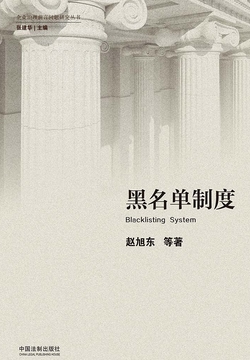
The Blacklist System
Tags
Summary
Editor's review
Who it's for
A good fit for
- Researchers and students interested in contemporary Chinese law and public policy, especially the construction of the social credit system
- Practitioners engaged in market regulation, financial risk control, integrity system development and related fields
- Observers seeking to understand the logic and transformation of China's social governance from an institutional perspective
- Upper-level undergraduates and graduate students in law, public administration, sociology and related disciplines, as supplementary reading
Not a good fit for
- Readers seeking only light entertainment or fiction
- Pragmatists expecting a simple "how-to guide" or "loophole guide"; the book focuses on theoretical and institutional analysis
Reading tips
- Read the preface and first chapter first to grasp the book's core questions and theoretical framework, then choose specific field chapters for deeper reading according to interest
- While reading, compare the discussion with recent news reports or policy documents that mention cases such as "persons subject to enforcement for dishonesty" and "key regulatory lists"
- Readers unfamiliar with legal terminology or institutional background may consult basic law or administrative law textbooks to better understand some professional discussions
About the publisher
China Legal Publishing House is a legal publisher overseen and sponsored by the Ministry of Justice, with the publication of standard texts of national laws and regulations as an important focus; its catalogue already contains 2,972 titles. Its publications cover fields such as criminal law, civil law, contract law, company law, real estate law and the security system, including article-by-article commentaries such as the Interpretation of the Contract Part of the Civil Code of the People's Republic of China, adjudication rules and case compilations oriented toward judicial practice such as Understanding and Applying Adjudication Rules in Contract Disputes and A Compendium of Court Views on Real Estate Cases, as well as legal classics such as On Crimes and Punishments and academic works such as The Theory of Procedural Sanctions. In terms of author resources, the publisher brings together classic legal authors such as Cesare Beccaria, scholars and practitioners such as Liu Junhai, Long Weiqiu and Zhu Shuying, and cooperates with institutions including the National Judges College and the Judicial Case Research Institute of the Supreme People's Court. Its publishing character lies in linking legal texts, scholarly interpretation and judicial application, balancing authoritative norms with practical guidance.
Contents
- 版权信息
- 前言
- 第一章 黑名单制度概述
- 一、黑名单的制度起源
- 二、境外国家黑名单制度的主要立法例
- 三、我国目前实践中的黑名单制度
- 四、黑名单概念的界定
- 五、黑名单的法律性质
- 六、黑名单制度的法律依据
- 七、黑名单的类型
- 八、黑名单制度与其他相关制度的关系
- 九、黑名单制度理论和立法研究的意义和作用
- 十、小结
- 第二章 黑名单制度的作用与意义
- 一、社会信用体系建设与黑名单制度
- 二、黑名单制度与行政监管形式创新
- 三、黑名单制度是交易安全的重要条件和保障
- 第三章 我国黑名单制度的发展、现状及问题
- 一、我国黑名单制度的发展脉络
- 二、我国黑名单制度的发展现状
- 三、我国黑名单制度存在的问题
- 第四章 境外黑名单制度的实践与经验
- 第一节 境外制度概况
- 第二节 境外具体立法实践与制度经验
- 第三节 结论
- 第五章 黑名单制度的立法目标与基本原则
- 一、黑名单制度的立法目标
- 二、黑名单制度立法的基本原则
- 第六章 我国黑名单的制度设计与立法建议
- 第一节 黑名单的管理体制
- 第二节 黑名单的设定制度
- 第三节 黑名单的列入条件
- 第四节 黑名单的列入程序
- 第五节 黑名单的分级制度
- 第六节 黑名单的公示方式和公示内容
- 第七节 黑名单的公示期限
- 第八节 黑名单的移出制度
- 第九节 黑名单历史信息查询制度
- 第十节 黑名单的法律效力和法律后果
- 第十一节 信息交换共享机制与失信联合惩戒机制
- 第十二节 黑名单的异议与救济
- 附件:黑名单制度文件选辑
- 一、国务院相关文件
- 二、部门黑名单规定
- 三、地方黑名单规定
- 四、境外黑名单规定
FAQ
Is this book mainly about the "list of persons subject to enforcement for dishonesty"?
Does the book support or criticize the blacklisting system?
How difficult is the book? Does it require a strong professional background?
Related on WeRead


Comments
Find this book
This site is an index: you start “Search all sources” in your browser, and the entries it lists all point to third-party sites; please judge their availability yourself.
About the author
Public information about Zhao Xudong is limited, and the available details are not enough to give a full picture of his life and background. The sixteen works held in the collection, however, show that his writing and editing span culture, medicine, social science, applied psychology, and law, suggesting a broad intellectual range. Representative works include The Gift, Guanxi, and the State: Constructing Chinese Interpersonal Relations and Subjectivity; Power and Its Disguises (new edition); Between the Native and the Foreign: The Self, Culture, and the Other in Anthropological Research; Psychosomatic Medicine; Psychotherapy; China's Tax Legal System; China's Foreign Trade Legal System; and A Comprehensive Guide to the Application of Law under the Belt and Road Initiative. His works range from theoretical discussions in anthropology and sociology to practical medical and legal readers, covering a wide range of subjects with clear problem awareness. They are suitable for readers interested in interpersonal relations, cultural comparison, and institutional practice.
