

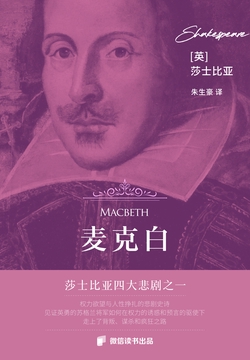
Macbeth
Tags
Summary
Editor's review
Who it's for
A good fit for
- Literature lovers interested in reading Shakespeare's tragedies
- University students of literature or foreign languages who need to study dramatic texts
- Creators engaged in theatrical adaptation or stage production
- Readers who wish to reflect on power and desire through classic works
Not a good fit for
- Readers who prefer light reading or are sensitive to tragic atmosphere
- Younger readers lacking experience with drama who want a plot summary
- Readers who only want a quick grasp of the plot and are unwilling to read the dialogue closely
Reading tips
- Read through once to clarify the characters and plot, then return to the key soliloquies of Macbeth and his wife
- While reading, note the recurring witches' prophecies and the imagery of darkness and blood, which link the characters' psychological changes
- You may watch a stage production or filmed adaptation alongside the text to help reconstruct the scenes and the characters' tones
- After finishing, trace the several turning points in Macbeth's path from loyal subject to tyrant, and consider the motive behind each choice
About the publisher
Jinzhang Book Company (Jinzhang Shuju) was a private publishing and distribution house in Shanghai during the late Qing and early Republican periods, issuing traditional works by lithographic printing. Judging from the 1,194 titles in the collection, its publishing focused on classical poetry, Eastern philosophy, historical reading, traditional Chinese medical texts, and canonical works, along with books on literary appreciation. Representative titles include the poetry and prose collections of Du Fu and Ouyang Xiu; historical works such as the Book of Han and Zizhi Tongjian; classical texts such as the Book of Documents and Mencius; and specialized and literary classics such as Treatise on Cold Damage and Li Sao. Its author resources cover major figures across the ages, including Du Fu, Ban Gu, Sima Guang, Zhang Zhongjing, Qu Yuan, Ouyang Xiu, and Tang Shenwei, reflecting the house's characteristic reliance on traditional scholarship and medical literature while serving general readers. Public information on its early history and operational details is limited, so no conjecture is offered here.
Contents
- 版权信息
- 剧中人物
- 地点
- 第一幕
- 第一场 荒原
- 第二场 福累斯附近的营地
- 第三场 荒原
- 第四场 福累斯。宫中一室
- 第五场 殷佛纳斯。麦克白的城堡
- 第六场 同前。城堡之前
- 第七场 同前。堡中一室
- 第二幕
- 第一场 殷佛纳斯。堡中庭院
- 第二场 同前
- 第三场 同前
- 第四场 同前。城堡外
- 第三幕
- 第一场 福累斯。宫中一室
- 第二场 同前。宫中另一室
- 第三场 同前。苑囿,有一路通王宫
- 第四场 同前。宫中大厅
- 第五场 荒原
- 第六场 福累斯。宫中一室
- 第四幕
- 第一场 山洞。中置沸釜
- 第二场 费辅。麦克德夫城堡
- 第三场 英格兰。王宫前
- 第五幕
- 第一场 邓西嫩。城堡中一室
- 第二场 邓西嫩附近乡野
- 第三场 邓西嫩。城堡中一室
- 第四场 勃南森林附近的乡野
- 第五场 邓西嫩。城堡内
- 第六场 同前。城堡前平原
- 第七场 同前。平原上的另一部分
FAQ
Can I read Macbeth directly without having read other works by Shakespeare?
What role do the witches' prophecies play in the drama?
Why is Lady Macbeth's character noteworthy?
Related on WeRead



Comments
Find this book
This site is an index: you start “Search all sources” in your browser, and the entries it lists all point to third-party sites; please judge their availability yourself.
About the author
William Shakespeare (1564–1616) was an English playwright, poet, and actor of the Renaissance. Born in Stratford, he is widely regarded as the greatest writer in the English language. His representative works include Hamlet, Othello, Macbeth, A Midsummer Night's Dream, Antony and Cleopatra, and his sonnets. His plays span tragedy, comedy, and history, with vividly drawn characters and a poetic, rhetorically charged style that probes human nature and power with particular depth. Translated into many languages and performed worldwide, his works have had a profound influence. This site holds 187 of his works, including English-Chinese bilingual editions for comparative reading.
