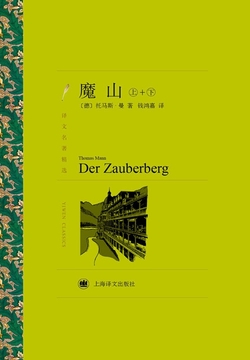
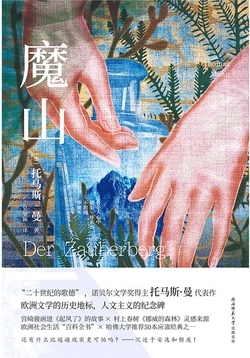
The Magic Mountain cover

The Magic Mountain

Rating 4.3
Word count
648K words
Chapters
61
ISBN
9787532741786

Tags

Summary

Young student Hans arrives at a mountain sanatorium for tuberculosis to visit his cousin Joachim, only to find he too has contracted the disease and must stay for treatment. The sanatorium's residents come from every corner of the world, with sharply different temperaments and beliefs. Hans is an idealistic young man, but after mingling with these people his thoughts grow confused and his spirits sink; the Russian woman Clavdia Chauchat bewitches him even more. He forgets his career and responsibilities; the mountain becomes a "magic mountain" in which he is hopelessly mired. Seven years pass in a flash: his cousin dies, Clavdia leaves, and the friends he was close to scatter to the four winds. Life shatters his illusions one by one, leaving him in pain and loneliness. The guns of a world war jolt him awake; looking back, Hans feels he has slept for seven years on the "magic mountain," and he resolutely sets out for the front.

Editor's review

The Magic Mountain is one of the masterpieces of Thomas Mann, the great German writer. Published in 1924, this novel is not only a milestone in his own career but also a profound "novel of its time" in twentieth-century German literature and world literature. Set in a mountain sanatorium in Davos, Switzerland, the story follows the seven-year stay of the young engineer Hans Castorp. On the surface, it is a work about illness, convalescence and time; in reality, it constructs an elaborate allegorical world that distills the spiritual climate and intellectual conflicts of European society before the First World War. With his characteristic delicacy, intricate speculation and profound symbolism, Thomas Mann explores a series of ultimate questions: life and death, time and eternity, reason and passion, health and disease, progress and decadence. The characters—Settembrini, who champions reason and humanism; Naphta, who represents irrationalism and nihilism; and Madame Chauchat, full of vital instinct and temptation—each embody contending currents of thought in Europe at the time. Reading The Magic Mountain is an intellectual challenge requiring patience: its pace is slow and its argumentation dense, and readers must immerse themselves in it, following the protagonist through spiritual confusion, exploration and growth. For readers who wish to appreciate the intellectual depth of German literature, explore the origins of Europe's crisis of modernity, or experience a distinctive "sense of time," this work offers an unparalleled reading experience. This edition from Shanghai Translation Publishing House, with its classic translation, is a reliable way for Chinese readers to encounter this monumental work.

Who it's for

A good fit for

  • Readers interested in early 20th-century European intellectual history and cultural atmosphere
  • Lovers of serious literature who appreciate grand structures and philosophical speculation
  • Readers eager to deepen their understanding of Thomas Mann's literary world and creative vision
  • Patient readers who can savor a slow narrative pace and relish details and symbols

Not a good fit for

  • Readers seeking fast-paced plots and intense dramatic conflict
  • Readers impatient with lengthy philosophical discussions and inner monologues

Reading tips

  1. Set aside uninterrupted reading time to accommodate its distinctive narrative rhythm and intellectual density.
  2. A basic familiarity with pre-WWI European history and schools of thought will help you understand the characters' debates.
  3. Don't try to grasp every metaphor in one reading; treat it as a spiritual journey and focus on the perceptions and changes of the protagonist, Hans Castorp.

About the publisher

Shanghai Translation Publishing House China · Founded in 1978

Shanghai Translation Publishing House is a Chinese publisher oriented mainly toward translation and publishing. Its publications cover foreign literature, world classics and classic works, as well as social culture, folk literature and classical poetry. The database contains 2,618 titles, including Never Let Me Go, Les Misérables (2 volumes), Don Quixote (illustrated collector's edition), The Complete Comedies of Molière (4 volumes), The Complete Novels of Kafka (3 volumes), The Collected Works of Dostoevsky (9-volume set), Reason and Persons, and Oedipus Rex (Translation Classics). Its author resources include foreign writers such as Kazuo Ishiguro, Victor Hugo, Cervantes and Molière, as well as translators such as Zheng Kelu, Sun Jiameng, Li Jianwu and Zhang Kun. The publisher has brands such as "Translation Classics Selections" and "Translation Documentary," and emphasizes translated works in foreign literature and the humanities and social sciences, while also publishing bilingual dictionaries and foreign-language educational books. Public information is limited; the above is based on the book information in the database.

Contents

  1. 版权信息
  2. 译本序
  3. 前言
  4. 第一章
  5. 到达
  6. 三十四号房间
  7. 在餐厅里
  8. 第二章
  9. 关于洗礼盆和两重性格的祖父
  10. 在蒂恩纳佩尔家以及汉斯·卡斯托尔普的品德
  11. 第三章
  12. 庄重与阴郁
  13. 早餐
  14. 取笑。旅行用品。欢乐的情绪受挫。
  15. 魔鬼
  16. 思想的磨炼
  17. 多余的话
  18. 当然,是一个女人!
  19. 阿尔宾先生
  20. 魔鬼提出不光彩的建议
  21. 第四章
  22. 必要的购买
  23. 关于时间感受的一些题外话
  24. 他试图讲法语
  25. 政治上可疑!
  26. 希佩
  27. 分析
  28. 怀疑和推测
  29. 餐桌上的谈话
  30. 恐惧情绪在增长。关于两个祖父和黄昏的舟游。
  31. 温度表
  32. 第五章
  33. 永恒的汤汁和豁然开朗
  34. 天哪,我看到了!
  35. 自由
  36. 水银的情绪
  37. 百科全书
  38. 人文方面的学识
  39. 探索
  40. 死神的舞蹈
  41. 瓦尔普吉斯之夜
  42. 第六章
  43. 变化
  44. 又来了一个人
  45. 关于神的国家和邪恶的释出
  46. 暴怒以及更令人难堪的事
  47. 进攻被击退
  48. 精神的修炼
  49. 雪
  50. 英勇的战士
  51. 第七章
  52. 海滩上的漫步
  53. 明希尔·皮佩尔科尔恩
  54. “二十一”点
  55. 明希尔·皮佩尔科尔恩(续)
  56. 明希尔·皮佩尔科尔恩(完)
  57. 麻木不仁
  58. 清音妙曲
  59. 极其可疑的问题
  60. 高度神经质
  61. 晴天霹雳

FAQ

Is The Magic Mountain a novel about a tuberculosis sanatorium?
The sanatorium is the concrete setting of the story, but the novel's core goes far beyond that. It is more a laboratory of ideas and a microcosm of an era, with illness and cure serving as vehicles and metaphors for exploring larger themes such as life, time, and civilization.
Why is The Magic Mountain called a "novel of its time"?
Through the ensemble of characters and clash of ideas in a closed space, Thomas Mann precisely captures and presents the intellectual state of pre-WWI Europe. Various currents of thought—Enlightenment rationality, Romanticism, nihilism, and others—collide here, foreshadowing the crisis and collapse of the old world.
What preparation is needed to read this novel?
The most important preparation is mental: accept its slow, meticulous, even somewhat lengthy narrative style. This is a reading journey that demands time and thought, not mere entertainment. Some familiarity with the German literary tradition or Western philosophy helps but is not essential.

Related on WeRead

Comments

Find this book

This site is an index: you start “Search all sources” in your browser, and the entries it lists all point to third-party sites; please judge their availability yourself.

About the author

Thomas Mann Author · German · 1875–1955

Thomas Mann (1875–1955) was a German novelist and essayist and a leading figure of twentieth-century German realist literature. He won the Nobel Prize in Literature in 1929 for Buddenbrooks, and his other major works include The Magic Mountain, Death in Venice, and Doctor Faustus. His writing probes the tensions between the artist and society and between reason and decadence, in a style both disciplined and deeply reflective. During his exile he firmly opposed the Nazis, and his stance and creative work together shaped the intellectual image of modern German literature. The library holds 21 of his works, spanning foreign literature, essays and miscellaneous writings, and social novels.

More by the same author

Top rated in the same category