

Waves of Revolution
Tags
Summary
Editor's review
The book's unique value lies in its cross-civilizational comparative perspective. The author attends not only to modern Western revolutions but also turns his gaze to transformative movements in Asia, Latin America, and other regions, exploring the localization and transformation of revolutionary ideas under different cultural backgrounds. This global-historical view enables readers to transcend regional limitations and understand both the universal significance and the particular forms of revolution as a key driver of modernity. The use of historical sources is rigorous yet vivid, supported by solid archival documents and skillfully interspersed with personal narratives such as diaries and letters, making the historical scene tangible and immediate.
For contemporary readers, Revolutionary Tide offers an important reference for reflecting on the origins of modern politics. In an age when globalization faces challenges and the issue of social change has once again come to the fore, the book's dialectical thinking on revolution and reform, ideal and reality, order and change is especially worth savoring. Beneath Professor Guo Fang's calm, restrained tone lies a deep respect for historical complexity—an attitude toward history that is itself a necessary corrective to oversimplified historical narratives.
The reading experience is like a meticulous intellectual expedition, requiring readers to have some historical knowledge and patience for critical thinking. Those expecting light stories or single conclusions may find it challenging, but for readers willing to delve into the texture of history and probe the nature of change, it is undoubtedly a rich intellectual feast.
Who it's for
A good fit for
- History enthusiasts interested in modern world history and political change
- Researchers and university faculty and students in the social sciences
- Reflective readers who enjoy in-depth analysis of the mechanisms of social change
- Knowledgeable readers who wish to understand the historical roots of contemporary international politics
Not a good fit for
- Readers seeking light, entertaining reading
- Readers with no interest whatsoever in historical and political topics
Reading tips
- It is recommended to read the introduction first to grasp the overall framework, then choose chapters of interest for deeper reading
- While reading, consult maps and timelines to aid understanding of temporal and spatial context
- Take notes on key concepts and figures to help grasp complex historical connections
About the publisher
Jilin Publishing Group Co., Ltd. focuses on fine fiction, social sciences, literary appreciation, history, classical poetry and classical literature, with 1,141 titles in the library. Representative books include Dan Simmons's science fiction novels Hyperion and The Fall of Hyperion, Freud's works on psychology and society such as The Ego and the Id and Group Psychology, and classical literature ranging from Laozi and Zhuangzi, Romance of the Three Kingdoms and Three Hundred Poems of the Tang, Song and Yuan Dynasties to Lü Simian's A General History of China. Its authors include Dan Simmons, Freud, Laozi, Lü Simian, Hengtang Tuishi, Pan Zhenhua, Li Yi and Guan Shanming, reflecting a balance between translated works and domestic editions. Public information is limited; the above is based on the library's holdings.
Contents
- 前言
- Chapter 1 世纪初的欧亚(1)
- Chapter 1 世纪初的欧亚(2)
- Chapter 1 世纪初的欧亚(3)
- Chapter 1 世纪初的欧亚(4)
- Chapter 2 觉醒与争雄(1)
- Chapter 2 觉醒与争雄(2)
- Chapter 2 觉醒与争雄(3)
- Chapter 2 觉醒与争雄(4)
- Chapter 3 革命风云(1)
- Chapter 3 革命风云(2)
- Chapter 3 革命风云(3)
- Chapter 3 革命风云(4)
FAQ
What distinguishes this book from similar historical works?
How much historical background is needed to understand it?
What is the book's political stance?
Related on WeRead
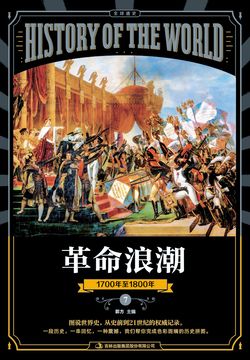 图说天下·全球通史系列革命浪潮
 车到山前:全球产业变革与日本汽车的未来(方寸)【“CASE革命”浪潮下,谁能领跑行业,谁又会固步自封?】
 跨越发展:全球新工业革命浪潮下中国制造业发展之路
 傻钱:社交浪潮与散户革命
 智能化浪潮:正在爆发的第四次工业革命
Comments
Find this book
This site is an index: you start “Search all sources” in your browser, and the entries it lists all point to third-party sites; please judge their availability yourself.
About the author
Guo Fang, born in 1948 and a native of Beijing, is a research fellow and doctoral supervisor at the Institute of World History, Chinese Academy of Social Sciences, and formerly vice chairman of the Chinese Society for the Study of Ancient and Medieval World History. He has long been engaged in research on and translation of world history, especially European history. His works concentrate on social and cultural history and world history, addressing themes such as the transition from antiquity to feudalism, turning points in European history, and the rise of great powers, while also attending to the overall course of human civilization. Besides monographs including The Formation of the Modern English State and Ancient Democracy and Republican Institutions, he has translated The Modern World-System and A History of Europe, and contributed to the compilation of A Global History and A Visible World History. His works in the library number 26. Public information on his personal career is limited, and this profile relies only on confirmed library data.
