

The Huo Guang Dynasty
Tags
Summary
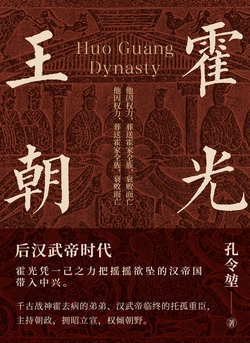
It analyzes how, in the post-Emperor Wu era, when the Han Empire was in decline, Huo Guang single-handedly steered the tottering empire toward revival.
Yet it was precisely in this process that Huo Guang, because of his own limitations, planted the seeds of his own downfall, so that the entire Huo family perished alongside the Han Empire's revival.
Do not the lessons of Huo Guang's success and failure serve as a warning to later generations?
Editor's review
Who it's for
A good fit for
- Readers interested in mid-to-late Western Han politics and the question of powerful officials
- Readers who want to understand the full arc of Huo Guang's regency and the rise and fall of the Huo clan
- General readers who enjoy drawing lessons from the successes and failures of historical figures
- Advanced readers who have read general histories of the Western Han and wish to go deeper into a particular period
Not a good fit for
- Readers expecting a complete life of Huo Guang, including details of his childhood and early years
- Readers who want only a general overview of Han history and do not wish to go deep into a single period
- Readers who prefer pure textual and historical scholarship and do not accept narrative analysis
Reading tips
- Begin with the basic background of the accession of Emperor Zhao and Emperor Xuan, then enter the narrative of Huo Guang's regency.
- As you read, keep Huo Guang's political measures and the fate of the Huo family separate, the better to see the logic of success and failure.
- Read alongside the Western Han volume of Zan Han: Four Hundred Years of the Han Dynasty (Part One) to fill in the background of the era.
- After finishing, revisit the author's summary of Huo Guang's limitations and reflect on the structural problems of the politics of powerful officials.
About the publisher
Tianjin Boji Xinmei Technology Co., Ltd. is a publisher focused mainly on literature and general reading. Public information about the company is limited, but its catalog of nearly one thousand titles indicates publishing directions that include mystery and detective fiction, foreign literature, classic works, health, and Eastern philosophy. Representative publications include The Complete Dark Stories of Edgar Allan Poe, the works of Jo Nesbø, Nobel laureates John Steinbeck and Yasunari Kawabata, the collected works of Shi Tiesheng, and the healing books of neurologist Oliver Sacks. Its author resources combine foreign classics such as Poe, Steinbeck, and Kawabata with contemporary mystery writers like Nesbø, supported by translators including Cao Minglun and Lin Liren, reflecting a publishing profile that balances retranslated classics with genre reading.
Contents
- 版权信息
- 第一节 没有汉武帝的时代反而更好?
- 第二节 来分蛋糕的人
- 第三节 真假太子
- 第四节 盐铁之议背后的故事
- 第五节 反霍联盟
- 第六节 走进新时代
- 第七节 污王的谍战故事
- 第八节 辽东往事
- 第九节 有刺客!
- 第十节 尴尬的挑战
- 第十一节 论昌邑王登基的必然性
- 第十二节 刘贺作恶千条的秘密
- 第十三节 我犯了什么罪?
- 第十四节 我们从不曾离开
- 第十五节 长安爱情故事
- 第十六节 霍光是怎么腐败的
- 第十七节 不怕被利用,就怕你没用
- 第十八节 五个人散步的故事
- 第十九节 汉宣帝的暗战
- 第二十节 霍光的谢幕
FAQ
What period does this book cover?
Why is the book titled The Huo Guang Dynasty?
Do I need to read a general history of the Han dynasty first?
Related on WeRead
Comments
Find this book
This site is an index: you start “Search all sources” in your browser, and the entries it lists all point to third-party sites; please judge their availability yourself.
About the author
Kong Lingkun is a Chinese author who writes mainly on historical subjects. Public information about him is limited, and reliable details of his life have yet to appear. Five of his works are currently held in the collection, the best known being the six-volume The Pinnacle of Power: Four Hundred Years of the Han Dynasty. His other titles include The Huo Guang Dynasty, Ten Figures Who Shaped the Fate of the Qing Empire, Empress Lü vs. Wu Zetian: Women at the Apex of Imperial Power (two volumes), and The Uncrowned Empress. These works show a focus on the workings of political power from the Han through the Qing, especially the relationships among imperial authority, the court, and powerful ministers, as well as the theme of female rulers. His books are commonly classified as history and biography, with one also placed in the alternate-world genre, suggesting that he ventures beyond popular history into fiction. Overall, his historical writing emphasizes characters and power structures and is aimed at general readers.
