

Snow Country
Tags
Summary
Editor's review
From a professional literary perspective, the book's core value lies in its pioneering "Shinkankaku-ha" (New Sensationist) technique. Kawabata abandoned conventional plot-driven narrative in favor of capturing fleeting sensations and impressions, fusing his characters' subtle moods with the natural scenery of the snow country. The famous opening line—"The train came out of the long tunnel into the snow country"—works like a film shot, instantly drawing the reader into a sealed-off, pure, cold world of beauty. This technique of building narrative space from sensation and imagery has had a profound influence on later literature.
The main thread is the restrained, understated emotional entanglement among Shimamura, the geisha Komako, and the young girl Yoko, but the plot itself is not the point. What Kawabata truly strives to depict is the play of light and shadow that feeling produces in an extreme environment, the contrast between life's ardor (Komako) and its illusion (Yoko), both finally dissolving into the vast void of the snow country. This pursuit of the aesthetics of mono no aware and yugen means that each reading may yield a different layer of feeling—it can be a love story, a meditation on life, or purely a sensory aesthetic experience.
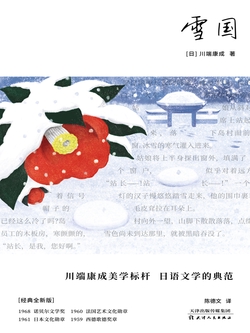
This edition from Tianjin People's Publishing House offers a fluent, expressive translation that preserves much of the original's understated, cool tone and rhythm, making it a reliable choice for appreciating the essence of Kawabata's art. For the reader, Snow Country is less a read than a discipline of immersion. It offers no thrill of triumph or revenge; instead it invites you, in quiet hours, to savor the snowflakes, mirror reflections, and dusk lights that seem almost to congeal in the prose, and finally to feel a deep lament—rooted in the marrow of Eastern culture—for fleeting beauty and the futility of life.
Who it's for
A good fit for
- Readers interested in exploring Japanese literature and aesthetics, such as mono no aware and yūgen
- Literary enthusiasts who prefer introspection and emphasize atmosphere and linguistic beauty over intense plot
- Readers who wish to read a Nobel Prize–winning classic and deepen their literary appreciation
- Readers seeking a tranquil refuge in words amid the clamor of daily life
Not a good fit for
- Readers who want strong plotting, a fast pace, and a clear resolution
- Readers impatient with extensive environmental description and psychological portrayal
Reading tips
- Read in a quiet, undisturbed setting so you can better immerse yourself in the atmosphere the text creates.
- Pay attention to recurring images such as "snow," "mirror," "lamplight," and "the Milky Way," and reflect on their symbolic meanings.
- Don't rush; savor the book in sections, and even reread certain passages to feel the subtle flow of language and emotion.
About the publisher
Tianjin People's Publishing House publishes across such fields as classic works, foreign literature, architecture, social culture and social sciences, with 749 relevant titles in the collection. In the areas of classics and scholarship, works such as Wang Guowei's Renjian Cihua and Fei Xiaotong's From the Soil and Fertility and Reproduction reflect a sustained attention to social culture and classic texts of thought. Architectural books are represented by Liang Sicheng's Annotated Yingzao Fashi and A History of Chinese Architecture, showing an emphasis on architectural heritage and building traditions. In foreign literature, translations of Sholokhov's And Quiet Flows the Don and Tolstoy's War and Peace and The Death of Ivan Ilyich, through the work of translators such as Li Gang and Yu Dawei, form a substantial series of translated works. Overall, the press combines classic texts, scholarly works and fine translations, with a publishing character oriented toward humanistic depth and the dissemination of knowledge.
Contents
- 版权信息
- 雪国
- 一
- 二
- 三
- 四
- 五
- 六
- 七
- 八
- 九
- 十
- 十一
- 附录一
- 1968年度 川端康成荣获诺贝尔文学奖授奖式欢迎辞
- 附录二
- 1961年度诺贝尔文学奖推荐川端康成
- 附录三
- 川端康成年谱
- 《雪国》译后记
FAQ
The story of Snow Country is hard to understand—what is it actually about?
Why is Snow Country regarded as a model of Japanese aesthetics?
The plot feels very faint when reading—how can I better appreciate this work?
Related on WeRead
Comments
Find this book
This site is an index: you start “Search all sources” in your browser, and the entries it lists all point to third-party sites; please judge their availability yourself.
About the author
Kawabata Yasunari (1899–1972) was a Japanese novelist and a leading figure of the New Sensationist school, born in Osaka. A prolific writer, he is represented on this site by 147 works, spanning essays and miscellaneous prose as well as foreign literature. His representative works include The Izu Dancer, Snow Country, Thousand Cranes, and The Old Capital; Snow Country in particular exists in multiple editions and translations, a sign of its wide circulation. Kawabata is known for his delicate prose, which interweaves human emotion with natural scenery to express the spiritual character of the Japanese people, and often conveys a sense of the beauty of impermanence in life and death. In 1968 he received the Nobel Prize in Literature, an important landmark in the global recognition of Japanese literature; he died in 1972. Beyond his novels, his essays and miscellaneous writings also deserve attention.
Chen Dewen is a Chinese translator known chiefly for rendering Japanese literature into Chinese, though his personal details are limited: his birth year, native place and educational background are not clearly documented. Judging from the sixty-eight titles held in the collection, his work centers on introducing foreign literature and classic works, with representative translations including Yukio Mishima's Spring Snow, The Decay of the Angel, Runaway Horses and Forbidden Colors in the Zitu Classic Library series, as well as Kawabata Yasunari's Snow Country and The Old Capital. These translations mainly serve Chinese readers of modern and contemporary Japanese fiction, focusing on major works by writers of high literary standing. Available materials do not systematically record his translation style or views on translation, and the repeated appearance of Snow Country may reflect different editions or reprints, a point that requires further verification. Overall, Chen Dewen's translations offer Chinese-language readers a readable channel into classic Japanese literature.
