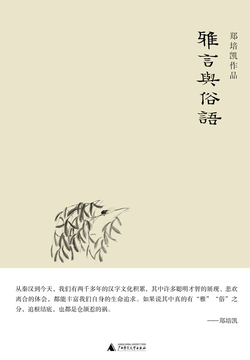
Refined Words cover

Refined Words

Rating 4.0
Word count
53K words
Chapters
1

Tags

Summary

Traditional Chinese thought and culture have a long history and are highly original, inventive, and literary. Early forms of thought are distinctive, covering religion and theology, traditional Chinese medical classics, ancient military strategy, Confucianism, Daoism, Buddhism and the Hundred Schools, feng shui and metaphysics, the Twenty-Four Histories, and local customs and geography, all profound and extensive. This "Essential Classics of Chinese Culture: Original Texts" series preserves the appearance of the original books and focuses on preserving and spreading traditional Chinese thought and culture. By reading the literary essence left by ancient sages, readers cultivate character and subtly appreciate the classics of Chinese learning.

Editor's review

Yayan is also a work by Lian Heng, included in the "Essential Classics of Chinese Culture: Original Texts" series; its publication approach is to preserve the original appearance of the book and to preserve and spread traditional Chinese thought and culture. Judging from the title and format, it is closer to a work discussing language, customs, and literary-historical questions in the form of notes and miscellaneous reflections; the pieces are flexible in length, and readers can dip in and out. Its value lies in showing how a modern literary figure observed and discussed traditional culture; it is both informative and personal in tone, and suits readers interested in language and writing, local customs, and general knowledge of Chinese classics. Because it preserves the original text, reading requires some adaptability to classical or near-classical Chinese, and it should not be skimmed as a popular book. It is best kept on a desk or bedside table, reading one or two items at a time and exploring further when an interesting entry appears, which better captures its essayistic charm and documentary value.

Who it's for

A good fit for

  • General readers interested in Chinese language and writing and in customs and anecdotes
  • Readers who enjoy note-style essays and dipping in and out
  • Readers concerned with modern literary history and the preservation of traditional culture
  • Those with some classical Chinese foundation willing to consult references and explore further

Not a good fit for

  • Readers expecting a systematic linguistics textbook or a guide to standard usage
  • Those who rely entirely on vernacular explanations and are unwilling to consult reference works
  • Readers seeking continuous narrative or lengthy argumentation

Reading tips

  1. There is no need to read in order; start with entries of interest from the table of contents.
  2. Keep a notebook to record linguistic phenomena, custom-related entries, and questions.
  3. Look up uncommon characters and words promptly to avoid giving up because of surface obstacles.
  4. Read alongside other modern note-style works to compare different authors' concerns.

Contents

  1. 版权信息

FAQ

Is Yayan a book about language norms?
It cannot simply be equated with a modern guide to language norms. It is closer to note-style writing by a modern literary figure, touching on language, customs, and literary-historical topics with personal observation and an essayistic tone. Readers should not treat it as a standard usage manual but as reading for understanding modern discussions of language and general knowledge of traditional culture.
Can I read this book without a foundation in classical Chinese?
It will be somewhat difficult. The book preserves the original form, its expression is classical or near-classical, and it may involve allusions and old-fashioned usage. Try reading a few entries first; if the obstacles are great, use annotations, dictionaries, or relevant background materials. Complete beginners should not make it their first book on Chinese classics.
Is this book suitable for reading from beginning to end?
There is no need to force a complete reading. Note-style works of this kind are flexible in format, and the entries are not necessarily in strict progression; they are better read by dipping in and choosing entries for close reading. Readers can skip according to interest and record what they read by category, which actually makes it easier to accumulate knowledge of language and literary history.

Related on WeRead

Comments

Find this book

This site is an index: you start “Search all sources” in your browser, and the entries it lists all point to third-party sites; please judge their availability yourself.

About the author

Lian Heng Author · Chinese · 1878–1936

Lian Heng (1878–1936), courtesy name Yatang and style name Jianhua, was a modern Chinese historian and poet. His ancestral home was Longxi in Zhangzhou, Fujian, and he was born in Tainan, Taiwan. Over ten years he completed The General History of Taiwan, the first comprehensive history of Taiwan, for which he has been called the Grand Historian of Taiwan. His other works include A Dictionary of the Taiwanese Language and Taiwan Poetry Collections, spanning history, poetry, and language studies. His writing is noted for solid use of historical sources and rigorous structure, and his work was pioneering in the writing and preservation of Taiwan's history. Twenty-three of his works are held in this collection, mostly different editions and volumes of The General History of Taiwan, along with history, classical poetry, and literary appreciation, showing how his writings have been read and transmitted.

More by the same author

Top rated in the same category