

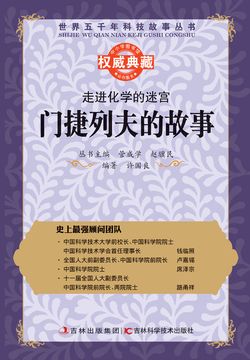
Dmitri Mendeleev
Tags
Summary
Editor's review
Who it's for
A good fit for
- Middle- and high-school students who need to understand how the periodic law came about
- Readers interested in the history of science who want to know the development of nineteenth-century Russian chemistry
- Teacher-training students or science educators looking for materials for teaching the history of chemistry
- General readers interested in the dual role of scientists as public technical administrators
Not a good fit for
- Professional chemistry researchers seeking rigorous theoretical derivation and experimental detail
- Biography readers who prefer literary narrative or deep psychological portraiture
- Researchers who need Mendeleev's original papers or Russian archival materials
Reading tips
- Read the chapters on the periodic law first, then return to the earlier account of his studies and teaching to understand the process of discovery.
- Read alongside secondary-school knowledge of the periodic table, matching the historical facts in the book to classroom concepts one by one.
- While reading, note Mendeleev's positions on the Bureau of Weights and Measures and on solution theory, and compare his scientific and social roles.
- Read it together with biographies of comparable scientists, noting differences in research methods under different scientific traditions.
About the publisher
International Culture Publishing Corporation is a publisher known for introducing foreign literature and world classics, with about 283 relevant titles in the database. Its representative books include Goethe's The Sorrows of Young Werther, Hesse's Siddhartha, Jiménez's Platero and I, and Gibran's The Prophet, as well as cultural readings such as Zhu Guangqian's Twelve Letters to Youth and Common Talk on Classics. In psychology, it offers the nine-volume Collector's Edition of C. G. Jung's Works, covering social psychology and applied psychology. Its author resources include Goethe, Hesse, Jiménez, Jung, and Zhu Guangqian, along with Chinese authors involved in translation and compilation. Its publishing focus is on foreign literature, classic works, psychology, and culture, serving both academic and general readers. Public information is limited, and the above is based mainly on the books in the database.
Contents
- 版权信息
- “中小学课本里的名人传记丛书”前言
- 苦难开端
- 好奇善问的小男孩
- 7岁直接进入中学
- 迈入大学门槛
- 失去了最亲的亲人
- 崭露头角
- 毅力战胜了病魔
- 不甘平凡的人生历程
- 到德国学习深造
- 与众不同的留学生
- 攻克科学难关
- 被巴赫的执着所折服
- 参加化学家国际会议
- 学成回国
- 把荣誉让给别人
- 首次走进婚姻殿堂
- 提出科学发展的蓝图
- 成立俄罗斯化学协会
- 科学探索
- 探讨元素间规律性
- 执着地进行研究
- 制成元素周期表
- 坦荡地面对冷遇
- 伟大的预测被证实
- 辛勤工作
- 遭遇不公平事件
- 勇敢地冲破旧观念
- 忙里偷闲的聚会
- 一次升空的冒险
- 关心民生事业
- 愤然辞职抗议
- 研制先进的火药
- 促进度量衡发展
- 把科学视为生命
- 辛勤地工作到最后
- 永远活在人们心中
FAQ
Is this book suitable for secondary-school students?
Does the book explain the chemical principles of the periodic law in detail?
What contributions did Mendeleev make beyond chemistry?
Related on WeRead
Comments
Find this book
This site is an index: you start “Search all sources” in your browser, and the entries it lists all point to third-party sites; please judge their availability yourself.
About the author
Feng Huatai was born in 1967 and graduated from the graduate program of the Lu Xun Academy of Literature. He currently works as a literary editor at Sina.com and writes freelance in his spare time. Public information about him is limited, but his 46 works in the library show a wide range: he has compiled classic works such as Selected Articles by Top Scholars of Successive Dynasties, and has also written on traditional family instructions and ways of dealing with the world, as exemplified by Dushi Kuanhou (Honest and Generous). At the same time, he writes popular science for young readers, covering robots, human science, maritime weapons, new materials, and road traffic, and extending to prehistoric civilization. Overall, his writing balances cultural transmission with the popularization of knowledge, and his works fall mainly into the categories of classic works, culture, inspirational growth, and popular science, suiting readers of different ages.
