

The House of Mirrors
Tags
Summary
Editor's review
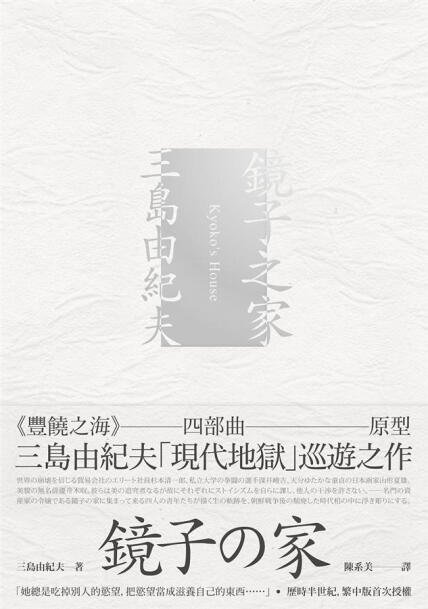
As an editor, I believe the value of this book lies in its profound philosophical propositions and unique artistic form. It is not an easy, plot-driven novel, but rather more like a philosophical drama forged in words. Mishima renders his characters highly symbolic, making them vehicles of different spiritual dimensions; their interactions and monologues are in fact fierce debates on the nature of existence. The book is filled with imagery of mirrors, reflection, and doubleness, metaphors for the predicament and illusory nature of self-knowledge. For readers familiar with Mishima's aesthetics (such as his contradictory worship of destruction, beauty, and youth), this offers a more systematized and visibly more anguished side of his thought.
This also means The House of Mirrors has a certain threshold for readers. Its pace is slow, its interior monologues dense, and its plot weak, focusing more on the collision of ideas and the depiction of spiritual states. This edition from Shanghai Translation Publishing House strives in its language to convey the concision and speculative feel of the original, offering Chinese readers a reliable path toward the style of the source text. Overall, this is a work for readers unafraid to venture deep into spiritual territory and willing to think through difficult questions alongside the author. It may not bring a pleasurable reading experience, but it can offer a startling intellectual adventure concerning the self, existence, and nothingness.
Who it's for
A good fit for
- Readers with a deep understanding of Yukio Mishima's literary world who wish to explore his philosophical system
- Deep readers who love existentialist literature and relish abstract philosophical propositions and complex psychological description
- Researchers or literature enthusiasts interested in postwar Japanese literature and the spiritual history of society
- Readers who appreciate novels with a strong sense of structure and a symbolist style
Not a good fit for
- Readers seeking light entertainment or strongly plot-driven narrative
- Readers new to Yukio Mishima who wish to start with his representative works
Reading tips
- It is advisable to first learn about Mishima's life and core aesthetic ideas (such as "the pen and the sword" and "the aesthetics of destruction") to better understand the intellectual background of the book.
- While reading, do not cling too much to linear plot; try instead to follow each character's perspective and experience the spiritual dimension and predicament they represent.
- It can be read alongside Mishima's works from the same period or slightly earlier (such as Forbidden Colors and The Sailor Who Fell from Grace with the Sea) to grasp the evolution of his creative trajectory.
About the publisher
Shanghai Translation Publishing House is a Chinese publisher oriented mainly toward translation and publishing. Its publications cover foreign literature, world classics and classic works, as well as social culture, folk literature and classical poetry. The database contains 2,618 titles, including Never Let Me Go, Les Misérables (2 volumes), Don Quixote (illustrated collector's edition), The Complete Comedies of Molière (4 volumes), The Complete Novels of Kafka (3 volumes), The Collected Works of Dostoevsky (9-volume set), Reason and Persons, and Oedipus Rex (Translation Classics). Its author resources include foreign writers such as Kazuo Ishiguro, Victor Hugo, Cervantes and Molière, as well as translators such as Zheng Kelu, Sun Jiameng, Li Jianwu and Zhang Kun. The publisher has brands such as "Translation Classics Selections" and "Translation Documentary," and emphasizes translated works in foreign literature and the humanities and social sciences, while also publishing bilingual dictionaries and foreign-language educational books. Public information is limited; the above is based on the book information in the database.
Contents
- 版权信息
- 第一部
- 一
- 二
- 三
- 四
- 五
- 第二部
- 六
- 七
- 八
- 九
- 十
FAQ
What place does The House of Mirrors occupy among Yukio Mishima's works?
Is this book difficult to read?
What special meaning does the "mirror" image have in the book?
Related on WeRead



Comments
Find this book
This site is an index: you start “Search all sources” in your browser, and the entries it lists all point to third-party sites; please judge their availability yourself.
About the author
Yukio Mishima (1925–1970) was a Japanese novelist and playwright, born Hiraoka Kimitake in Tokyo and a graduate of the Faculty of Law at the University of Tokyo. He established his literary standing with Confessions of a Mask in 1949, and went on to explore beauty, desire and death in a coolly refined and intensely aesthetic style. His major works include The Temple of the Golden Pavilion, The Sound of Waves and the tetralogy The Sea of Fertility, whose volumes Spring Snow, Runaway Horses and The Decay of the Angel are available in Chinese. He was nominated for the Nobel Prize in Literature several times. On 25 November 1970 he committed seppuku at a Self-Defense Forces base, and his life and writing have remained a subject of public discussion. The library holds 84 of his works, mostly under foreign literature, young adult literature and classics.
Yang Wei is an author about whom limited public information is available. His work spans two areas: foreign literature and software learning. In foreign literature, he has participated in the translation and compilation of several Japanese and Western classics, with representative works including No Longer Human, Jane Eyre (Illustrated Edition), The Osamu Dazai Trilogy (3 Volumes), Close Friends, The House of the Mirror, and the Essential Collection of Japanese Classic Literature (10 Volumes), involving works by Osamu Dazai and other Japanese authors, and combining textual translation with illustrated adaptation. In software learning, he wrote SOLIDWORKS 2020 Product Design Basic Training (3rd Edition), a practical guide to product design. Seven of his works are held in the collection, commonly classified under foreign literature and software learning, reflecting his engagement with both literary translation and technical handbook writing.
