

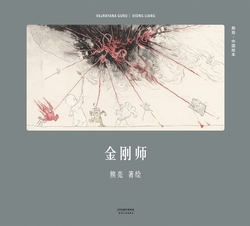
Vajra Master
Tags
Summary
Editor's review
Who it's for
A good fit for
- Children aged 3–7, experiencing a world where all things have spirit through parent-child reading
- Young independent readers who enjoy Eastern fairy tales and short, rhythmic text
- Teachers and creators engaged in children's aesthetic education or picture-book creation
- Parents who wish to use picture books to discuss nature and life with their children
Not a good fit for
- Readers expecting a complete plot and a clear ending
- Children who prefer information-dense, knowledge-rich nonfiction
Reading tips
- Don't rush to explain the moral; imitate the sounds of wind and thunder with your child and chant the spell together, turning the text into a sound game.
- Pause on each page and let the child point out which things in the picture have "come alive," then say what they would like to say to them.
- After reading, take the child outdoors to find a stone or a tree and try making up a spell for it.
About the publisher
Tianjin People's Publishing House publishes across such fields as classic works, foreign literature, architecture, social culture and social sciences, with 749 relevant titles in the collection. In the areas of classics and scholarship, works such as Wang Guowei's Renjian Cihua and Fei Xiaotong's From the Soil and Fertility and Reproduction reflect a sustained attention to social culture and classic texts of thought. Architectural books are represented by Liang Sicheng's Annotated Yingzao Fashi and A History of Chinese Architecture, showing an emphasis on architectural heritage and building traditions. In foreign literature, translations of Sholokhov's And Quiet Flows the Don and Tolstoy's War and Peace and The Death of Ivan Ilyich, through the work of translators such as Li Gang and Yu Dawei, form a substantial series of translated works. Overall, the press combines classic texts, scholarly works and fine translations, with a publishing character oriented toward humanistic depth and the dissemination of knowledge.
Contents
- 版权信息
- 正文1
- 正文2
FAQ
Is this book suitable for children who are just beginning to recognize characters to read on their own?
Who is Master Vajra, and does the book explain his origins?
Is this book better as a bedtime story or for daytime reading?
Related on WeRead



Comments
Find this book
This site is an index: you start “Search all sources” in your browser, and the entries it lists all point to third-party sites; please judge their availability yourself.
About the author
Xiong Liang is an author active in the field of Chinese picture books and illustrated books. Public information about him is limited: his nationality, dates of birth and death, and educational background are not clearly recorded. Five of his works are included in the collection—Zaowang Ye (The Kitchen God), Xiong Liang's Chinese Picture Books, Changbanpo, Jingang Shi (Master Jingang), and Meiyu Guai (The Plum Rain Monster)—and they are commonly classified under social sciences. Judging from their subject matter, he often draws on traditional Chinese folk customs, popular beliefs, and classical stories, such as the worship of the Kitchen God and the Changbanpo episode from the Three Kingdoms, retelling them through visual narrative with both traditional flavor and personal imagination, while works such as Jingang Shi and Meiyu Guai show a stronger fantastical vein. Overall, his creations use the picture book as a medium to bridge traditional culture and children's reading, emphasizing the interplay of text and image and visual storytelling, and are representative of explorations of indigenous themes in original Chinese picture books.
