

Reading the Records of the Grand Historian 4
Tags
Summary
Editor's review
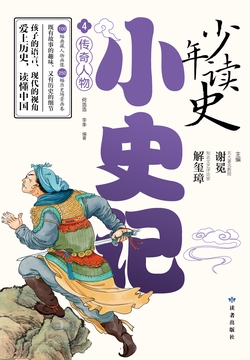
The professional value of this book lies in the depth of its "interpretation." The author excels at combining commentaries from successive dynasties with modern historiographical perspectives to conduct multidimensional analysis of key figures and events in the Records of the Grand Historian, with particular attention to exploring Sima Qian's craft and revealing the historical judgments and emotional tendencies behind his "Spring and Autumn style." For example, when analyzing the political ecology of the Han dynasty, the author not only sorts through historical facts but also probes deeply into Sima Qian's situation and stance as a recorder of history, enabling readers to understand the generative context of the Records of the Grand Historian text more three-dimensionally.
Compared with previous volumes, this book is more speculative in its choice of topics, suitable for readers who already have some foundation in the Records of the Grand Historian to further deepen their understanding. Its reading value lies not only in acquiring knowledge but also in learning a rigorous method of historical textual analysis and experiencing the pleasure of intellectual dialogue with a great ancient historian. For readers who wish to go beyond the story level and truly enter the inner chambers of classical historiography, this book is a precious key.
Who it's for
A good fit for
- Readers who already have a preliminary understanding of the Records of the Grand Historian and wish to conduct in-depth textual analysis and intellectual exploration
- Researchers and enthusiasts interested in ancient Chinese historiographical methodology and Sima Qian's historical philosophy
- University students in history and Chinese literature, as supplementary reading and reference for academic training
- Readers who love traditional culture and are accustomed to critical thinking while reading
Not a good fit for
- Beginning readers who only wish to quickly grasp the plot outlines of the Records of the Grand Historian or seek popular history books
- Readers seeking light, entertaining reading who find scholarly analysis and close textual reading difficult
Reading tips
- It is recommended to read alongside the corresponding chapters of the original Records of the Grand Historian, thinking as you read, for the best results
- Take notes while reading to organize the author's analytical threads and core arguments
- There is no need to rush; after finishing each chapter, pause briefly to reflect before continuing
About the publisher
Northern Literature and Art Publishing House focuses on contemporary and modern literary and artistic works, literary theory, and translations of foreign literature, while also covering categories such as history, popular science, Eastern philosophy, and world classics. Its collection includes 737 titles, with representative publications ranging from traditional Chinese classics such as Records of the Grand Historian, The Exploitation of the Works of Nature, and The Analects to foreign literary works including the complete classic plays of Shakespeare, Balzac's Old Goriot and Eugénie Grandet (in celebrated translations by Fu Lei), and The Complete Sherlock Holmes. Its author resources span classical figures such as Sima Qian, Song Yingxing, and Confucius, foreign writers such as Shakespeare and Balzac, and translators such as Zhu Shenghao and Fu Lei. The press combines the transmission of classics with an orientation toward general reading, developing a distinctive profile in both the editing of traditional texts and the translation of foreign literature. Public information is limited, so the above emphasizes the publishing profile reflected in the books held in the collection.
Contents
- 版权信息
- 主编
- 特邀顾问
- 主角是青铜,配角是王者 平原君和门客的故事
- 公子无双 信陵君的故事
- 安楚和盗楚 春申君的故事
- 睚眦必报的相国 范雎的故事
- 诸葛亮的偶像 乐毅的故事
- 真正的勇气 蔺相如、廉颇的故事
- 赵国的名将们 赵奢和李牧的故事
- 火牛出击 田单的故事
- 一个人挽救一座城 鲁仲连的故事
- 爱国者,殉国者 屈原的故事
FAQ
Will there be obstacles reading the fourth volume directly without having read the first three?
Is the interpretive style of this book more academic or more popular?
Is this book suitable for high school students?
Related on WeRead




Comments
Find this book
This site is an index: you start “Search all sources” in your browser, and the entries it lists all point to third-party sites; please judge their availability yourself.
About the author
Yang Yanqi is an author who writes primarily on historical subjects. Publicly available information about him is limited, and his life, education, and professional positions remain unclear. Judging from the seven works recorded in the library, his writing centers on the Shiji (Records of the Grand Historian). His representative work is the eight-volume Reading the Shiji series, which also includes the individual volumes Reading the Shiji 1 through 5, Reading the Shiji-7, and Reading the Shiji-8, indicating that he interprets this biographical general history systematically in separate volumes. Such works are usually aimed at general readers, focusing on turning the original content into readable narratives that help readers understand the figures and events recorded in the Shiji. Yang Yanqi's approach tends toward popularization rather than rigorous academic textual research, making his books suitable as introductory historical reading. Because the available information is limited, the specific reception of his works among scholars and in the market cannot be determined, but the continued publication of these volumes suggests a certain systematic quality in his organization and retelling of the Shiji, offering ordinary readers convenient access to this classic.
Han Zhaoqi is one of the more prolific authors in the field of Chinese book publishing, with nineteen works included in the collection. His editorial work centers mainly on classical Chinese poetry and Eastern philosophical classics. It includes annotated and appreciative editions of poetry anthologies such as Three Hundred Tang Poems and Three Hundred Song Ci Poems, as well as fully annotated, translated, and phonetically glossed editions of pre-Qin classics, including the Book of Songs, the Songs of Chu, the Analects, Mencius, and the Great Learning and Doctrine of the Mean. He has also compiled historical readers such as Classical Chinese Articles by Top Imperial Examination Graduates: A Chinese-Vernacular Bilingual Edition. Overall, he focuses on accessible editions for general readers, characterized by detailed annotations, vernacular translations, and phonetic guides that make traditional texts easier to read. Due to limited public information, reliable details about his personal life, nationality, and dates of birth and death are unavailable, so readers may instead understand his editorial style and thematic choices through the works listed above.
