

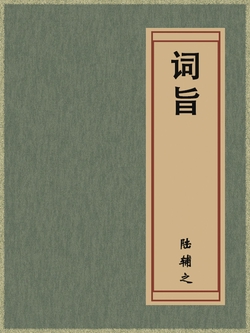
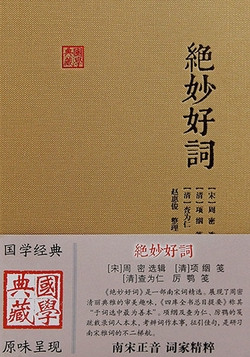
The Purport of Ci
Tags
Summary
Editor's review
Who it's for
A good fit for
- Ci scholars who need to understand the original Cizhi and Hu Yuanyi's commentary
- Lovers of classical documents interested in Qing scholars' editorial methods
- Readers of poetry with some classical Chinese who want to broaden their reading of ci criticism
- Chinese majors who can use the book as supplementary material for a topic on ci criticism
Not a good fit for
- Beginners in classical Chinese, for whom the interwoven original and commentary set a high threshold
- Readers seeking only a modern general introduction to ci studies, since the book is document-oriented
- Readers hoping for extensive appreciation of ci works, since the book is mainly discursive
Reading tips
- First read through the original entries, mark unclear points, then read Hu Yuanyi's commentary entry by entry for comparison.
- Use two colors of pen to distinguish original text from commentary and avoid mixing them.
- When reading Hu's preface, pay attention to his citations and check the relevant documents yourself.
- After finishing, summarize Lu Fuzhi's core entries on ci into brief notes.
About the publisher
Jinzhang Book Company (Jinzhang Shuju) was a private publishing and distribution house in Shanghai during the late Qing and early Republican periods, issuing traditional works by lithographic printing. Judging from the 1,194 titles in the collection, its publishing focused on classical poetry, Eastern philosophy, historical reading, traditional Chinese medical texts, and canonical works, along with books on literary appreciation. Representative titles include the poetry and prose collections of Du Fu and Ouyang Xiu; historical works such as the Book of Han and Zizhi Tongjian; classical texts such as the Book of Documents and Mencius; and specialized and literary classics such as Treatise on Cold Damage and Li Sao. Its author resources cover major figures across the ages, including Du Fu, Ban Gu, Sima Guang, Zhang Zhongjing, Qu Yuan, Ouyang Xiu, and Tang Shenwei, reflecting the house's characteristic reliance on traditional scholarship and medical literature while serving general readers. Public information on its early history and operational details is limited, so no conjecture is offered here.
Contents
- 版权信息
- 序
- ●词旨叙
- ●词旨上
- ●词旨下
FAQ
What is the relationship between Cizhi and Cizhi Chang?
What are the characteristics of Hu Yuanyi's commentary?
Is this book suitable as an introduction to ci studies?
Related on WeRead


Comments
Find this book
This site is an index: you start “Search all sources” in your browser, and the entries it lists all point to third-party sites; please judge their availability yourself.
About the author
Lu Fuzhi's life, nationality, and dates of birth and death are all unknown, and publicly available information about him is very limited. All that is known is that a single work attributed to him, Cizhi (The Meaning of Ci), has come down to us, and it is classified among works on ancient poetry and ci. Cizhi is a treatise on ci poetics and methods of composition. It deals mainly with fundamental questions such as conception, structure, diction, and prosody in ci writing, and it quotes and comments on lines by earlier writers, offering guidance for the study and practice of ci composition. Though brief, the book is clearly organized and concise in language, reflecting the author's understanding of and regard for the ci genre. Because there are no direct records of Lu Fuzhi himself, later generations have known him and his work mainly through Cizhi. As one of the documents of ancient ci scholarship, Cizhi offers a reference for the study of ci poetics and compositional norms, and it allows us a glimpse of Lu Fuzhi's views on ci.
