

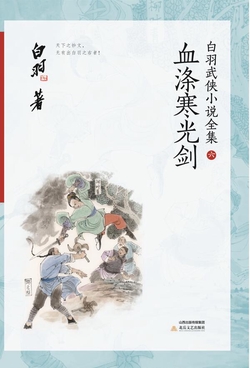
The Cold Gleam Sword Bathed in Blood
Tags
Summary
Editor's review
Who it's for
A good fit for
- Readers and collectors seeking to systematically collect the Republican Wuxia Fiction Collection
- Researchers interested in the socially satirical school of wuxia and in the ideological substance of literary works
- Literature lovers patient with Republican-era vernacular narrative and fond of slow reading
- Readers hoping to gain an overall picture of the ten great wuxia novelists of the North and South
Not a good fit for
- Genre-fiction readers seeking tight plotting and a fast reading experience
- Younger readers unaccustomed to Republican-era vernacular expression
- Readers who want only a single famous work and have no interest in the collection's context
Reading tips
- Begin with the collection's general preface or the publisher's note to understand Bai Yu's place in Republican-era wuxia before turning to the text.
- As you read, note the characters' choices between moral duty and expediency, and savor where the so-called social irony lands.
- If time is limited, proceed chapter by chapter, pausing every few chapters to sort out the relationships among characters.
- After finishing, compare with other Bai Yu works in the same volume to observe the themes he returns to.
About the publisher
China Culture and History Press has long devoted itself to modern and contemporary literature and culture-and-history reading matter, with publishing directions centered on classic works, social novels, prose and miscellaneous writings, and Eastern philosophy, alongside culture-and-history periodicals such as Zongheng. Among the more than 1,500 titles in the collection, representative books include Zhang Henshui's Ti Xiao Yin Yuan, Lu Xun's Complete Classic Works (10 volumes) and Wild Grass, and Lao She's Four Generations Under One Roof series and the boxed set of Lao She's Classic Works (10 volumes), while its author resources are concentrated on figures such as Zhang Henshui, Lu Xun, Lao She and Sima Qian. Its publishing character lies in solid editorial work on culture-and-history source texts and in issuing famous authors' works in sets, balancing the readability of individual texts with the systematic presentation of complete collections for focused reading and collecting. Beyond these directions, public information on the press's contemporary original publishing is limited, so it is not elaborated here.
Contents
- 版权信息
- 我的生平
- 初版自序
- 叙略
- 第一章 初踏江湖
- 第二章 小贼孩
- 第三章 半只胳膊一条命
- 第四章 寻仇人来
- 第五章 江边决斗
- 第六章 剑夺争锋
- 第七章 抟沙女侠怒斗师兄
- 第八章 烙铁疗毒
- 第九章 弹指翁寻贼赠药
- 第十章 恩怨分明
- 第十一章 峨眉派卷土重来
- 第十二章 弹指翁只身驰援
- 第十三章 搜敌觅伴
- 第十四章 抟沙女侠彷徨歧路
- 第十五章 男女三骑客
- 第十六章 陈元照误缀柳叶青
- 第十七章 林边诱战
- 附录
- 后记
- 整理后记
FAQ
Is this book Bai Yu's representative work?
What is the "socially satirical school" of wuxia?
Why is this collection worth attention?
Related on WeRead



Comments
Find this book
This site is an index: you start “Search all sources” in your browser, and the entries it lists all point to third-party sites; please judge their availability yourself.
About the author
Bai Yu (1899–1966), originally named Gong Wanxuan and later Gong Zhuxin, was a prominent Republican-era Chinese writer of martial arts fiction. His ancestral home was Dong'e, Shandong, and he was born in Machang, Tianjin. In his early years he received guidance from Lu Xun and Zhou Zuoren and engaged in new literature writing before turning to martial arts fiction; he rose to fame in 1938 with The Twelve Money Darts. His works combine martial arts fiction with social fiction, and his representative works also include Stealing Boxing, Records of Martial World Strife, The Joint Escort Chronicle, and Blood-Washed Cold Light Sword. He is counted among the "Five Masters of Northern School Martial Arts Fiction." Bai Yu's novels emphasize social observation and character portrayal and hold a place in Republican-era popular literature. In his later years he turned to the study of oracle bones and epigraphy. Public information on the details of his life is limited; the collection contains 77 works, mostly on martial arts, social, and folk themes.
