

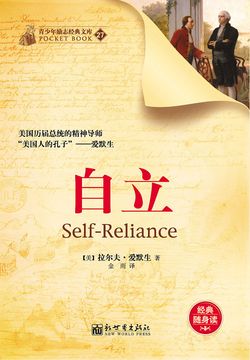
Self-Reliance
Tags
Summary
Editor's review
Who it's for
A good fit for
- Thinkers seeking spiritual independence and freedom from the grip of external evaluation
- Explorers at a life turning point who need inner strength to confirm their own direction
- Literature and philosophy lovers interested in Transcendentalism and American intellectual history
- Professionals and creators who feel swept along by the crowd and long to recover their own judgment and creativity
Not a good fit for
- Readers expecting a self-help guide with concrete, actionable steps
- Readers who prefer tightly reasoned, systematic philosophical argument and are uncomfortable with essayistic aphorisms
Reading tips
- Read slowly and savor it in a calm mood, treating it as a conversation with a sharp-witted sage rather than a source of quick answers
- You may read it alongside Emerson's life and the background of the Transcendentalist movement, but focus above all on how the text speaks directly to your own inner life
- Feel free to pause at any point to reflect on how the ideas relate to your own circumstances, keeping personal notes
About the publisher
Harbin Publishing House is a comprehensive city publisher known for classic works and social fiction. Its "Little Blue Book Classic Works Collection" includes modern literary masterpieces such as Lu Xun's Wandering and A Madman's Diary, and Xiao Hong's The Story of Hulan River; the complete Lu Xun fiction is also in its catalogue. In history, Lü Simian's History of the Two Jin and Northern and Southern Dynasties appears in multiple volumes, while foreign literature and Eastern philosophy are represented by Yukio Mishima's The Temple of the Golden Pavilion and Spring Snow. Its authors include Lu Xun, Xiao Hong, Lü Simian and Yukio Mishima, as well as Yang Xiao, Tong Fan, Dong Haiyan and others. Common categories cover classic works, social fiction, history, foreign literature, Eastern philosophy and essays. Public information is limited, so this profile focuses on the publishing directions reflected in its 500 titles.
Contents
- 第01章 自立(1)
- 第01章 自立(2)
- 第02章 力量(1)
- 第02章 力量(2)
- 第03章 风度(1)
- 第03章 风度(2)
- 第04章 性格
- 第05章 命运(1)
- 第05章 命运(2)
- 第05章 命运(3)
- 第06章 爱默生励志格言
- 第07章 爱默生大事记
FAQ
How is this book different from typical "success" or "personal growth" books?
Are Emerson's views too idealistic to put into practice?
What are the features of this translation?
Related on WeRead



Comments
Find this book
This site is an index: you start “Search all sources” in your browser, and the entries it lists all point to third-party sites; please judge their availability yourself.
About the author
Ralph Waldo Emerson (1805–1882) was a nineteenth-century American thinker, essayist, and poet, born in Boston and died in Concord. He studied at Harvard and briefly served as a minister before turning to writing and public lecturing, becoming a central figure in American transcendentalism. His essays are known for their eloquence, concision, and aphoristic style, emphasizing personal intuition, self-reliance, and independent judgment against authority; his influence on American literature and thought has been profound. His representative work Self-Reliance embodies his advocacy of independent thinking and trust in oneself, and its concise, forceful prose has made it a classic in inspirational and personal-growth literature. It should be noted that public information on the Chinese rendering of his name, biographical details, and the number of his works is limited; this entry offers only a brief introduction based on the facts in the database and widely accepted general knowledge.
