

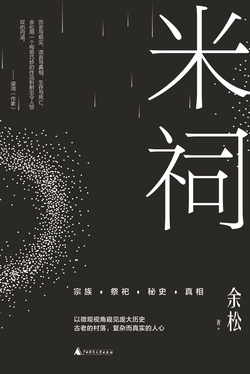
Mi Ancestral Hall
Tags
Summary
Through one man, this work recounts the ups and downs of a family history, revealing the innermost entanglements and choices among its members.
Editor's review
From an editor's perspective, the book's core value lies in its narrative ambition to "see the great in the small." "Mi Ci" is not merely a folk shrine where rice is offered and fertility prayed for; it is a metaphorical vessel that holds memory and bears witness to change. Drawing on solid fieldwork and deep knowledge of local culture, Yu Song folds the methods of local chronicle and ethnography into his fiction, so that the geography, folk rituals, and characters' fates are bound together as flesh and blood. Reading it, you can clearly feel the quiet, tenacious narrative force behind the words: it does not rush to advance the plot but patiently lays out detail after detail, letting history surface slowly in the seams between grains of rice, in the bricks and tiles of the shrine, and in the whispers of the clan.
This is not an easy, diverting novel. It asks readers for a measure of patience and an interest in historical depth. The author's style is austere and restrained, with a documentary quality; that style is itself a threshold, and it is precisely where the book's literary character lies. It carries family history out of the private sphere and into public reflection, exploring the complex tensions among faith, inheritance, memory, and the onrush of modernity. For serious readers in search of intellectual depth and literary beauty, Mi Ci is unquestionably a richly rewarding work: it offers not just a story but a cultural journey of return, a way of asking how we understand "where we come from.
Who it's for
A good fit for
- Readers with a strong interest in family history and local-chronicle narrative
- Readers who appreciate literary fiction with steady pacing and a rich historical texture
- Those concerned with the changing fate of traditional culture in modern society
- Readers hoping for literary work with strong regional character and an ethnographic flavor
Not a good fit for
- Readers looking for fast-paced, plot-driven entertainment fiction
- Readers with little patience for quieter historical narrative that lays out detail at length
Reading tips
- Read in a relatively quiet setting where you can concentrate, so as to enter the deep atmosphere the work creates.
- Pay some attention to the descriptions of folk rituals and local customs; they are key to understanding the characters' behavior and fates.
- Don't rush; read slowly, chapter by chapter, and appreciate the care the author brings to spans of time and to detail.
About the publisher
Guangxi Normal University Press is a publisher known for literature, foreign literature and history titles. Its 1,175 books in the database show a solid accumulation in classics and prose collections, including foreign literary works such as Les Fleurs du mal: Annotated Poems of Baudelaire, Snow Country, Dubliners and The Wild Palms, as well as modern prose compilations like The Complete Prose of Zhou Zuoren. History and philosophy also hold a notable share, with titles such as Running Dogs: Clerks and Runners in Qing County Yamen and The History and Thought of the Taiping Heavenly Kingdom reflecting attention to Qing local administration and modern history. In art literature there is the 16-volume Ten Bamboo Studio Painting and Calligraphy Manual. Its author resources include foreign writers Charles Baudelaire and Yasunari Kawabata, translators and annotators Liu Nanqi and Zou Bo, and scholars such as Zhong Shuhe, Bradly W. Reed and You Chenjun. As public information is limited, this characterization is based only on the books in the database, which together present a profile balancing Chinese and foreign literary classics with academic works in the humanities and social sciences.
Contents
- 版权信息
- 人物
- 第一章 米祠
- 第二章 米度
- 第三章 老米卡的疯女儿
- 第四章 安排
- 第五章 米度的家人
- 第六章 米陀
- 第七章 婚礼
- 第八章 第三天
- 第九章 米普
- 第十章 死亡
- 第十一章 旅游
- 第十二章 恢复
- 第十三章 选举
- 第十四章 洞
- 第十五章 夜访
- 第十六章 申遗
FAQ
Is Mi Ci a historical novel or a family novel?
What is Yu Song's writing style like?
Is this book difficult to read?
Related on WeRead


Comments
Find this book
This site is an index: you start “Search all sources” in your browser, and the entries it lists all point to third-party sites; please judge their availability yourself.
About the author
Yu Song is an author about whom limited public information is available. Beyond the name, the available records do not clearly confirm nationality, dates of birth and death, or an English name. According to existing data, Yu Song has one work, the social novel Mi Ci, which is also the only representative work currently verifiable. In common classification, the novel is placed under social fiction, suggesting that its subject matter centers roughly on social reality and the situations of its characters rather than on fantasy or highly genre-driven storytelling. Because reliable records about the author's personal experience are lacking, it is not possible to introduce his life, creative path, or literary background in further detail, nor is it appropriate to make excessive inferences about his writing style. For readers, Yu Song is currently known mainly through this single work, Mi Ci; to understand his creative profile, one should return to the text itself and consider the social issues and modes of expression reflected in its choice of subject and narrative approach.
