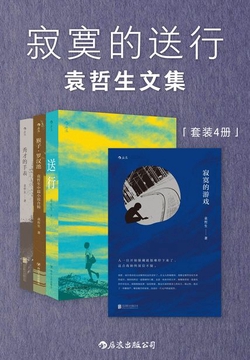
The Xiucai's Watch cover

The Xiucai's Watch

Rating 4.4
Word count
84K words
Chapters
11
ISBN
9787559604781

Tags

Summary

Comprising three independent yet interconnected stories set in the old rural settlement of "Shaoshuigou," Xiucai's Watch follows a cast of local characters—Xiucai, Wuxiong, Huoyanzai, Kongmaoyangzai, and Wu Xilang. There is Xiucai, who insists on delivering letters to faraway places; Kongmaoyangzai, who leads a band of beggars; and Wu Xilang, who can alter time. Rich with dialect and folk elements, the book reveals how Yuan Zhesheng forged a fresh and distinctive mode of rural fiction, while its pervasive, in-depth treatment of time shows how he brings out the many subjective and complex facets of time within its objective, absolute essence.

Editor's review

Xiucai's Watch is a short story collection by Taiwanese author Yuan Zhesheng, containing three works including the title story and "The Timekeeping Ghost." Known for his distinctive rural writing and delicate psychological portrayal, Yuan sustains here his signature style—cold, detached, yet deeply poetic. Set in the fictional village of "Shaoshuigou," the stories use images such as a wristwatch and a timekeeping ghost to explore the complex relationships among time, memory, and rural kinship. In Yuan's hands, everyday objects take on surreal symbolic meaning; time no longer flows linearly but becomes a labyrinth that can fold, stall, or even run backward. His prose is spare and restrained, yet within plain narration it can suddenly erupt with profound loneliness and existential reflection, letting readers glimpse the universal spiritual predicaments of modern people through the details of rural life. Compared with his better-known The Stolen Bicycle, this book is more strongly rooted in rural life and bolder in its magical-realist technique, making it an essential part of understanding Yuan's literary world. With a Douban rating holding steady around 8.5, it proves a literary quality that has withstood the test of time. For readers familiar with Chinese-language literature, it offers a deep narrative experience; for newcomers, it reveals a cool-toned aesthetic markedly different from mainstream storytelling.

Who it's for

A good fit for

  • Readers who love Taiwanese rural literature and cool, detached narrative styles
  • Literary enthusiasts interested in philosophical reflection on time and memory
  • Readers hoping to encounter a distinctive magical-realist work in Chinese-language literature
  • Writers who appreciate spare prose with deep atmosphere and masterful psychological description

Not a good fit for

  • Readers seeking strong plot and fast-paced storytelling
  • Readers impatient with rural settings and slow narrative

Reading tips

  1. Best read slowly in a quiet setting, savoring the white space and imagery between the lines
  2. Can be read alongside Yuan Zhesheng's other works (such as The Stolen Bicycle) to understand his creative trajectory
  3. Pay attention to the symbolic meaning of core images such as the "watch" and the "timekeeping ghost," which are often the key to understanding the text's deeper meaning

About the publisher

Beijing United Publishing Co., Ltd. China · Founded in 1993

Beijing United Publishing Co., Ltd. is a publisher known for its literature and history titles, with 2,065 books in the collection. Its publishing covers foreign literature, contemporary Chinese prose and essays, history, folk literature, and cultural books. Its list ranges from Sima Qian's complete edition of the Records of the Grand Historian to foreign classics such as The Book of Disquiet, All Quiet on the Western Front, Snow Country, The Stranger, and Jean-Christophe, as well as modern Chinese works including Teahouse and Dawn Blossoms Plucked at Dusk. Its authors and translators include Yasunari Kawabata, Fernando Pessoa, Erich Maria Remarque, Jin Xinyi, Zhou Miao, and Chen Chao. Public information is limited, but its catalogue reflects a balance between Chinese and foreign literary classics and historical and cultural works.

Contents

  1. 版权信息
  2. 代序 袁哲生的寂寞与游戏
  3. 自序 语言安静下来的时候
  4. 秀才的手表
  5. 天顶的父
  6. 乞丐
  7. 西北雨
  8. 天顶的父
  9. 徒弟
  10. 时计鬼
  11. 袁哲生生平写作年表

FAQ

What are the characteristics of Yuan Zhesheng's writing style?
Yuan Zhesheng's style is known for being cool, detached, and poetic. He excels at depicting everyday details in minimal prose, yet beneath the plainness lie profound loneliness and existential anxiety. His narrative pace is slow, with emphasis on psychological portrayal and imagery, carrying a strong modernist flavor.
How does this book differ from The Stolen Bicycle?
Xiucai's Watch is more rooted in rural life and more magical-realist in color, with its stories centered on the fictional village of "Shaoshuigou" and its exploration of time through surreal elements; The Stolen Bicycle focuses more on childhood memory and interpersonal alienation in urban life, with a more introspective and psychological style. Together they reflect Yuan Zhesheng's ongoing inquiry into loneliness and existence.
How is the theme of "time" presented in the book?
Through images such as the watch and the timekeeping ghost, Yuan Zhesheng materializes and spectralizes time. Time is not merely a backdrop but a core element that participates in the narrative and shapes the characters' fates. Now frozen, now recalled, it appears as a non-linear, manipulable dimension, prompting reflection on the authenticity of memory, the weight of history, and the existential predicaments of the individual.

Related on WeRead

Comments

Find this book

This site is an index: you start “Search all sources” in your browser, and the entries it lists all point to third-party sites; please judge their availability yourself.

About the author

袁哲生 Author

Yuan Zhesheng is a distinctive writer in Chinese-language literature. Public information about him is limited, and a complete account of his life has yet to be made available. Judging from the five works collected here—including Farewell, The Lonely Game, and The Scholar's Watch—his writing spans personal essays and social fiction, and is often placed among classic works. His texts typically begin with everyday experience, and through plain narration they reveal a close observation of human alienation and the human condition, with a restrained tone that leaves a lingering resonance. Works such as The Lonely Game and the novella collection Monkey · Luohan Pool show his command of the short story and novella forms; he is skilled at advancing narrative through spare dialogue and scenes, allowing ordinary characters to carry deep emotion. This understated and precise approach gives his work a unique place in contemporary Chinese writing and offers readers a way into the loneliness and warmth of daily life.

More by the same author

Top rated in the same category