

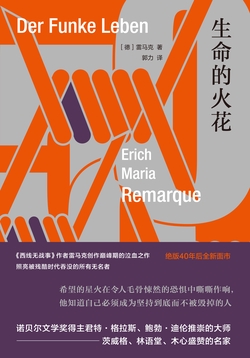
Sparks of Life
Tags
Summary
Set in the final months of World War II, the story revolves around several prisoners and guards in the fictional Mellern concentration camp. Most of the inmates at Mellern are held for their dissident politics or religious beliefs; they endure inhuman abuse and live constantly under the shadow of death. That spring, the protagonist, 509, keenly senses that the city near the camp is being repeatedly bombed, and he suspects that Nazi Germany's defeat may not be far off. Through information obtained from various channels, the prisoners in the small camp feel hope for the first time. They go to great lengths to obtain food through the camp's black market, assume the identities of the dead to evade purges, and even boldly defy the guards' orders... In the end, they make contact with the underground resistance in the camp, join forces to foil the Nazis' plan for a massacre before their flight, and regain their freedom. And 509 dies in the final armed resistance. Beyond the imprisoned inmates, the book also portrays several Nazi officers of sharply differing temperaments, showing how Nazi German society and its system turned many people who once had a conscience into cogs in a killing machine.
Editor's review
Who it's for
A good fit for
- Readers with a strong interest in twentieth-century war literature and exile literature
- Thinkers who wish to understand postwar trauma and the theme of human recovery in depth
- Literature lovers who appreciate Remarque's concise, powerful, and vivid style
- Readers looking for a serious novel that prompts deep reflection on life
Not a good fit for
- Readers seeking light entertainment or fast-paced plots
- Readers impatient with historical background and inner-monologue-style narrative
Reading tips
- Read in a relatively quiet environment so as to immerse yourself in the novel's condensed and tension-filled atmosphere.
- Read it alongside Remarque's All Quiet on the Western Front or Arch of Triumph to better appreciate the evolution of his creative trajectory.
- Pay attention to the seemingly plain details of daily life in the book; they are often the key moments when the spark within the characters collides with the cold external world.
About the publisher
Shanghai People's Publishing House is a comprehensive publisher whose list focuses on academic monographs and general-interest titles in philosophy, social sciences, politics and law, economics and management, and history. Among its books are Wei, Jin, Southern and Northern Dynasties History in the Chinese Dynastic History series; The Hobbit and The Lord of the Rings trilogy in foreign literature; the Wenjing Classical Translation Illustrated Edition of The Complete Greek Tragedies of Euripides; and works of social theory such as Max Weber's Economy and Society and Dialectic of Enlightenment: Philosophical Fragments. Its authors include Wang Zhongluo, J.R.R. Tolkien, Luo Niansheng, and Zhou Zuoren.
Contents
- 版权信息
- 1
- 2
- 3
- 4
- 5
- 6
- 7
- 8
- 9
- 10
- 11
- 12
- 13
- 14
- 15
- 16
- 17
- 18
- 19
- 20
- 21
- 22
- 23
- 24
- 25
FAQ
What is the connection and difference between this book and All Quiet on the Western Front?
Is the novel's tone very heavy and oppressive?
Will readers unfamiliar with World War II history have difficulty reading it?
Related on WeRead




Comments
Find this book
This site is an index: you start “Search all sources” in your browser, and the entries it lists all point to third-party sites; please judge their availability yourself.
About the author
Remarque is a writer whose works continue to be translated and introduced in the field of foreign literature; reliable public information about his life and nationality is limited, and no speculation is offered here. Six of his works are held in the collection, including All Quiet on the Western Front, Arch of Triumph, Spark of Life, and others, with themes centering on war, exile, and the fate of ordinary people caught in the upheavals of their time. His style is calm and restrained, his emotion understated, and his plain narration often presents how individuals survive and make choices in extreme circumstances. All Quiet on the Western Front is his widely read representative work, and Arch of Triumph also exists in multiple Chinese translations. These works have given Remarque a lasting presence among Chinese readers, and he is often placed within the tradition of war and exile writing in foreign literature, offering readers one perspective on the turbulent experience of the twentieth century.
Public information about Guo Li is limited, and his nationality, dates of birth and death, and educational background cannot currently be confirmed. The five works held in the library nonetheless show that his interests and writing span several fields. In literature, he compiled or translated Poems on Life (Selected Poems of Hesse) and Poems on Life, and wrote The Spark of Life, indicating a sustained attention to poetry and foreign literature; his writing tends to use poetic language as an entry point, guiding readers to reflect on life and experience. In medicine, Management Standards and Operating Routines for Radiology Departments shows his involvement in practical management in radiology, with attention to standards and workable procedures. In inspirational and personal growth, Pyramid Expression: Using the McKinsey Method to Improve Writing and Speaking Skills (Illustrated Practical Edition) explains structured expression through diagrams and practical exercises for readers' writing and speaking needs. Overall, Guo Li's works combine literary reading, professional practice, and expression skills for different readerships.
