

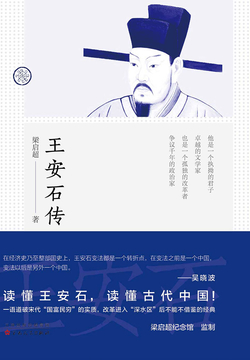
Wang Anshi: A Biography
Tags
Summary
Editor's review
Who it's for
A good fit for
- Readers with a deep interest in the history of political reform in ancient China
- Social science enthusiasts hoping to draw contemporary lessons from historical cases
- Literary readers who appreciate Liang Qichao's prose style and depth of thought
- Students and scholars researching Song dynasty history or Chinese reform thought
Not a good fit for
- Readers seeking only light, entertaining reading
- Readers expecting a purely objective compilation of historical sources who reject the author's subjective commentary
Reading tips
- Gain a basic understanding of Northern Song history and the outline of Wang Anshi's reforms before reading in depth
- Read alongside works such as Liang Qichao's Methods for the Study of Chinese History to appreciate his historical outlook and method
- Distinguish between historical narrative and the author's analysis as you read, and maintain critical thinking
About the publisher
Founded in August 1958 and restructured into Baihua Literature and Art Publishing House (Tianjin) Co., Ltd. in 2009, Baihua Literature and Art Publishing House is known for publishing essays and fiction, and it hosts the journals Fiction Monthly and Essays. Its 757 titles in the library span classic works, culture, folk literature, essays and miscellaneous writings, foreign literature, and general biography. They include Lao She's Camel Xiangzi, Zhu Ziqing's selected essays and Classic Essays, Fu Lei's Twenty Lectures on Masterpieces of World Art, and a Chinese translation of Ryūnosuke Akutagawa's Rashōmon, as well as cultural and performing-arts titles such as the illustrated Biography of Liang Qichao and A Dictionary of Crosstalk. Its authors include Lao She, Zhu Ziqing, Wu Qichang, Fu Lei, Xue Baokun, Gao Yucong, Wei Zhiqiang, and Ryūnosuke Akutagawa.
Contents
- 版权信息
- 自序
- 例言
- 第一章 叙论
- 第二章 荆公之时代(上)
- 第三章 荆公之时代(下)
- 第四章 荆公之略传
- 第五章 执政前之荆公(上)
- 第六章 执政前之荆公(中)
- 第七章 执政前之荆公(下)
- 第八章 荆公与神宗
- 第九章 荆公之政术(一)
- 第十章 荆公之政术(二)
- 第十一章 荆公之政术(三)
- 第十二章 荆公之政术(四)
- 第十三章 荆公之武功
- 第十四章 罢政后之荆公
- 第十五章 新政之成绩
- 第十六章 新政之阻挠及破坏(上)
- 第十七章 新政之阻挠及破坏(下)
- 第十八章 荆公之用人及交友
- 第十九章 荆公之家庭
- 第二十章 荆公之学术
- 第二十一章 荆公之文学(上)
- 第二十二章 荆公之文学(下)
FAQ
How does this book differ from ordinary biographies of historical figures?
Is the book's evaluation of Wang Anshi objective?
Can non-specialist readers understand this book?
Related on WeRead


Comments
Find this book
This site is an index: you start “Search all sources” in your browser, and the entries it lists all point to third-party sites; please judge their availability yourself.
About the author
Liang Qichao, courtesy name Zhuoru and pseudonym Rengong, was a native of Xinhui, Guangdong. He was a thinker, politician, historian, and man of letters of the late Qing and early Republican periods, and one of the leaders of the Hundred Days' Reform. He founded the newspapers Shiwu bao and Xinmin congbao, and advocated the "revolution in poetry" and the "revolution in fiction," exerting a profound influence on intellectual enlightenment and literary reform. In his later years he served as a tutor at the Tsinghua Institute of Chinese Studies, continuing academic research and teaching. The library holds 131 of his works, spanning categories such as examinations, comprehensive biography, classic works, historical reading, and Eastern philosophy. Representative works include A History of Chinese Scholarship in the Last Three Hundred Years, The Biography of Li Hongzhang, An Introduction to Qing Dynasty Scholarship, The New Citizen, and the supplemented collection of writings outside the Yinbingshi Collected Works. His writings cross history, philosophy, and political commentary; his prose is vigorous and fluent, his reasoning clear, and his work combines scholarly weight with strong appeal, making it important material for understanding the intellectual transformation of modern China.
