

Lingyin
Tags
Summary
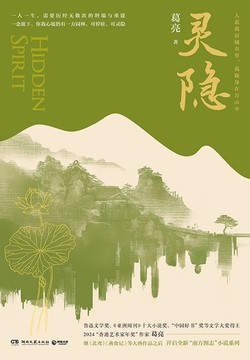
Tracing a century of Guangdong and Hong Kong history, through warmth and cold alike, it builds a garden of the heart for the lost.
A case of bloodshed within the family,
father and daughter,
from then on embark on utterly different paths...
Lian Yueming, professor at Nanhua University, on the verge of retirement, finds himself behind bars.
As a man, a husband, a father, having seen all the world has to offer, how did he come to walk this isolated road? Vast and boundless, life slowly unfolds a turbulent historical scroll.
Years after the case, his daughter Lian Sirui, deeply shaken by public opinion, hides herself in the dust and smoke, drifting up and down. In the Buddhist hall left by her great-grandmother, she meets the young statue maker Duan He. His legendary family history in Macau, like a mirror of moon in water, makes her seem to see another self...
Clinging and letting go, reconciliation and farewell, saving others and saving oneself, the reverberations linger long.
One life, one person, must pass through countless collapses and rebuildings.
A single thought let go. Deep in your heart and mine there is still a garden, where one may pause, where the soul may find retreat.
This book is Ge Liang's new "Southern Chronicle" novel series, following such hit works as The Northern Kite and A Record of Swallows' Farewell Feast.
Editor's review
Who it's for
A good fit for
- Readers interested in Jiangnan culture, Zen aesthetics, and the spiritual underpinnings of the city
- Urban readers who feel anxious in life and seek inner calm and spiritual solace
- Literature lovers who appreciate Ge Liang's elegant, quiet, and delicate narrative style
- Readers who enjoy exploring philosophical meaning and spiritual depth in everyday life through fiction
Not a good fit for
- Entertainment-oriented readers seeking strong plot, fast pacing, and dramatic conflict
- Readers with no interest whatsoever in religion, philosophy, or inner exploration
Reading tips
- Choose a quiet setting and slow your reading pace, immersing yourself in the atmosphere and details the text creates
- While reading, pay attention to the plain descriptions of Hangzhou's geographical spaces (such as Tianzhu Road and Fayun Lane) and temple life; they are important background for understanding the characters and themes
- Do not rush to seek the story's "answer" or "ending"; it is better to appreciate the subtle shifts and flow of the characters' inner journeys
About the publisher
Hunan Literature and Art Publishing House is a publisher known for its literary titles, with a catalogue spanning foreign literature, world classics, classical Chinese literature, essays and miscellaneous writings, and mystery and detective fiction. Judging from the more than 1,100 books in the database, the press publishes foreign classics such as Crime and Punishment, Snow Country, The Complete Sherlock Holmes and Letter from an Unknown Woman, as well as Chinese classical and modern literary works including Lu Xun's Wandering and A Madman's Diary and Wu Jingzi's The Scholars. In terms of translators and authors, translations by Cao Guowei and Tan Jinghua appear in its foreign literature titles, and the authors involved include Dostoevsky, Kawabata Yasunari, Conan Doyle and Zweig. Its publishing character lies in introducing Chinese and foreign literary classics side by side, balancing popular and serious works and attending to both readability and literary value. Public information is limited; the above is a brief overview based solely on the books in the database.
Contents
- 版权信息
- 章壹 父篇:浮图
- 一
- 二
- 三
- 四
- 五
- 六
- 七
- 八
- 九
- 十
- 章贰 女篇:灵隐
- 一
- 二
- 三
- 四
- 五
- 六
- 七
- 八
- 九
- 章叁 番外:侧拱时期的莲花
- 一 罗仙枝
- 二 黄壳齐眉
- 三 莲花庵
- 四 阿咒
- 五 侧拱时期
- 尾声
- 后记
- 出版说明
FAQ
How is this book different from Ge Liang's earlier works The Northern Kite and Suzaku?
Will it affect my reading if I have never been to Lingyin Temple or know nothing about Buddhism?
Is the book's tone heavy, or does it offer hope?
Related on WeRead
Comments
Find this book
This site is an index: you start “Search all sources” in your browser, and the entries it lists all point to third-party sites; please judge their availability yourself.
About the author
Ge Liang is an author about whom publicly available information is currently limited. The library holds two of his works, Lingyin and A Brief History of Orthopedics, with common categories spanning social fiction and medicine. Judging from the existing works, his writing crosses the fields of literature and medicine: the former uses fiction to attend to social reality and the fortunes of individual characters, while the latter organizes and narrates around orthopedics as a medical specialty. This cross-disciplinary pairing gives his works both a literary narrative's observation of human affairs and a medical writer's effort to sort and present specialized knowledge. Because information such as nationality, dates of birth and death, educational background, and writing career cannot yet be confirmed, this introduction makes no speculation and, based only on the library's works and categories, presents the range of subjects and the basic profile of his writing for readers' reference.
