

Homeland of Stray Bullets
Tags
Summary
Editor's review
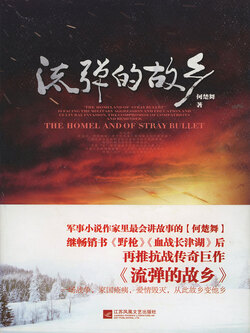
The book's greatest strength is its narrative tension—grand historical events interwoven with delicate personal emotions, with life-and-death moments on the battlefield and choices of human nature surging beneath the surface. The book's exploration of the concept of "homeland" is especially profound: homeland in wartime is both a geographical home and a spiritual belonging, and moreover the mark of a nation's identity in turbulent times. Through the protagonist's main line of searching for separated relatives amid the chaos of war, the author skillfully links a group portrait of characters from multiple social classes, presenting a three-dimensional picture of Northeast China at a historical turning point.
In terms of literary value, the book continues He Chuwu's epic writing style, but compared with his previous work, "Homeland of Stray Bullets" is more refined in psychological portrayal. Battles given only a few strokes in history textbooks become warm life stories in the book. Particularly noteworthy is the author's equal historical attention to ordinary people in war—whether Chinese peasants, Japanese settlers, or Soviet soldiers, all display complex and diverse human faces under the gears of war. This narrative perspective, transcending simple binary opposition, gives the work deeper modern reflection.
Reading this book, you will feel that history is not cold years and numbers but the resonance of countless individual fates. Those glimmers of humanity shining in the flames of war and the dignity of life upheld in desperate straits form the most moving spiritual foundation of this work.
Who it's for
A good fit for
- History enthusiasts interested in the modern and contemporary history of Northeast China
- Literary readers who enjoy deep depictions of human nature
- Thinkers concerned with the themes of war and peace
- Readers who appreciate realistic narrative style
Not a good fit for
- Readers who prefer light, entertaining reading
- Readers seeking simple binary narratives of good and evil
Reading tips
- Reading alongside reference materials on modern Northeast Chinese history is recommended
- Pay attention to the interwoven fate lines of characters from different ethnic groups
- Note the contrast in narrative rhythm between war scenes and daily life
About the publisher
Jiangsu Phoenix Literature and Art Publishing House focuses on literary publishing while also covering the humanities, social sciences, and books on art and daily life. Its approximately 1,535 titles in the database span social novels, world history, design, science fiction, classic works, and film and television: they include modern Chinese literary classics by Lu Xun such as A Madman's Diary: The Complete Short Stories of Lu Xun, Call to Arms, Four Generations Under One Roof, and Teahouse, as well as foreign literary memoirs like Stefan Zweig's The World of Yesterday. In science fiction it offers Asimov's Galactic Empire series, while in architecture and art it publishes Liu Dunzhen's Classical Gardens of Suzhou and design titles from Phoenix Space. Its authors are concentrated among classic writers such as Lu Xun, Zweig, and Asimov, with translators including Liang Xijiang, Zhong Haonan, and Ye Lihua. Its overall character is built on classic works while embracing genre fiction and visual culture. Public information is limited, and this introduction is based on the titles in the database.
FAQ
What is the connection between this book and "Golden Family"?
Are the descriptions of war scenes too cruel?
Is this book suitable for young readers?
Related on WeRead
Comments
Find this book
This site is an index: you start “Search all sources” in your browser, and the entries it lists all point to third-party sites; please judge their availability yourself.
About the author
He Chuwu is an author about whom little public information is available, whose work spans several genres; eleven of his titles are held in this collection. In historical writing he focuses on modern and contemporary China and the memory of war, with works such as Manchukuo: Japan's New Attempt at Colonizing China (2 volumes), Shangganling, My War to Resist US Aggression and Aid Korea, and The Defenders, which treat colonial experience and battlefield experience in a documentary manner. In military and popular narrative he has written Wild Gun (2 volumes), Wild Gun Season 1: Bent Spear and The Hometown of Stray Bullets, with tight plotting and an emphasis on action and ensemble casts. He has also worked in social fiction, modern romance and science fiction, as in First Love Angel. His writing moves between serious history and genre fiction, covering a wide range of subjects and showing a sustained interest in war, memory and the fate of ordinary people.
