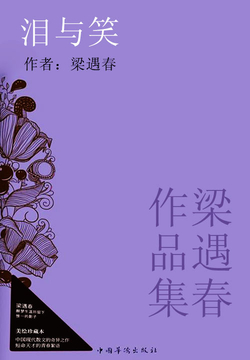
Tears and Laughter cover

Tears and Laughter

Rating 4.2
Word count
53K words
Chapters
29

Tags

Summary

Teardrops and Laughter is a posthumous prose collection by the modern essayist Liang Yuchun: At dawn today, when I sobered up, I suddenly recalled that the night before last he had mentioned to me the two lines “In vain I hold the silken sash; looking back, I grieve with lingering longing.” It seemed that after drinking the night before I had many feelings. Still not fully sober from the lingering wine, I closed my eyes and secretly traced the traces of my thoughts at that time. What is written below is some fragments that still linger in my heart. Perhaps someone will dissect these random reflections with an analytic eye and with mockery, regarding them as abnormal, or even low-grade, psychological manifestations; but I always like them very much.

Editor's review

Tears and Laughter is Liang Yuchun's posthumous prose collection. It is short, yet it best reveals his manner of blending the lingering haze of wine, the melancholy of old verse, and the small, scattered sensations of daily life into one voice. The book offers no lofty lectures and makes no effort at grand structure; instead it follows half-sober, half-drunken thoughts wherever they lead, drawing readers into a reading atmosphere close to a private whisper. Its value lies not in how much certain knowledge it provides but in preserving a candor rare in modern prose: admitting that one's random reflections are fragmentary, and admitting that these fragments are worth writing down in earnest. The writing has a classical foundation yet carries the self-awareness of the new literature; quoting lines of verse and analyzing states of mind both feel natural. It suits being opened at random on a quiet night or during a journey; there is no need to finish it in one sitting—let its broken rhythm carry you. For readers who love modern prose and are willing to feel the subtle turns of emotion within words, this book is like a small cup of warmed wine: its force does not come at the start but rises slowly after the book is set down.

Who it's for

A good fit for

  • Readers who love modern prose and want to feel the temperament of Republican-era writers
  • Those willing to savor delicate emotions and verbal rhythm in short pieces
  • Readers interested in Liang Yuchun's work who want to read his posthumous collection
  • Literature lovers who want a few pages to read before sleep or on a journey

Not a good fit for

  • Readers expecting a complete long narrative or plot momentum
  • Readers who prefer systematic theoretical analysis and clear conclusions
  • Readers with little interest in lyrical prose and quotations from old verse

Reading tips

  1. No need to read straight through; pick one or two pieces each time and leave room for aftertaste.
  2. When you come to a quoted line, look up its source to help understand where the author's emotion comes from.
  3. Keep a pen handy and mark the fragmentary sentences that move you, to reread later.

Contents

  1. 版权信息
  2. 泪与笑
  3. 天真与经验
  4. 途中
  5. 论知识贩卖所的伙计
  6. 观火
  7. 破晓
  8. 救火夫
  9. 她走了
  10. 苦笑
  11. 坟
  12. 猫狗
  13. 这么一回事
  14. 一
  15. 二
  16. 无情的多情和多情的无情
  17. 毋忘草
  18. 一
  19. 二
  20. 三
  21. 黑暗
  22. 一个“心力克”的微笑
  23. 善言
  24. KISSING THE FIRE(吻火)
  25. 第二度的青春
  26. 又是一年春草绿
  27. 春雨
  28. “春朝”一刻值千金
  29. 谈“流浪汉”

FAQ

Is this book suitable for reading in one sitting?
Not really. It is a series of fragmentary reflections with a broken rhythm and a rather private, whispered emotional tone. Read in one sitting, it can feel scattered; better to read it in several sessions, one or two pieces at a time, so the lingering flavor of the writing has room to stay.
Can I read it without having read other works by Liang Yuchun?
Yes. This book is itself a posthumous work, short in length and low in threshold, and does not depend on prior works for setup. That said, if you first understand the overall style of his essays, it will be easier to enter that half-drunk, half-awake way of following thoughts as they come.
The book mentions psychological analysis—is that theoretical content?
No. The author only mentions that some people might view these reflections through the lens of psychological analysis, and then says he is very fond of them. The book remains in an essayistic tone, not a psychological treatise; there is no need to expect a theoretical work.

Related on WeRead

Comments

Find this book

This site is an index: you start “Search all sources” in your browser, and the entries it lists all point to third-party sites; please judge their availability yourself.

About the author

Liang Yuchun Author · Chinese · 1906–1932

Liang Yuchun (1906–1932), a native of Minhou, Fujian, wrote under the pen names Qiuxin and Yucong and was a modern Chinese essayist and translator. He graduated from the English Department of Peking University, taught at Jinan University and worked at the Peking University Library, and died young of scarlet fever in 1932 at the age of twenty-six. Influenced by the English essay, his prose combines composure, reflection and lyricism and draws meaning from everyday matters and the feelings of life. His works include Spring Wine and Tears and Laughter, along with collections such as Forget-Me-Not and Innocence and Experience. He also translated Selections of English Poetry, contributing to the introduction of English literature in China. The library holds eighteen of his works, commonly classified under literary appreciation, prose and miscellaneous writings, and classic works. Because of his early death, public materials are limited, and the style of his essays and his translation practice deserve closer attention.

More by the same author

Top rated in the same category